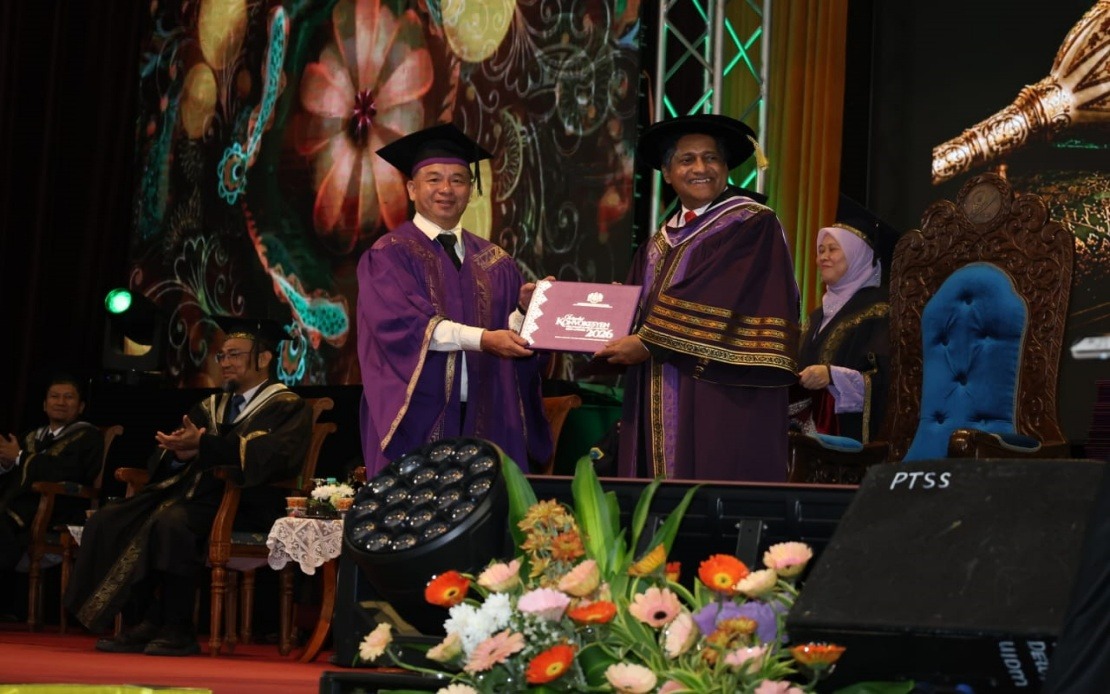
Heng Meng Lai has shattered preconceptions about age and educational achievement by graduating from Seberang Perai Polytechnic at 57, earning his place in the institution's annals as its oldest diploma recipient. The milestone was marked during PSP's Convocation Ceremony 2026 in Bukit Mertajam, where Heng received his Diploma in Electrical and Electronic Engineering after years of sustained effort that defied conventional career timelines.
The journey that culminated in Heng's academic credentials began decades earlier, shaped by personal adversity that steeled his resolve to pursue meaningful self-improvement. Losing his father at age nine forced his mother to shoulder the family's financial burden through work at a sewing factory, while managing the care of seven children. These childhood experiences instilled in Heng a determination to transcend his circumstances through educational advancement, even as immediate survival needs and the demands of earning a livelihood repeatedly deferred this ambition.
For nearly fifty years, Heng channeled his aspirations into employment, moving progressively through roles as a storekeeper before stabilising in a position as a production line supervisor at an electronics manufacturing facility. Rather than viewing these decades as a detour from education, Heng cultivated practical knowledge and technical familiarity that would later inform his academic choice. When the opportunity to pursue formal qualification finally crystallised, his work experience in electronics naturally guided him toward specialising in Electrical and Electronic Engineering—a field where his hands-on understanding could merge with theoretical frameworks.
What distinguishes Heng's achievement is not merely the chronological novelty of his graduation but the pedagogical environment that enabled it. Rather than encountering resistance or indifference from instructors, Heng benefited from deliberate institutional support at PSP. Lecturers provided patient guidance through curricula that might have seemed daunting for someone returning to structured learning after such prolonged absence from classrooms. The absence of stigma or marginalisation, despite being substantially older than his peers, reflected an educational culture attentive to diversity and inclusive of non-traditional learners.
Heng himself emphasised that his experience at PSP affirmed a conviction that remained constant throughout his extended professional interlude: learning transcends chronological boundaries and chronological age presents no legitimate impediment to intellectual development. His willingness to enrol alongside younger cohorts and his successful navigation of contemporary polytechnic curricula constitute practical validation of this principle. The personal articulation—"I never felt marginalised even though I was the oldest student"—underscores that institutional culture significantly shapes whether mature learners feel welcomed or sidelined.
The implications of Heng's trajectory extend beyond his individual accomplishment to encompass broader Malaysian educational philosophy. His story illustrates the concept of lifelong learning that policymakers frequently invoke but institutions must actively operationalise through flexible entry points, supportive pedagogy, and recognition of prior work experience. For Malaysia's aspiration to develop high-skilled human capital and maintain workforce competitiveness, harnessing the latent potential of adults who wish to upskill or undertake formal qualification becomes strategically significant, particularly as demographic patterns shift and career longevity extends.
Seberang Perai Polytechnic's director, Mohd Ruzi Hamzah, framed Heng's achievement as institutional pride while articulating a commitment to accessibility across age and socioeconomic categories. This positioning reflects a recognition that polytechnics, particularly in Malaysia's technical education ecosystem, serve citizens whose pathways diverge from conventional school-to-institution progression. By celebrating Heng's graduation and emphasising that education constitutes a universal right rather than a privilege confined to youth, PSP signals institutional values aligned with inclusive educational development.
Looking forward, Heng intends to channel his newly acquired qualification into employment, applying theoretical knowledge and practical skills in industrial settings before potentially pursuing a Bachelor's degree. This sequential progression—moving from diploma into professional application before advancing to degree-level study—reflects a measured approach characteristic of mature learners who recognise education as instrumental to career development and personal advancement. His intention to continue advancing educationally suggests the completion of his diploma represents a waypoint rather than a terminus in his learning trajectory.
For Malaysian policymakers and educational administrators, Heng's narrative offers substantive evidence that institutional barriers to mature learner participation can be dismantled through deliberate design. His success demonstrates that qualified instructors capable of patience and flexibility, curricular structures permitting flexible progression, and organisational cultures that normalise age diversity create conditions enabling adults to return to education successfully. In an era when workforce demands evolve rapidly and technological change necessitates continuous reskilling, Heng's precedent suggests that remaining receptive to returning adult learners represents not merely an equity consideration but an economic imperative.
The broader significance of Heng's achievement resonates particularly within Southeast Asia, where many nations grapple with balancing rapid technological transformation against educational access for populations whose working years commenced before formal qualification became normative. His story validates the principle that professional identity and educational credentials need not be permanently determined by circumstances prevailing during youth, and that institutions genuinely committed to skills development and social mobility must extend opportunity across the entire lifespan rather than concentrating resources exclusively on youth cohorts.

