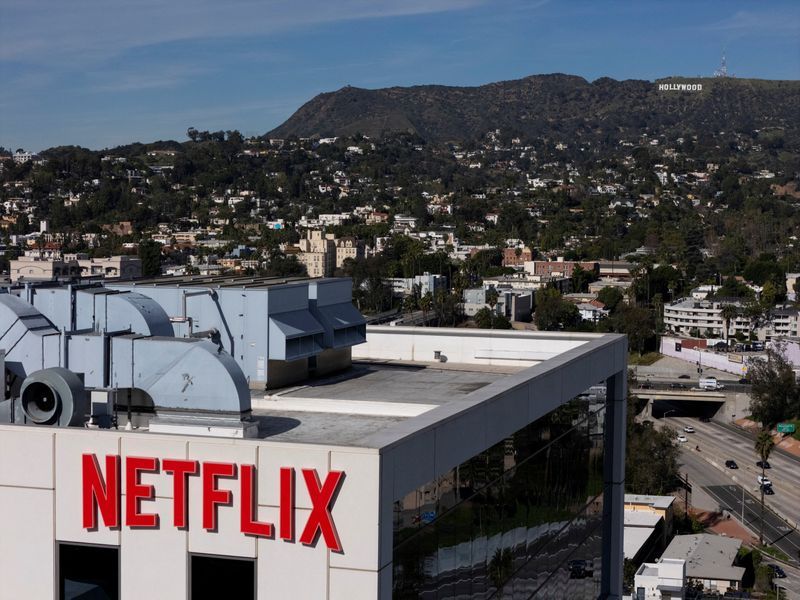
Netflix confronts a defining moment in its corporate trajectory as the streaming platform prepares to report second-quarter results, facing mounting pressure from investors sceptical about its ability to sustain expansion in an increasingly crowded marketplace. The company has forfeited over one-fifth of its market value during the current year, reflecting widespread concern about the viability of its growth strategy at a time when traditional television networks, YouTube, and mobile-first competitors have begun eroding its competitive advantages. The earnings announcement arrives at a critical juncture where management must convince the financial community that the company possesses credible strategies to maintain momentum from its enlarged operational base.
Analysts project Netflix will announce revenue growth of 13.6 per cent to $12.59 billion, marking its slowest quarterly expansion in more than a year, while adjusted earnings per share are anticipated to reach 79 cents according to consensus forecasts compiled by LSEG. These figures represent a fundamental shift in the company's growth narrative, which has been characterised for years by double-digit percentage increases that significantly outpaced broader market performance. The deceleration reflects a maturing business model in developed markets where market penetration has reached saturation, forcing management to identify fresh revenue sources to justify premium valuations that investors have historically assigned to technology-driven growth companies.
The advertising business represents Netflix's most significant opportunity to reignite expansion, yet early results have disappointed expectations across the industry. Forecasts now project the division will generate approximately $705.8 million in revenue during the second quarter, but this trajectory falls substantially short of the robust growth projections analysts made when Netflix introduced this business line. Ross Benes, an analyst at Emarketer, acknowledged the widening gap between expectations and reality by noting that his firm has been forced to reduce revenue forecasts for the advertising segment as growth rates have proven significantly weaker than the consensus initially anticipated. This underperformance is particularly troubling because the company exhausted much of the low-hanging fruit in password-sharing enforcement and price increases over the preceding two years, making the advertising business essential to achieving the investor-pleasing growth rates the market demands.
Recognising the limitations of traditional subscription economics, Netflix has aggressively pursued live event programming as a mechanism to differentiate its offering and create incremental engagement opportunities that justify advertising premiums. Reports suggest the company is investigating the acquisition of broadcasting rights for the 2030 and 2034 FIFA World Cup tournaments in the United States, a move that would position the platform alongside traditional sports broadcasters and signal serious commitment to competing for premium live content. Simultaneously, the company is negotiating to acquire Letterboxd, an online film discussion platform with a devoted community of cinema enthusiasts, suggesting Netflix recognises that content ecosystems transcending pure consumption may enhance user stickiness and advertising appeal.
This strategic repositioning reflects a fundamental transition in Netflix's market position, as analyst Paolo Pescatore of PP Foresight articulated by observing that the company has progressed from operating as a disruptive challenger to functioning as an entrenched dominant player. The challenge that Netflix now faces differs fundamentally from earlier competitive battles, because sustaining growth from a much larger revenue base requires identifying expansion vectors that were immaterial to smaller competitors. The mathematics of continued percentage growth become exponentially more difficult as absolute revenues climb, forcing management to pursue either entirely new business categories or acquisition of competitors to achieve targets that equity investors have come to anticipate.
Among the most pressing concerns for investors is emerging evidence that viewer retention across sequential seasons of major franchises has deteriorated markedly. Bloomberg News reported that audiences for acclaimed shows including The Night Agent and Beef demonstrate substantially reduced engagement in subsequent seasons compared with inaugural launches, with some series experiencing audience declines exceeding fifty per cent. This pattern suggests that Netflix's content strategy may be generating short-term viewing spikes that do not translate into the sustained subscription value proposition that distinguishes the business model from transactional video-on-demand competitors. For advertisers contemplating whether to allocate budgets to Netflix's advertising tier, declining viewer loyalty across seasons represents a material risk factor that could undermine the commercial attractiveness of the platform.
The broader competitive environment has intensified considerably as traditional media conglomerates have launched direct-to-consumer streaming initiatives to protect their existing business models and their relationships with audiences. Companies including Comcast's NBCUniversal have undertaken significant strategic reorganisations specifically designed to compete more effectively in streaming, while simultaneously exploring options to optimise their streaming assets through potential transactions. While some speculation exists that Netflix might pursue major acquisitive moves to consolidate its market position, many analysts expect the company to pursue a more disciplined approach focused on smaller, targeted acquisitions that strengthen specific capabilities or audience segments rather than transforming the business model through transformational deals.
For Malaysian and Southeast Asian viewers and investors, Netflix's challenges reflect a broader pattern of consolidation in global media markets where scale increasingly determines survival in capital-intensive content production and distribution. The Southeast Asian region represents a significant growth opportunity for streaming platforms given the region's expanding middle class and rising internet penetration, yet local competition from platforms including iQiyi in the region and competition from traditional cable providers complicates Netflix's expansion calculus. The company's struggles with viewer retention and advertising monetisation may reshape investment priorities in the region, potentially leading to different content strategies or pricing approaches tailored to local market conditions and purchasing power.
The fundamental question animating investor sentiment centres on whether Netflix can construct sustainable competitive advantages at a scale sufficiently large to justify its valuation multiples in an era of intense competition. Management's second-quarter presentation must articulate a credible pathway toward profitability and cash generation that does not depend entirely upon sustained price increases that could erode subscriber counts in price-sensitive markets. The answers provided during this earnings cycle will substantially influence investor confidence in the company's strategic direction and determine whether Netflix retains the growth narrative that has defined its corporate history.

