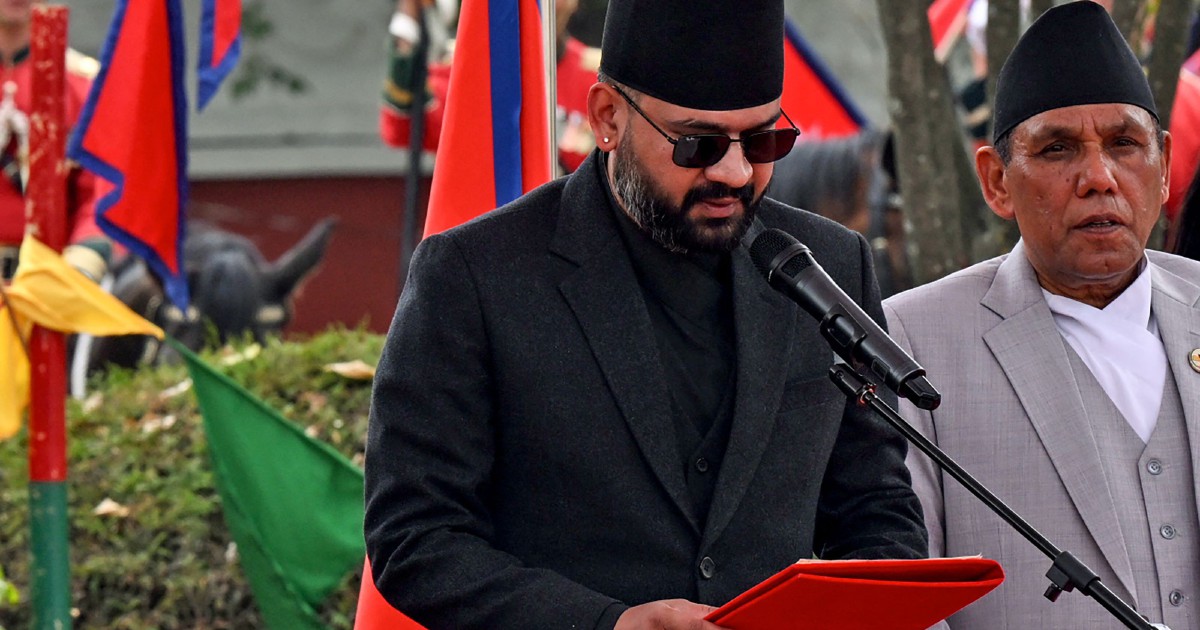
Nepal's Prime Minister Balendra Shah will be permitted to retain his characteristic dark sunglasses while attending sessions of the legislature, officials confirmed Tuesday, resolving a question about parliamentary dress norms that had arisen following guidance from the parliament speaker discouraging the practice. The decision hinges on documented medical necessity for eyewear protection, according to statements from government representatives in Kathmandu.
The episode underscores evolving questions about personal health accommodations within formal institutional settings across South Asia, where parliamentary protocol has traditionally emphasised formal dress standards and visible identity during legislative proceedings. Shah's signature eyewear has become closely associated with his public persona, and the exemption represents a practical acknowledgment that health considerations may sometimes warrant flexibility in longstanding parliamentary conventions.
Parliament speakers and house leadership in Westminster-influenced democracies have conventionally maintained strict dress codes for legislators, reflecting institutional traditions that emphasise formality and the visibility of elected representatives during debate and voting. These standards have historically included restrictions on sunglasses indoors, with the underlying rationale that members should maintain eye contact and be fully visible to colleagues and the public during legislative business. However, interpretations of these rules have gradually become more nuanced across various parliaments as medical accommodations have been better understood.
The situation in Nepal reflects broader patterns observable in South Asian legislatures, where balance between institutional tradition and individual health requirements has become increasingly important. Nepal's parliament, like many regional institutions, operates within frameworks influenced by historical precedent while gradually adapting to modern understandings of medical needs. The resolution of Shah's situation suggests that parliamentary officials have recognised the importance of distinguishing between casual non-compliance with dress codes and legitimate health-related exceptions.
Sunglasses worn indoors due to photosensitivity, light-sensitive conditions, or other documented medical reasons represent a distinct category from voluntary choices about personal appearance. Officials recognised this distinction in determining that Shah's ongoing use of dark eyewear fell within permissible grounds for exception. The medical justification provides institutional legitimacy for what might otherwise be viewed as departing from standard parliamentary presentation.
This development carries implications for how other South Asian parliaments may approach similar requests from legislators. Nepal's decision establishes precedent that health-related accommodations can override general dress code expectations, creating a framework that other regional bodies may reference when evaluating comparable requests. The approach balances respect for parliamentary tradition with recognition of individual health circumstances, offering a practical model for inclusive institutional governance.
The episode also illustrates how personal style elements can become meaningful aspects of political identity in contemporary South Asian democracies. Prime ministers and senior political figures develop distinctive visual signatures that voters and constituents come to associate with their leadership. Shah's sunglasses have become sufficiently characteristic that their removal from his parliamentary appearance would constitute a notable visual change, potentially affecting how constituents and media perceive his presence and engagement during legislative sessions.
Parliamentary protocol across the region has evolved considerably over recent decades, with modern legislatures increasingly recognising that flexibility on certain personal presentation matters need not compromise institutional dignity or formal proceedings. Nepal's decision reflects this broader shift toward pragmatic interpretation of rules, where procedural substance and actual legislative business are understood as distinct from particular elements of appearance code compliance.
The resolution also speaks to the administrative maturity of Nepal's parliamentary system in addressing such questions through official guidance rather than allowing ad-hoc decisions or disputes to create uncertainty about institutional rules. Clear documentation of medical grounds and explicit authorisation from parliamentary officials create transparency about how exceptions are granted, reducing potential for inconsistent application or accusations of favouritism.
For Malaysia and other ASEAN parliaments, Nepal's approach offers instructive perspective on managing contemporary questions about legislative dress and presentation standards. As regional legislatures become increasingly diverse in their membership and more attentive to health and accessibility considerations, frameworks for accommodating documented medical needs while maintaining institutional standards become increasingly relevant. Nepal's experience suggests that such accommodations can be managed through straightforward official processes that preserve parliamentary integrity while recognising individual circumstances.

