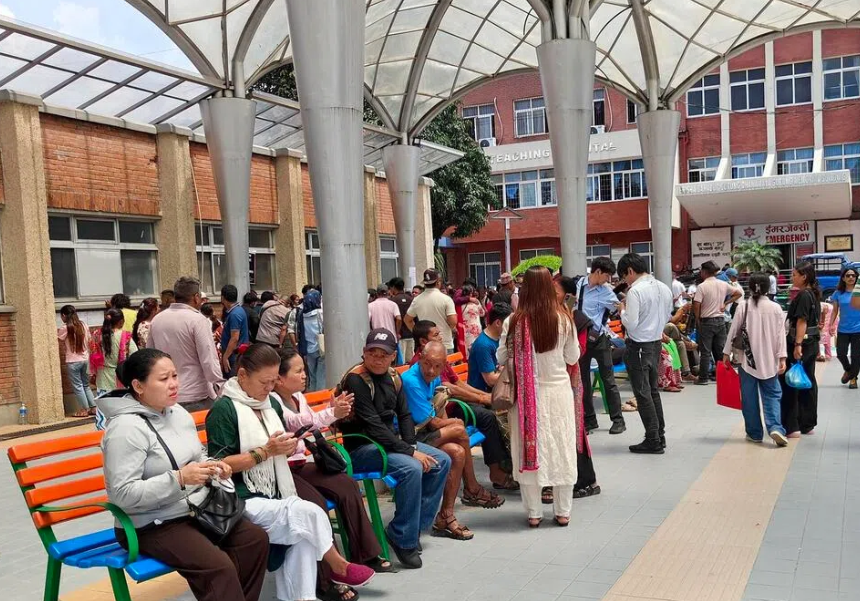
A haunting scene has unfolded outside Tribhuvan University Teaching Hospital in Kathmandu over the past seventy-two hours. The gates display a grim collection of photographs depicting mangled corpses, transformed into an improvised identification board where the bereaved come searching for answers about their missing relatives. This macabre installation represents the human cost of the devastating flash flood that tore through Nepal's border region on August 26, an event that has claimed over 500 lives and left more than 1,500 people unaccounted for.
The catastrophe struck with little warning as torrential waters surged through the Bhotekoshi river system and its downstream channels, destroying everything in their path. Search and rescue teams continue combing through debris fields and along riverbanks, racing against time and dwindling hope. The scale of the tragedy has overwhelmed even the capital's major medical facilities, which now serve as both morgues and command centres for the identification effort. Authorities have deployed over 4,400 police personnel alongside the Nepali Army and Armed Police Force in what has become the nation's largest peacetime emergency response.
Outside the hospital gates, a heartbreaking scene repeats endlessly. Dolma Tamang, a 36-year-old woman, carefully examines each photograph displayed on the metal barriers, searching for any trace of her sister and brother-in-law. The couple were traversing Rasuwa district on August 26, transporting goods from the Chinese border, when the flood swept through. Their phones have remained silent for three agonizing days, prompting Tamang to abandon all other responsibilities and make the rounds of Kathmandu's hospitals, driven by a mixture of dread and diminishing hope. "It has been very difficult; my tears have run dry," she confessed to reporters, her emotional exhaustion evident in every word.
Similar scenes play out repeatedly within and around the hospital. Families arrive clutching printed photographs and smartphone images of their missing relatives, showing them to medical staff, other visitors, and police officers in the desperate hope that someone might have seen them. One entire wall section at TUTH has been commandeered for missing person posters, a chaotic collage of faces representing the human dimensions of the disaster. Inside the hospital corridors, 23-year-old Sushila Shrestha searches for her brother Bir Bahadur, a 21-year-old truck driver who was heading toward the Chinese border when the flood struck. Despite the lack of news, she clings to belief: "I am convinced he will return; he has to return." Such resilience masks profound uncertainty.
The psychological toll on those forced to examine the photographic evidence is severe. Bikesh Shrestha, searching for his cousin Rakesh, found himself unable to look directly at the images of unidentified bodies. "I had to turn my eyes away," he said, his composure barely intact as he hugged himself to prevent an emotional collapse. The experience of reviewing corpses—even photographically—proves overwhelming for relatives already traumatized by uncertainty and loss. Many hospital visitors oscillate between grim determination to identify their loved ones and psychological self-protection mechanisms that make such identification nearly impossible.
The international dimension of this tragedy has added layers of complexity to rescue and identification efforts. Nine Singaporeans remain missing following the flood, while around 288 Indian nationals are also unaccounted for. Many of these individuals were part of pilgrimage groups traversing the popular Kailash-Mansarovar route through Rasuwa district toward Mount Kailash and Lake Manasarovar in Tibet. A group of men from Tamil Nadu flew into Kathmandu on August 28 specifically to locate their missing travel companions. One visitor from Coimbatore came to assist his friend in the search for the friend's wife and son, offering the simple but profound reassurance: "Whatever it is, we will face it together; you have to be strong." The Gyirong border crossing, severely damaged in the disaster, has become a symbol of the tragedy's scale and the vulnerability of cross-border transit routes.
As of August 28, the situation remained fluid and increasingly dire. Rescue operations briefly paused when authorities feared a barrier lake—created by the accumulated debris blocking normal water flow—might rupture and unleash a secondary disaster. Though officials eventually determined there was no immediate danger, the situation remained far from stable. The Nepal Tourism Board reported that 121 foreign tourists had been rescued by this point, including 85 Indian nationals and 16 Chinese citizens, though hundreds more remained missing. The government's website listing rescued individuals provided the only systematic means for families to track whether their loved ones had been located.
Downstream from the epicentre of destruction, the situation has become equally desperate. Chitwan district, celebrated internationally for its national park and elephant populations, has been devastated by the flooding. Roads lie buried under mountains of debris and silt, with 186 bodies recovered by the afternoon of August 28. The district's hospitals collectively possess morgue capacity for only 30 to 50 bodies—leaving a critical shortage of storage space for the deceased. Similar constraints exist across multiple districts, with morgues rapidly reaching capacity. The Kathmandu Post reported on August 28 that hospitals in several districts had begun running critically short of space, raising urgent questions about preservation of remains and the dignity of the deceased.
Nepal's government has taken a distinctive approach to international assistance, shaped by lessons learned from the 2015 earthquake. Prime Minister Balen Shah declined offers from China, India, and other nations to deploy their own search and rescue teams, having witnessed how multiple international rescue operations created coordination nightmares fifteen years prior. Instead, Nepal has requested financial assistance channelled through a single mechanism that the government announced it would establish. This approach allows Nepal to maintain control over response efforts while still benefiting from international support. India has already provided significant humanitarian assistance—47 tonnes of temporary shelters, blankets, hygiene kits, solar lamps, medicines, and food packets delivered via military aircraft. New Delhi has additionally offered prefabricated truss bridges, recognizing that dozens of bridges spanning both major and minor waterways were destroyed or severely damaged.
The long-term reconstruction challenge looming ahead demands careful planning and sustained funding. While immediate rescue operations continue, government sources have indicated that international agencies and countries will be approached specifically for rehabilitation and reconstruction assistance, not for emergency response operations. This phased approach, though controversial, reflects a sober assessment that coordination of multiple foreign rescue teams would ultimately hinder rather than help immediate response efforts. The missing persons list continues growing—it stood at more than 1,500 by the afternoon of August 28, suggesting that comprehensive casualty figures may not be known for weeks or months.
For those gathered outside Tribhuvan University Teaching Hospital, the immediate reality is one of uncertainty mixed with desperate hope. Some arrive to identify deceased relatives and brothers, while others come seeking confirmation that their missing family members have been rescued and hospitalized. Medical staff attempt to maintain records and provide information, yet the volume of inquiries overwhelms normal administrative procedures. Each photograph displayed on the hospital gate represents not only a deceased individual but shattered families and communities. The visible human cost—captured in the anguished expressions of visitors and the emotional testimonies of those searching—provides the truest measure of this disaster's devastating scope.

