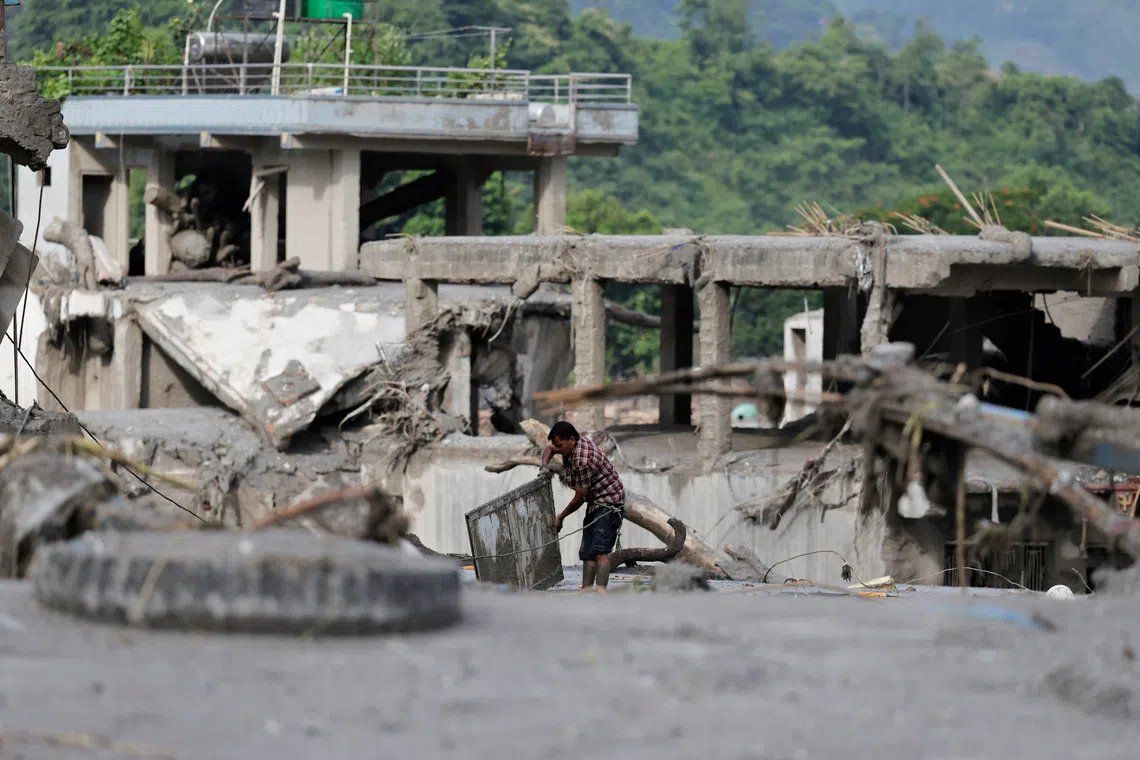
The humanitarian crisis unfolding across the Nepal-China border has entered a precarious new phase, with both nations now confronting the prospect of secondary disasters stemming from the catastrophic glacier collapse that devastated the region on Wednesday. Rescue operations continue in the wreckage-filled valleys and slopes of the Himalayan borderlands, yet authorities acknowledge that finding the more than 1,000 missing persons becomes increasingly difficult as new threats loom. At least 362 deaths have been confirmed across Nepal and China's Tibet Autonomous Region, making the initial disaster one of the region's deadliest geological events in recent memory.
The immediate trigger for Wednesday's catastrophe originated in a massive glacier rupture that released enormous quantities of rock, ice, mud and associated debris into the river systems threading through the high mountains. The sheer volume and velocity of material transformed normally manageable waterways into torrents that obliterated villages and swept away everything in their path. Yet the glacier collapse's destructive legacy extends far beyond the initial inundation. As the floodwaters subsided, they left behind a drastically altered landscape where debris now functions as natural dams, creating lakes that grow heavier and more unstable with each passing hour.
Nepal's disaster management apparatus moved swiftly to alert the public about conditions at the flood site itself, where a debris-formed barrier has begun restricting water flow and causing an accumulation behind it. Officials monitoring the situation issued a formal notice on Thursday cautioning residents in downstream areas about the rising water levels behind this uncontrolled dam. The alert emphasised that persons in vulnerable zones—particularly those living along riverbanks or working in rescue and recovery operations—should relocate immediately to higher elevations and avoid exposed areas altogether. This warning represents an attempt to prevent the secondary disaster scenario where rescue workers and residents could find themselves caught in a sudden deluge if the debris barrier fails.
China's assessment of its side of the border presents even more alarming mathematics. Government water resources officials have calculated that approximately three million cubic meters of water—a volume equivalent to roughly twelve hundred Olympic-sized swimming pools—will drain into an already-engineered dam facility over the course of the next seventy-two hours. This influx into an already-stressed artificial reservoir creates substantial risk of structural failure, with Chinese officials projecting that the critical juncture will arrive around September 1st. The convergence of these two events—the accumulation of meltwater and glacial runoff combining with pre-existing dam operations—reflects how human infrastructure intersects with natural catastrophe in ways that can compound rather than mitigate disaster.
Weather forecasts compound the anxiety among officials on both sides of the border. State meteorological agencies in China have issued predictions indicating that significant rainfall will persist throughout the coming week across the Himalayan region. Such precipitation would substantially increase the volume of water flowing into both the debris-formed lake in Nepal and the engineered facility in China, narrowing any remaining safety margins. Zhu Jinfeng, a senior hydrologist at China's water resources ministry, articulated the grim progression during a broadcast interview, noting that the quantity of accumulated water rises simultaneously with the statistical probability of containment failure. The combination of concentrated water mass and continued moisture influx creates what experts term a cascading risk scenario.
The situation reflects broader vulnerabilities affecting the high mountain regions where Nepal and China interface. Glacial retreat across the Himalayas has intensified in recent decades, making dramatic collapses like this week's event more frequent. When such geological events occur in territories where human settlement has expanded upward into previously marginal valleys and where modern water infrastructure—dams and reservoirs—manages river systems, the consequences become compounded. A glacier collapse alone might have caused significant but localised damage; the same collapse intersecting with engineered waterworks creates exponentially greater hazard.
Recognising the upgraded threat level, rescue personnel operating on the Nepalese side have begun deliberate repositioning away from the most exposed areas. Pawan Koirala, supervising a thirteen-member rescue team, exemplified this calculated retreat. His group made the difficult decision to abandon lower-elevation positions where they had been conducting search and recovery operations and move to safer terrain further from the river channel. The move reflected a stark choice: continuing rescue efforts in increasingly dangerous conditions offered minimal chance of locating additional survivors whilst substantially raising the probability that rescuers themselves would become casualties if the debris dam failed unexpectedly.
For the broader region, this crisis underscores the interconnectedness of disaster response across international boundaries. Neither Nepal nor China can independently manage threats that span their shared frontier. The glacier collapse that triggered this sequence of events respects no border, nor do the lakes it created. Both governments recognised that coordinated warnings and information-sharing offered the only sensible response to a threat neither could fully control alone. This cooperation, whilst limited in scope, demonstrates that even in territories where geopolitical tensions periodically surface, immediate humanitarian emergencies can prompt collaborative action.
The coming days will prove critical in determining whether the natural and engineered barriers containing these Himalayan lakes hold firm or catastrophically release their accumulated water. Emergency planners in both countries are developing contingency responses should secondary flooding occur. Yet the fundamental vulnerability remains: in regions where tectonic and glacial forces operate at geological scales, human infrastructure and settlements occupy an inherently precarious position. The 362 confirmed deaths already represent an immense tragedy; the warnings issued by Nepal and China reflect collective determination that this toll should not rise further through preventable secondary disasters.

