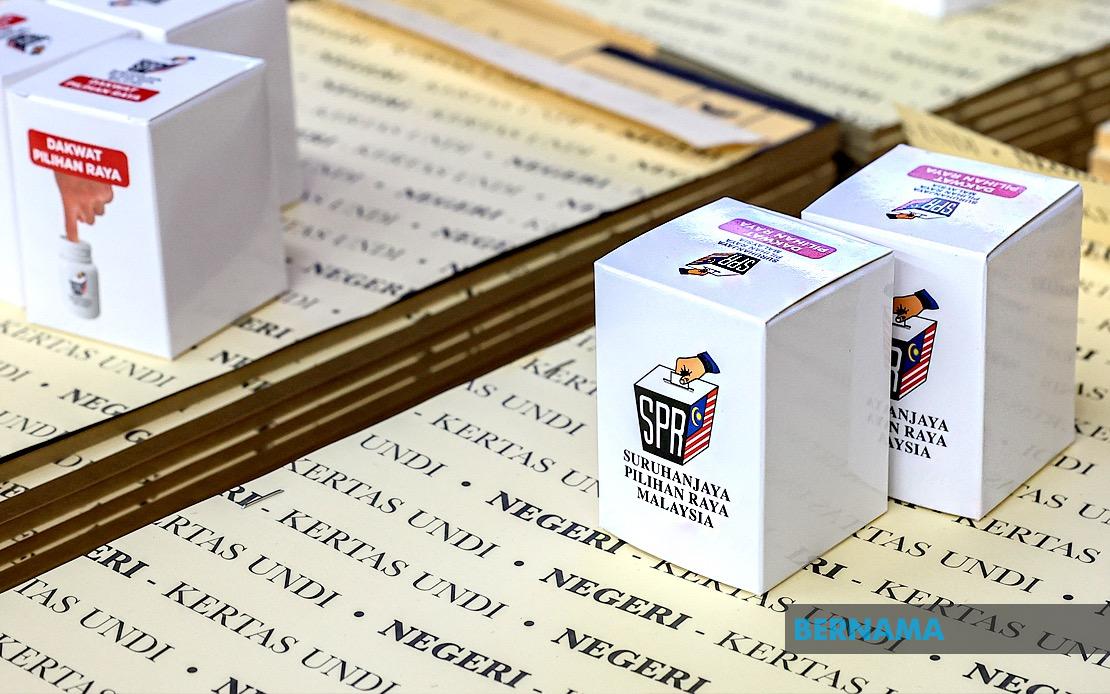
The Johor state election campaign enters its final stretch with a significant early voting exercise scheduled tomorrow, as 24,751 security personnel and their families prepare to cast ballots ahead of the main polling day on Saturday. This organised early voting process reflects the electoral commission's effort to accommodate the heavy operational commitments of those in uniform, ensuring their participation in the democratic process without compromising security operations across the state.
The early voter contingent divides equally between two security branches: military personnel and their spouses account for 12,041 votes, while police staff and their dependents constitute 12,710 votes. This bifurcation reflects Malaysia's standard electoral practice of providing such accommodations to the armed forces and civil law enforcement, recognising their essential public duties during election periods. The arrangement underscores how electoral participation remains a priority even for those whose regular duties might otherwise prevent attendance on election day.
Tomorrow's voting will unfold across 64 dedicated early polling centres distributed throughout Johor's territory. Police personnel and their spouses will access 53 of these centres, while military voters will use 11 dedicated facilities. All polling centres will open simultaneously at 8 am, establishing a coordinated administrative structure designed to process voters efficiently. Among the police contingent, 12,067 electors will vote in person at their assigned centres, whereas 643 have opted for postal voting—a minority choice that speaks to the general preference for direct participation despite the convenience postal votes offer.
Electoral administration for tomorrow's early voting requires substantial logistical mobilisation. The police force alone will deploy 3,565 personnel dedicated to managing the early polling operations. This deployment encompasses 647 commissioned officers, 2,806 rank-and-file constables, and 112 civilian administrative staff. Their responsibilities extend well beyond the polling centres themselves, encompassing security cordons, ballot box escorts, traffic management, crime prevention patrols, and strategic location monitoring throughout affected areas. This layered security approach demonstrates the state's commitment to maintaining order while facilitating peaceful democratic participation.
The operational footprint of early voting centres varies considerably by location and expected voter volume. Smaller centres serving remote or less populated areas will close as early as noon tomorrow, having processed their compact voter rolls. Three such centres—Buloh Kasap Police Station in Segamat, Tenang Police Station in Labis, and Bandar Penawar Police Station—each anticipate between six and 28 early voters. Conversely, major urban polling venues will remain open until 6 pm to accommodate heavier demand. The largest early voting centre identified is the Federal Reserve Unit Hall No 2 at Johor Police Headquarters, servicing the Stulang state constituency with 1,338 registered early voters. Close behind sits the KEMAS Preschool facility at the 6th General Operations Force Battalion in Bakri, which will process 927 electors from the Bukit Naning constituency.
Weather considerations present a secondary operational factor for tomorrow's voting. The Malaysian Meteorological Department forecasts morning rainfall across four districts: Batu Pahat, Muar, Pontian, and Tangkak. The remainder of Johor's territory is expected to experience fair weather conditions. Such meteorological intelligence informs the planning of traffic management and security deployments, ensuring that wet conditions in affected districts do not disrupt voting logistics or create security challenges.
The early voting tomorrow represents merely the initial phase of Johor's extended electoral process. The 16th Johor State Election proper will occur on Saturday, July 11, when a broader electorate will determine representation across 56 state assembly seats. A total of 172 candidates have registered to contest these positions, suggesting competitive races across most constituencies. The early voting framework accommodates security personnel, yet the main election will test the broader state's appetite for political change or continuity.
For Malaysian observers watching Johor's electoral dynamics, this state election carries significance beyond the state's borders. Johor represents Malaysia's most southern peninsula territory and has traditionally served as a bellwether for broader political sentiment. The composition of the next Johor state government could influence coalition calculations at federal level and signal popular mood regarding governance performance and policy direction. The participation of security forces in early voting—while procedurally routine—reminds observers that electoral legitimacy depends on inclusive processes that respect the circumstances of voters in essential services.
The coordination visible in tomorrow's early voting operation illustrates Malaysia's established electoral machinery. Despite periodic criticisms regarding electoral fairness and representation, the administrative capacity to mobilise multiple agencies, secure polling facilities, and process thousands of voters demonstrates institutional competence in the mechanics of voting. Whether this efficiency translates into public confidence and perceived legitimacy remains an ongoing question for Malaysia's electoral observers and participants alike. The weekend election will provide the next data point in that continuing assessment.

