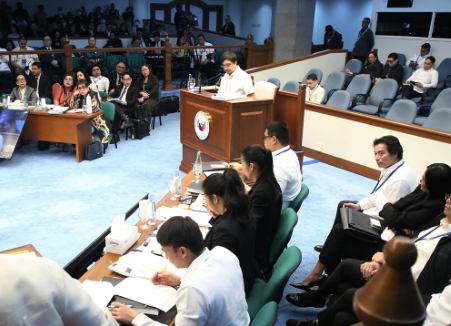
In a dramatic fifth day of the impeachment proceedings against Vice President Sara Duterte, the National Bureau of Investigation presented testimony asserting that the Vice President had the demonstrated ability and intent to execute assassination threats she made publicly against President Ferdinand Marcos, first lady Liza Araneta-Marcos and former Speaker Martin Romualdez. NBI regional director Jeremy Lotoc, who previously headed the agency's Cybercrime Division, told the Senate impeachment court on Tuesday that investigators concluded Duterte's remarks were "serious, real and active" rather than merely rhetorical or inflammatory language typical of political discourse. The prosecution sought to establish through Lotoc's testimony that the Vice President's statements constituted both grave threats under Philippine law and a fundamental betrayal of public trust, grounds for removal from office under the Constitution.
Lotoc's assessment of Duterte's capability rested partly on her constitutional position and political lineage. When asked directly by Senate President Sherwin Gatchalian whether the Vice President possessed the capacity to carry out the threats, Lotoc responded affirmatively without hesitation. He grounded this conclusion in her office as second-highest official in the land, which alone provides access to state resources and mechanisms. More significantly, Lotoc pointed to her family background, noting that her father had previously served as President of the Philippines, suggesting that her connections and political networks extended her capacity beyond her formal position. The implication in the testimony was that a former First Daughter with established political machinery possessed meaningful advantages in executing threats that an ordinary citizen would lack.
A central pillar of the prosecution's case involves claims that Duterte contracted an assassin to carry out killings should she herself be killed. Lotoc acknowledged that the NBI possessed no direct evidence identifying such a person or confirming their existence. Instead, the bureau's conclusion relied entirely on Duterte's own public statements made during a November 23, 2024 online press conference and subsequent November 26 interview, where she explicitly stated she had spoken to someone about exacting revenge if she were murdered. The investigator testified that the bureau interpreted these admissions as genuine rather than hypothetical or performative, saying "we believe the Vice President was not kidding when she made those remarks." He emphasized that investigators wanted to question Duterte directly to explore the matter further, but she did not appear before the bureau to clarify or provide additional information.
The question of evidence became contentious during the questioning. When defense counsel raised the bureau's reliance on Duterte's statements alone, Lotoc acknowledged straightforwardly that the NBI had based its conclusions on "statements and admission." He argued, however, that Duterte's written denial of hiring an assassin proved insufficient to negate the offense, since she never denied making the controversial remarks themselves. In legal terms, Lotoc asserted that mere denial without substantiating evidence or counternarrative could not override the fact that she had publicly uttered the statements and claimed to have engaged someone. This position reflects the prosecution's theory that Duterte's own words constitute the primary evidence of her intent and capability, irrespective of whether the alleged hitman can be identified.
During redirect examination by private prosecutor Amado Virgil Ligutan, a key distinction emerged regarding Duterte's response to the charges. Rather than retracting her original remarks, the Vice President had instead reiterated them in the November 26 interview, effectively doubling down rather than walking back her language. Lotoc interpreted this repetition as evidence that Duterte was serious rather than making a momentary outburst. This pattern matters significantly because it distinguishes between a single incident of inflammatory speech and a sustained pattern of threatening rhetoric, suggesting deliberation and intent rather than momentary loss of composure. The NBI director stated plainly that the repeated nature of the remarks indicated the Vice President "did not joke when she uttered those utterances."
The defense raised concerns about typographical and clerical errors in NBI documents, attempting to undermine the reliability of the investigation. Lotoc dismissed these issues as inconsequential to the substance of the findings, arguing that such errors did not alter the bureau's core conclusion that Duterte committed grave threats and incitement to sedition. The prosecution adviser Robert Ace Barbers later characterized the defense's cross-examination strategy as focusing on minor procedural flaws rather than engaging with the substance of Lotoc's testimony, suggesting the defense lacked substantive counters to the NBI's core arguments.
Another dimension of the case involves the so-called "Operation Romanov," which Duterte has cited as justification for her fear of assassination and rationale for her defensive posture. Lotoc testified that the NBI traced the term's origin to Davao City Mayor Sebastian "Baste" Duterte during a January 2024 rally, where it was directed at President Marcos and his family rather than at the Vice President herself. Information brought forward by vlogger Princess Maui regarding Operation Romanov during Duterte's November 23 briefing was deemed unreliable by the bureau after Maui failed to appear before investigators to substantiate her claims. The NBI found no validated threat against the Vice President, and Lotoc suggested the investigation stalled partly because neither Duterte nor her representatives cooperated with or provided actionable information to the bureau.
The impeachment proceeding represents an extraordinary moment in Philippine constitutional history, with Duterte, as sitting Vice President and constitutional successor to the presidency, facing removal based partly on public statements suggesting contemplation of violence against the sitting president. The prosecution's case rests on a chain of reasoning that moves from public utterances to inferred intent to alleged capacity, with Lotoc's testimony attempting to anchor each link. For Malaysian observers, the case highlights the peculiar constitutional vulnerabilities of Southeast Asian vice presidents, who often function as semi-autonomous power centers with their own political constituencies and networks, creating potential for the kind of dual power structures that occasionally erupt into open constitutional conflict.
The emphasis on Duterte's family history and political networks in assessing her capacity to execute threats also underscores how dynastic politics in the Philippines creates differential access to state machinery and networks of influence. Unlike an ordinary citizen making similar remarks, someone from a presidential family potentially possesses deeper connections throughout the bureaucracy, security apparatus, and political establishment. This distinction matters for the legal analysis because it transforms the question from abstract capability to demonstrated access and network potential. Lotoc's testimony essentially argues that in the Philippine context, being a Duterte automatically confers a certain level of real-world capacity that a similarly situated person without such a background would not possess.
The case also illuminates broader questions about the standards of evidence in impeachment proceedings versus criminal trials. While Lotoc acknowledged that the NBI had recommended criminal charges to the Department of Justice, the impeachment trial operates under different evidentiary rules and burdens of proof. The Senate judges need not be convinced of guilt beyond reasonable doubt but rather whether the Vice President's conduct amounts to betrayal of public trust and renders her unfit to remain in office. This distinction allows for greater reliance on circumstantial evidence and inference from public statements. Duterte's defenders maintain that her remarks, however intemperate, constitute protected political speech and expression of fear rather than genuine criminal intent, a fundamental dispute about the nature and meaning of the utterances themselves.
As the trial continues into subsequent phases, the tension between respecting the Vice President's rights to defense and maintaining standards of accountability for the nation's second-highest official will likely remain at the forefront. The Lotoc testimony represents the prosecution's attempt to establish through official investigative findings that Duterte's words were not mere hyperbole or political theater but genuine expressions of intent backed by capability. The defense will need to either undermine the reliability of these conclusions or articulate a fundamentally different interpretation of what Duterte's statements signify and whether the office of Vice President carries inherent limitations that prevent mere words from constituting grave threats regardless of the speaker's political connections or family background. The resolution of these questions will carry significance not only for Duterte's political future but for the precedent it establishes regarding the boundaries of acceptable speech for high Philippine officials.

