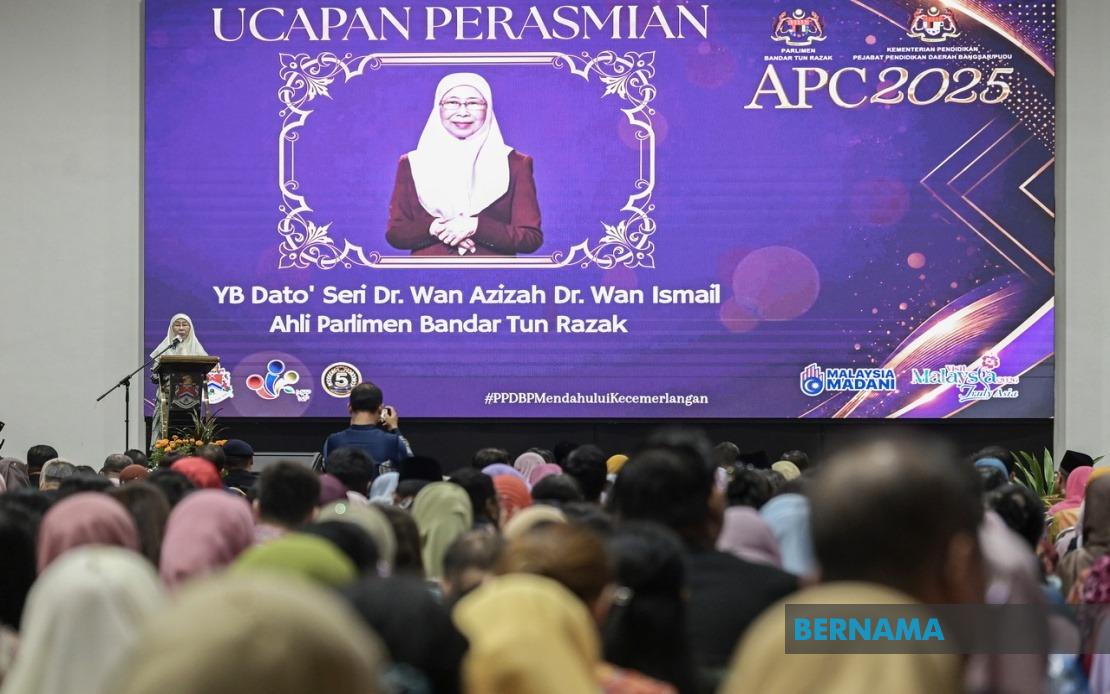
Datuk Seri Dr Wan Azizah Wan Ismail, wife of the Prime Minister and Member of Parliament for Bandar Tun Razak, has articulated a vision of national development that extends beyond conventional economic indicators, arguing instead that a country's true measure of strength emerges from its capacity to cultivate individuals of integrity, learning and compassion. Speaking at the 2025 Excellent Service Award ceremony organised by the Bangsar/Pudu District Education Office at the Kuala Lumpur City Hall Training Institute, she positioned character formation and ethical development as foundational to Malaysia's long-term prosperity and stability.
Dr Wan Azizah's remarks situated education within a broader framework that acknowledges the multifaceted demands placed on contemporary families and schools. Urban Malaysian parents, she noted, frequently balance demanding professional commitments with parenting responsibilities, creating circumstances where educational institutions shoulder expanded responsibility for children's formative years. This reality positions teachers not merely as content deliverers but as influential figures in the developmental arc of young Malaysians, particularly during critical periods when values, habits and worldviews crystallise.
The education system's mission, according to Dr Wan Azizah, transcends the transmission of academic knowledge to encompass the cultivation of character, deportment and ethical sensibility. This framing represents an important departure from purely credentials-focused educational discourse, instead advocating for holistic human development. She stressed that educators function as architects of the nation's most valuable resource—its young people—and carry the weight of responsibility for shaping citizens capable of ethical deliberation and compassionate action.
Amidst the rapid advancement of artificial intelligence and the deluge of digital information saturating contemporary society, Dr Wan Azizah identified values-based education and critical thinking as essential safeguards. The proliferation of unverified information and algorithmic amplification of sensationalism demand that Malaysian students develop robust intellectual faculties capable of distinguishing credible knowledge from misinformation. This capability assumes particular significance in Southeast Asia, where digital literacy remains unevenly distributed and susceptibility to disinformation campaigns presents tangible social risks.
The recognition of award recipients, in Dr Wan Azizah's estimation, extends beyond individual acknowledgment to serve as catalytic reinforcement for systemic commitment to educational excellence. By honouring 746 teachers and school administrators from 143 schools across the Bangsar/Pudu district, the ceremony validates pedagogical dedication while signalling to the broader educator community the institutional importance attached to exemplary performance and unwavering commitment to student development.
The scale of the 2025 Excellent Service Award ceremony—attended by approximately 1,000 guests and spanning 143 educational institutions—demonstrates the infrastructure Malaysia has established for recognising and incentivising excellence across its education sector. This systematic approach to celebrating achievement reflects evolving understanding that educator motivation, professional recognition and institutional support operate as crucial levers for improving educational outcomes across diverse communities.
For Malaysian policymakers and parents, Dr Wan Azizah's articulation of education's purpose carries practical implications. Her emphasis on character and ethical formation suggests that educational assessment frameworks should expand beyond standardised testing to encompass development of moral reasoning, civic engagement and interpersonal competencies. This becomes particularly relevant as Malaysia positions itself as a knowledge-based economy requiring not merely technically skilled workers but citizens capable of ethical decision-making across professional and civic contexts.
The ceremony also highlighted contributions from education support staff alongside teachers, acknowledging that institutional excellence emerges from coordinated effort across multiple roles. School administrators, clerical workers, maintenance personnel and security staff all contribute to creating environments conducive to learning and development. This holistic recognition reflects sophisticated understanding that educational outcomes depend on systemic coherence rather than exceptional individual effort alone.
Dr Wan Azizah's remarks arrive at a juncture when Malaysian education grapples with persistent challenges including achievement disparities across socioeconomic strata, concerns regarding critical thinking capacity, and questions about curriculum relevance to contemporary labour market demands. Her emphasis on ethical and compassionate citizenship, filtered through the lens of character formation, offers educators a clarifying vision of purpose beyond credential production. This reframing may encourage practitioners to prioritise developing students' moral imagination and capacity for empathetic engagement alongside academic competencies.
The attendance of Prime Minister's Political Secretary Datuk Azman Abidin and Kuala Lumpur Federal Territory Education Department director Megat Affandi Ismail underscored governmental commitment to the occasion. Their presence signalled high-level institutional endorsement of the recognition programme and the values it embodies, suggesting alignment across multiple levels of educational governance regarding priorities and direction.
Looking forward, Dr Wan Azizah's vision invites reflection on how Malaysia cultivates informed, ethically grounded citizenship within a rapidly transforming regional and global context. The convergence of technological disruption, evolving employment patterns and intensifying information warfare creates pressing need for educational approaches that produce graduates capable of navigating complexity with both intellectual rigour and moral clarity. By centring ethical development alongside knowledge acquisition, Malaysian educators respond to demands that extend beyond economic competitiveness toward the deeper challenge of sustaining cohesive, rights-respecting democratic communities.

