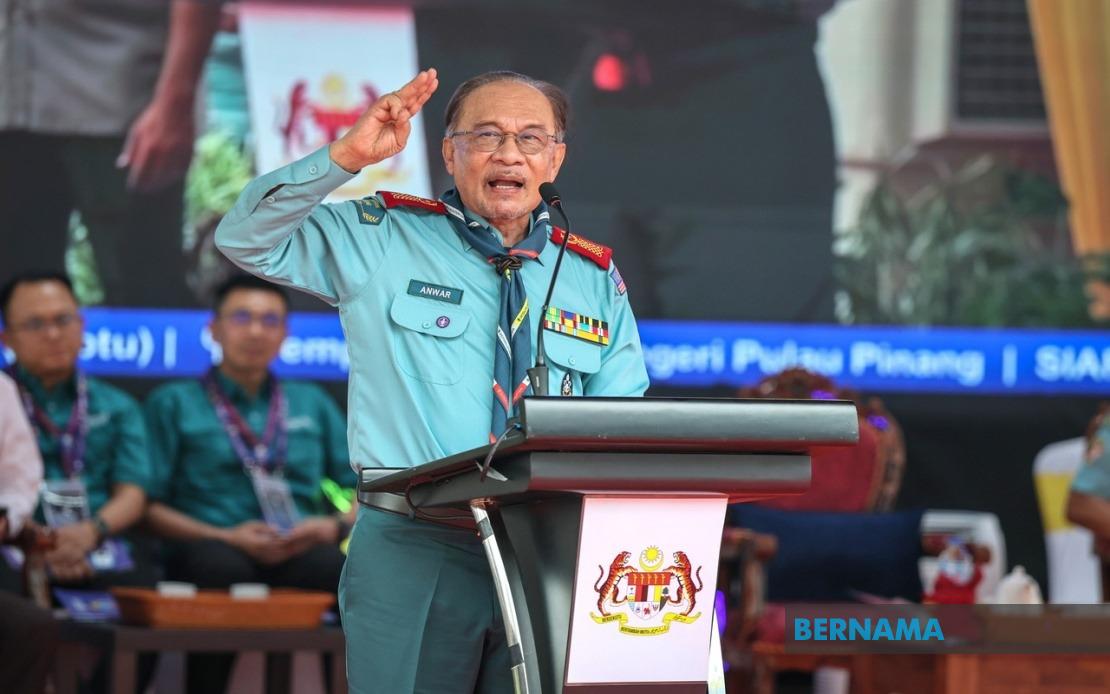
Prime Minister Datuk Seri Anwar Ibrahim has painted a vision of national success that extends well beyond economic metrics and technological advancement, arguing instead that Malaysia's future prosperity rests fundamentally on cultivating a generation of young people equipped with both knowledge and moral character. Speaking at the 15th Malaysian Scouts Jamboree (MYJAM15) at the Penang State Stadium, Anwar articulated a holistic development philosophy that places ethical formation and civic responsibility at the centre of educational policy, challenging a purely technocratic approach to nation-building that has dominated much policy discussion in recent years.
The Prime Minister's remarks come at a time when Malaysia, like many developing economies, is rapidly expanding investment in digital infrastructure and artificial intelligence capabilities. However, Anwar's comments suggest concern that such technological gains risk becoming hollow without corresponding development of the human character that sustains functional societies. He emphasised that formal education—whether at schools, colleges or universities—should serve a dual purpose: equipping students with practical knowledge while instilling the values, sense of civic duty and personal discipline that enable individuals to contribute meaningfully to their families, communities and nation.
Anwar's vision places particular weight on what he termed a "culture" of purposeful learning. His framing suggests education should not be reduced to credential accumulation or economic competitiveness but understood as transformation toward moral and civic maturity. This perspective carries particular resonance in Malaysia's multicultural context, where educational institutions serve not only economic functions but also broader nation-building roles. The Prime Minister's emphasis on fostering young people who understand their obligations to family, society and state reflects traditional Malaysian values while attempting to position them as essential counterweights to potential social fragmentation during periods of rapid technological and economic change.
The setting for these comments—the Malaysian Scouts Jamboree—underscores Anwar's conviction that character development operates through structured, experiential learning beyond classroom walls. The jamboree tradition, with its emphasis on outdoor skills, teamwork, leadership and service, embodies the integrated development model the Prime Minister advocates. By hosting the event, Malaysia reaffirms scouting's role as an institution dedicated to developing young people's practical abilities alongside their moral and social sensibilities.
MYJAM15 represents a significant gathering, bringing together more than 5,450 participants from eleven nations spanning South Korea, Indonesia, Singapore and Sri Lanka. The international dimension adds weight to Anwar's implicit argument that character-focused education represents not a parochial concern but a universal imperative. The presence of scouts from regional neighbours reinforces themes of regional cooperation and shared commitment to youth development standards that transcend individual national boundaries. For Malaysia specifically, hosting scouts from ASEAN member states and beyond positions the country as a centre for fostering regional understanding among younger generations.
The jamboree's return to Penang after a sixty-year interval carries symbolic importance. The last time Malaysia hosted MYJAM at this scale in the state was 1966 in Teluk Bahang, during a foundational period of Malaysia's independent existence. This historical arc—from the early post-independence era to the contemporary moment of artificial intelligence and digital transformation—frames the jamboree as a continuity marker. It suggests that despite Malaysia's dramatic modernisation, the fundamental commitment to developing disciplined, service-oriented young people remains constant.
Anwar's specific reference to the challenge of balancing technological advancement with cultural preservation reflects genuine tensions evident across Southeast Asia. Rapid digitalisation and exposure to global information flows have disrupted traditional value transmission mechanisms in many societies. Young people navigate worlds where global tech companies' values sometimes conflict with familial or national cultural priorities. The Prime Minister's call for the younger generation to "not neglect their cultural roots and values" while engaging with technological change articulates a strategy of selective modernisation—embracing beneficial innovations while maintaining identity anchors.
The emphasis on "unity in diversity" in Anwar's remarks acknowledges Malaysia's particular demographic and religious composition. As a nation with significant Chinese, Indian and indigenous populations alongside the Malay-Muslim majority, Malaysia's cohesion depends substantially on younger generations understanding and respecting pluralistic values. By positioning cultural preservation and diversity-awareness as complementary rather than opposed concepts, Anwar addresses long-standing concerns about whether modernisation and social cohesion can advance simultaneously in multiethnic societies.
Looking toward Malaysia's 2026 National Day celebrations, Anwar urged young people to maintain and strengthen their patriotic commitment while preparing for future challenges. This forward-looking dimension suggests awareness that Malaysia faces distinct testing periods ahead—whether economic, geopolitical, environmental or social. By emphasising patriotism alongside adaptability, Anwar attempts to frame national identity not as static heritage but as dynamic commitment that evolves while retaining core values.
The presence of Penang Chief Minister Chow Kon Yeow and Chief Scout Datuk Prof Dr Mohd Zin Bidin at the jamboree opening reflected institutional alignment around youth development priorities across state and national governance structures. This unity of official messaging suggests broad political consensus that character-focused education warrants sustained institutional investment and public rhetoric, even as policymakers grapple with competing budget demands.
Anwar's framing of national development as requiring simultaneously technological advancement and moral maturity presents a particular challenge for Malaysian policymakers. Education systems must somehow deliver both advanced STEM capabilities competitive in global markets and civic formation that produces citizens committed to collective welfare. The jamboree, as a practical institution embodying this integrated approach, offers a model that other youth-development initiatives might emulate or adapt to their specific contexts across Southeast Asia.

