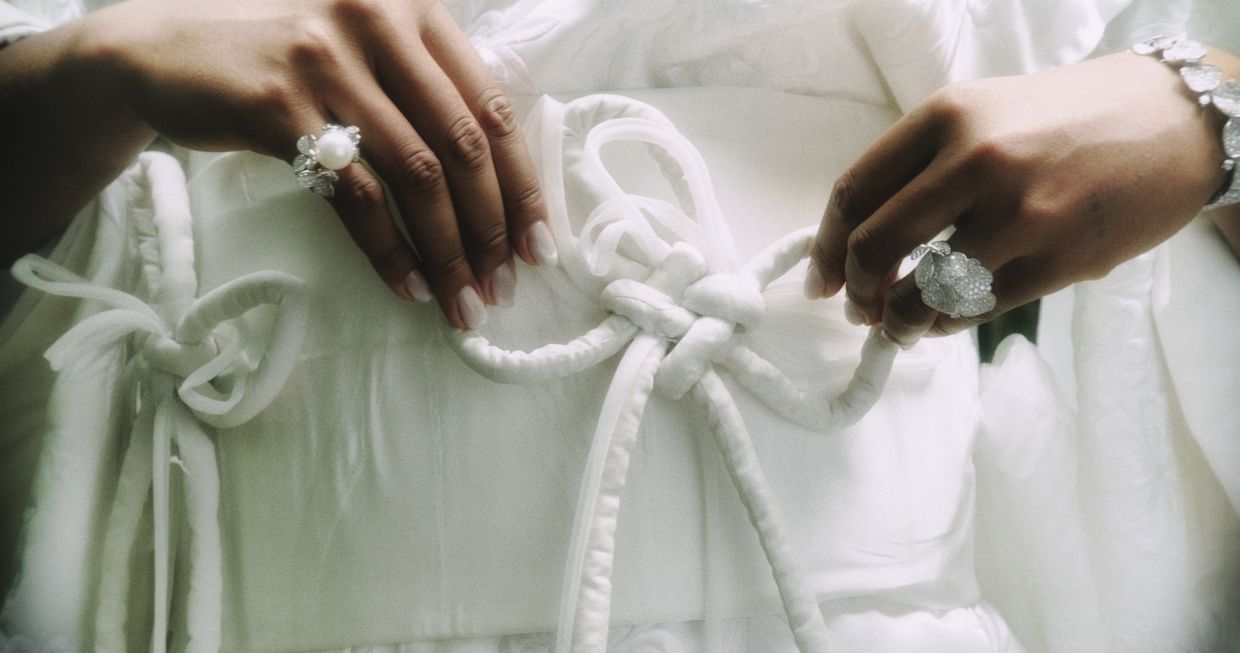
Tennis fans attending Wimbledon were treated to more than competitive athleticism when Naomi Osaka made her entrance. The 14th-seeded former world number one arrived on day one in an all-white creation by Hana Yagi, a Tokyo-based independent Japanese designer, transforming the tournament walk-on into a carefully orchestrated cultural moment. Despite navigating a foot injury that threatened her participation, Osaka demonstrated that her commitment to sartorial innovation extends beyond traditional boundaries of sports fashion.
The dress itself told a story rooted in Japanese tradition and contemporary design. Titled "Evolving Ceremony," the creation drew inspiration from the kimono and the junihitoe, a twelve-layer ceremonial robe worn by noblewomen during Japan's Heian period spanning from 794 to 1185. What made this piece particularly distinctive was its construction: Yagi fashioned the gown from seven different textiles sourced from vintage kimonos, a traditional shiromuku wedding dress, and a deconstructed wedding ensemble. This approach aligned perfectly with Osaka's broader interest in sustainable fashion practices, ensuring that historical garments received new life rather than remaining dormant in storage.
The complementary Nike performance dress worn beneath added another layer of cultural significance. Its design incorporated Japanese kirigami motifs through floral appliques, micro-pleating, and a curved hemline that referenced the ancient paper-cutting art form. The piece resonated so strongly with audiences that it sold out before the tournament even commenced, indicating that Osaka's fashion choices carry commercial weight alongside their artistic merit. Completing the ensemble were pearls from Mikimoto, the venerated Japanese jeweller whose heritage and global reputation reinforced the unified aesthetic vision.
Osaka's statement accompanying her outfit revealed the deliberate philosophy underpinning these choices. She described her collaboration with Yagi as an opportunity to "celebrate Japanese history and craftsmanship while creating something that feels entirely modern," emphasizing that the design achieved a balance between power and delicacy. The emphasis on movement proved crucial, as the garment needed to function as both a visually stunning entrance piece and a practical competition outfit. This duality separated Osaka's approach from purely decorative runway fashion, requiring engineering ingenuity to match aesthetic ambition.
This Wimbledon appearance represents the latest chapter in a narrative that began six months earlier at the Australian Open in Melbourne. There, Osaka emerged in a Robert Wun gown fashioned to resemble a jellyfish, accompanied by a butterfly-adorned hat that suggested transformation and her identity as a young mother. When she took the court, she shed the formal outer layer, revealing her competition attire. The French Open followed with a black corset and voluminous ballgown skirt by Kevin Germanier, created as homage to the Eiffel Tower and constructed from upcycled Nike kits that Osaka had previously worn. These three consecutive tournament appearances establish a coherent artistic arc rather than isolated fashion moments.
Viewers observing all three looks simultaneously can discern several interconnected themes that reveal Osaka's broader strategic vision. Sustainability emerges as a primary concern, with each outfit incorporating recycled materials or vintage garments that might otherwise remain unused. This aligns with growing expectations among younger athletes and consumers that brands and public figures demonstrate environmental responsibility. More provocatively, Osaka uses her tournament platform to elevate emerging talent, deliberately partnering with designers who lack the international recognition of established fashion houses. Her stylist, Marty Harper, articulated this philosophy explicitly, describing the approach as providing "voices to new kids on the block."
Yagi's background exemplifies this commitment to emerging creatives. Still in her twenties, the Tokyo-born designer founded her company after achieving finalist status in the International Talent Support competition held in Italy in 2019. By selecting Yagi for Wimbledon, Osaka offered the young designer exposure to millions of television viewers and global media coverage, effectively serving as both client and career catalyst. This generosity toward less-established talent distinguishes Osaka's approach from competitors like Jannik Sinner, who leverage established brand ambassadorships with major fashion houses.
The practical engineering required to execute Osaka's vision often escapes public notice but deserves recognition for its sophistication. Tournament organizers permit roughly three minutes for dressing and less than one minute for undressing, creating severe temporal constraints that most designers never encounter. Yagi solved this challenge through meticulous construction: she engineered nine distinct segments of the Wimbledon dress to separate and recombine using Velcro fasteners. This ingenious solution allowed the dress to adapt as Osaka progressed through the tournament, with each component capable of adjustment or removal as circumstances demanded.
The dress incorporated additional practical considerations that reflected deep knowledge of tournament logistics. An adjustable train extending nearly ten feet could be modified based on whether Osaka played on centre court or outer courts. This detail matters considerably at Wimbledon, where the distance from outer courts to the players' lounge could potentially damage delicate materials during transit. Such forward-planning distinguishes haute couture created for runway spectacle from performance clothing designed for athletic use, requiring Yagi to balance artistic vision with professional pragmatism.
For Malaysian and regional audiences, Osaka's approach offers instructive lessons about personal branding and cultural representation in globalized sports. As an athlete of mixed Japanese and Haitian heritage, Osaka has consistently used public platforms to affirm her identities and support underrepresented communities. Her fashion choices extend this commitment by celebrating Japanese artistic traditions and supporting Asian designers who might lack access to international visibility. In Southeast Asia, where numerous talented designers and artisans remain comparatively unknown globally, Osaka's model of strategic patronage demonstrates how individuals with substantial platform reach can democratize fashion industry access.
The competitive results of individual tournaments matter less to Osaka's fashion narrative than the attention she captures before competition begins. Regardless of how she performs against opponents on the court, her tunnel walk ensures that she dominates media conversation and public imagination through costume and aesthetic presentation. This represents a conscious decision to control narrative through garment rather than permit tournament outcomes to define her public image. In an era where social media amplifies visual content far more dramatically than match statistics, Osaka's strategic deployment of fashion functions as shrewd personal brand management.
Osaka's evolution as a style innovator reflects broader transformations within professional tennis, where players increasingly recognize that competition appearances offer opportunities for self-expression extending beyond athletic performance. Where previous generations of players viewed tournament clothing primarily as functional requirements or brand sponsorship obligations, contemporary athletes understand that entrance moments provide potent platforms for messaging and identity assertion. Osaka's sustained commitment to this approach, implemented across multiple Grand Slam tournaments and refined through collaboration with her stylist Marty Harper, establishes her as the sport's most sophisticated practitioner of fashion as competitive strategy.

