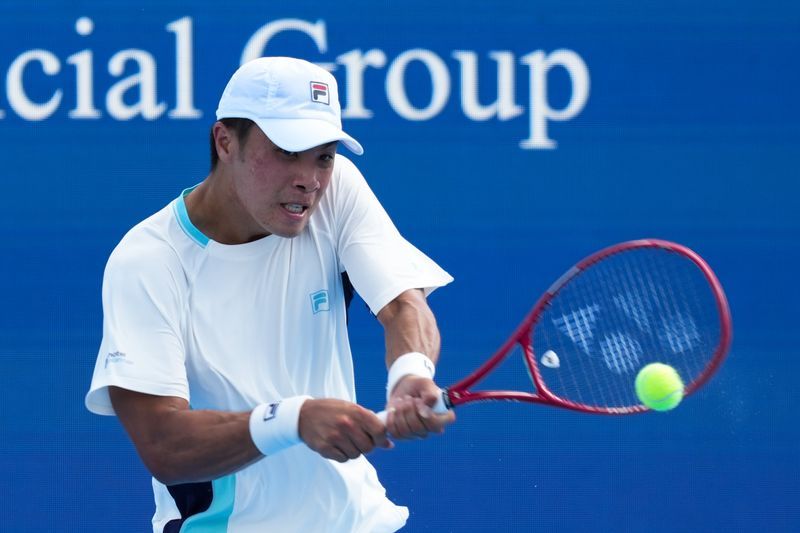
Brandon Nakashima continued his remarkable ascent through the professional tennis ranks on Friday, overcoming American sixth seed Taylor Fritz 7-6(9) 4-6 6-3 in Cincinnati to secure his place in the semifinals of the Masters 1000 event. The 25-year-old's come-from-behind victory represents another significant milestone in what has become a defining stretch of his career, as he now stands on the precipice of consecutive deep runs at tennis's elite level.
Nakashima's achievement marks only his second consecutive appearance in the final four of a Masters 1000 tournament, following his breakthrough run in Montreal the previous week. This consecutive qualification underscores the consistency and mental fortitude he has demonstrated on the North American hard-court circuit—a region that has historically served as both a testing ground and launching pad for American players seeking major tournament success. With the U.S. Open looming later in August, Nakashima appears to be hitting precisely the right form at the moment when it matters most for his domestic standing and Grand Slam aspirations.
The match itself proved to be a fascinating tactical battle between two Americans seeking different objectives. Entering their head-to-head encounters, Nakashima carried a decidedly unfavourable 1-4 record against Fritz, suggesting the Cincinnati contest represented an opportunity to prove his capacity to overcome established rivals. The opening set exemplified the calibre of serving and baseline stability both players could muster, with neither competitor willing to surrender serve through twelve games of concentrated tennis. This defensive stalemate ultimately necessitated a tiebreak to determine the set winner, a format that often decides matches between evenly matched opponents.
The tiebreak itself evolved into a protracted battle of wills and execution. After multiple exchanges of mini-breaks and shifts in momentum, Nakashima finally converted his fifth set point when Fritz's return went fractionally beyond the baseline—a narrow margin that nonetheless proved decisive in a tight opening frame. Having captured the first set, Nakashima appeared positioned for potential momentum, yet Fritz responded with precisely the aggressive intensity the situation demanded. The sixth seed's returning game became particularly incisive as he broke Nakashima early in the second set, then consolidated his advantage by closing out the frame with an ace, forcing the confrontation into a final set where anything remained possible.
The deciding set witnessed a dramatic swing in control and fortune. Fritz, having gained psychological momentum from levelling the match, capitalised on some unforced errors from Nakashima to establish a commanding 3-2 lead while holding serve. At that juncture, Fritz held multiple pathways to victory, and conventional wisdom suggested his experience and position favoured him heavily. However, Nakashima demonstrated the mental resilience increasingly characteristic of his improved performances. Facing a 30-0 deficit in a critical game, he clawed back to manufacture his second break-point opportunity of the match and executed it flawlessly, immediately restoring parity at 3-3.
From that pivotal moment onward, the momentum shifted decisively in Nakashima's favour. Fritz's unforced error count climbed as his opponent's confidence blossomed, and the 27th seed proved unable to recover the initiative. Nakashima then simply ran out the remaining games, demonstrating the aggressive finishing that has become his hallmark during this career-best sequence. The capacity to close out matches without offering opponents escape routes represents a crucial evolution in his game, distinguishing him from earlier versions of his player profile that sometimes faltered when victory approached.
This victory extends what Nakashima can legitimately claim as the finest stretch of his professional career. He has now notched four top-10 victories during the 2024 season, a tally that reflects both his dramatic improvement against elite-ranked opponents and his enhanced consistency across multiple surfaces and tournament contexts. For Southeast Asian and broader Asian tennis observers, Nakashima's rise carries particular significance, as it demonstrates the emerging depth of American tennis talent competing at the sport's highest levels. His pathway from promising prospect to genuine threat at Masters and Grand Slam events provides a model of the development trajectory increasingly common among younger American professionals.
Nakashima's opponent in the Cincinnati semifinals will be determined by the match between Italian 10th seed Lorenzo Musetti and fellow American Frances Tiafoe. Either opponent would represent a substantial challenge, yet Nakashima's current form and confidence suggest he arrives at that encounter as a legitimate threat to advance further. The Italian brings technical refinement and crafted court sense, while Tiafoe possesses explosive physicality and aggressive tendencies—contrasting styles that would each present different problems for Nakashima to solve tactically.
Looking forward, Nakashima's recent performances have implications extending beyond Cincinnati itself. The U.S. Open, commencing later in August, represents the season's final Grand Slam and provides American players with particular home-court advantages in terms of crowd support, travel logistics, and familiarity with the venue. Should Nakashima maintain his current trajectory through the final hard-court events before Flushing Meadows, he could arrive at his domestic major championship operating at peak competitive levels. His demonstrated capacity to overcome adversity, convert break points in critical moments, and sustain focus through gruelling three-set matches suggests he possesses the essential attributes for extended Grand Slam runs.

