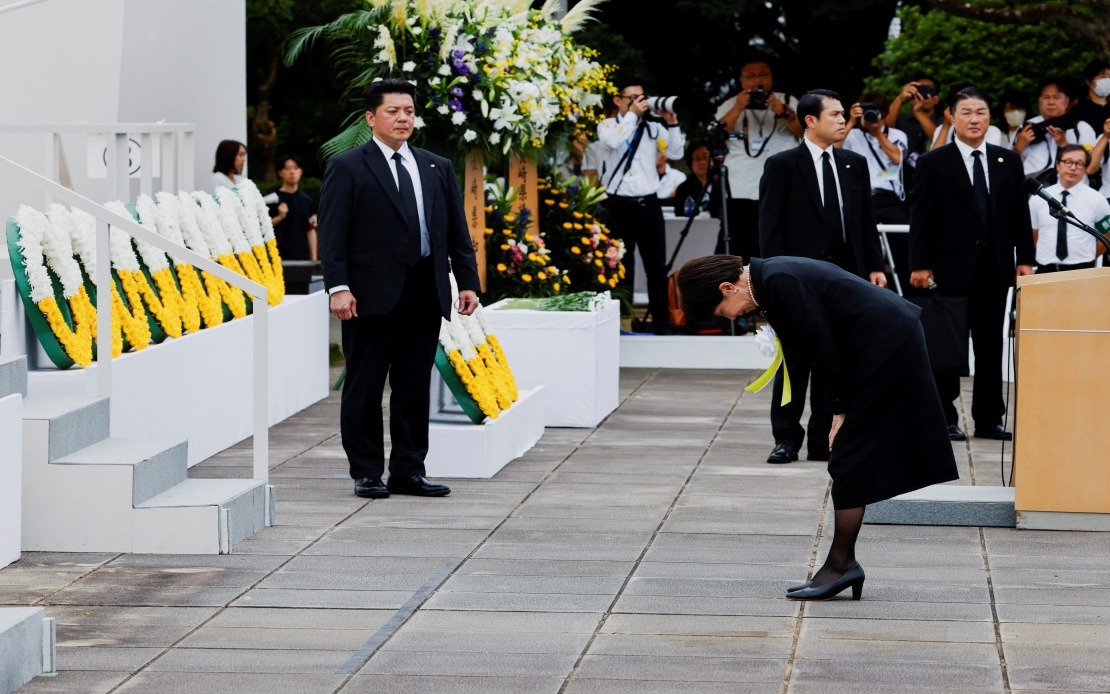
Nagasaki marked another solemn anniversary on Sunday, commemorating eight decades since the United States dropped an atomic bomb on the southwestern Japanese city in 1945, an event that claimed approximately 74,000 lives by year's end and left countless others grappling with lifelong consequences. The ceremony took place against a backdrop of intensifying international discussions about nuclear weapons and deterrence, driven by contemporary geopolitical instability and growing concerns over nuclear proliferation in an increasingly fractured world order.
At 11:02 a.m., the precise moment when the plutonium-based device known as "Fat Man" detonated over Nagasaki—just three days following the destruction of Hiroshima—participants observed a solemn silence to honour the victims. Nagasaki remains the only populated area ever subjected to nuclear attack, a distinction that has shaped Japan's historical relationship with nuclear weapons and informed its pacifist post-war orientation for nearly eight decades.
Mayor Shiro Suzuki used the occasion to call upon global leaders to prioritise nuclear disarmament and abandon weapons that threaten human survival. His remarks underscored a fundamental position held by Japanese leadership since 1945: that peaceful coexistence with nuclear arsenals remains impossible. This messaging resonates deeply within Japan's political discourse, where the atomic bombings occupy sacred ground in national memory and identity.
Prime Minister Sanae Takaichi attended the ceremony to represent the government, while UN Secretary-General António Guterres contributed a statement acknowledging the significance of the commemoration. The presence of high-level officials reflected Japan's continued commitment to honouring atomic bomb victims and advancing international disarmament agendas, even as the political consensus around these positions faces unprecedented strain.
Yet beneath the ceremonial unity lies a contentious policy debate that has gradually emerged within Japan's leadership. The nation's three non-nuclear principles—prohibitions on producing, possessing, or allowing nuclear weapons on Japanese soil—have guided defence policy since the 1960s. However, escalating regional tensions, particularly involving China's military expansion and North Korea's weapons development, have prompted some politicians and defence strategists to question whether these principles remain tenable. Following Hiroshima's commemoration earlier in the week, Prime Minister Takaichi reaffirmed that the government continues "upholding" this policy, yet the careful wording suggests ongoing deliberation rather than absolute conviction.
The broader international context underscores why this debate has resurfaced with such urgency. In May, the Nuclear Non-Proliferation Treaty review conference—typically convened every five years to assess global nuclear disarmament progress—concluded without achieving consensus for the third consecutive time following extended negotiations in New York. This failure reflects deeper fractures in the international order, with nuclear-armed states prioritising strategic calculations over non-proliferation commitments and nations pursuing deterrent capabilities amid security dilemmas.
For Southeast Asian nations including Malaysia, Japan's nuclear policy trajectory carries significant implications. As a regional economic and military anchor, Japan's potential abandonment of its non-nuclear stance could trigger security competition dynamics throughout East and Southeast Asia. Such a shift might encourage other Japanese allies or regional powers to pursue independent nuclear capabilities, destabilising the strategic equilibrium that has underwritten regional prosperity and prevented major-power confrontation.
The ageing population of hibakusha—officially recognised atomic bomb survivors now averaging over 86 years old—intensifies the urgency surrounding both memory preservation and disarmament advocacy. These survivors and their advocates face a race against time to transmit first-hand testimonies to younger generations before this crucial living link to nuclear war's humanitarian consequences vanishes. Their efforts represent a moral counterweight to strategic arguments for nuclear deterrence, grounding abstract defence debates in human suffering and radioactive devastation.
Nagasaki's commemoration each August embodies this tension: a nation honouring its victims while simultaneously reconsidering the weapons policies that stemmed directly from those victims' sacrifice. The 81st anniversary occurs at a pivotal moment, with Japan's political establishment subtly repositioning itself on nuclear weapons amid international pressure, regional threats, and evolving alliance dynamics. Whether this year's ceremony marks an inflection point toward policy revision or merely reflects ongoing internal tensions remains uncertain, but the trajectory suggests Japan's post-war nuclear exceptionalism increasingly faces challenges that transcend commemoration and enter the realm of pragmatic statecraft.

