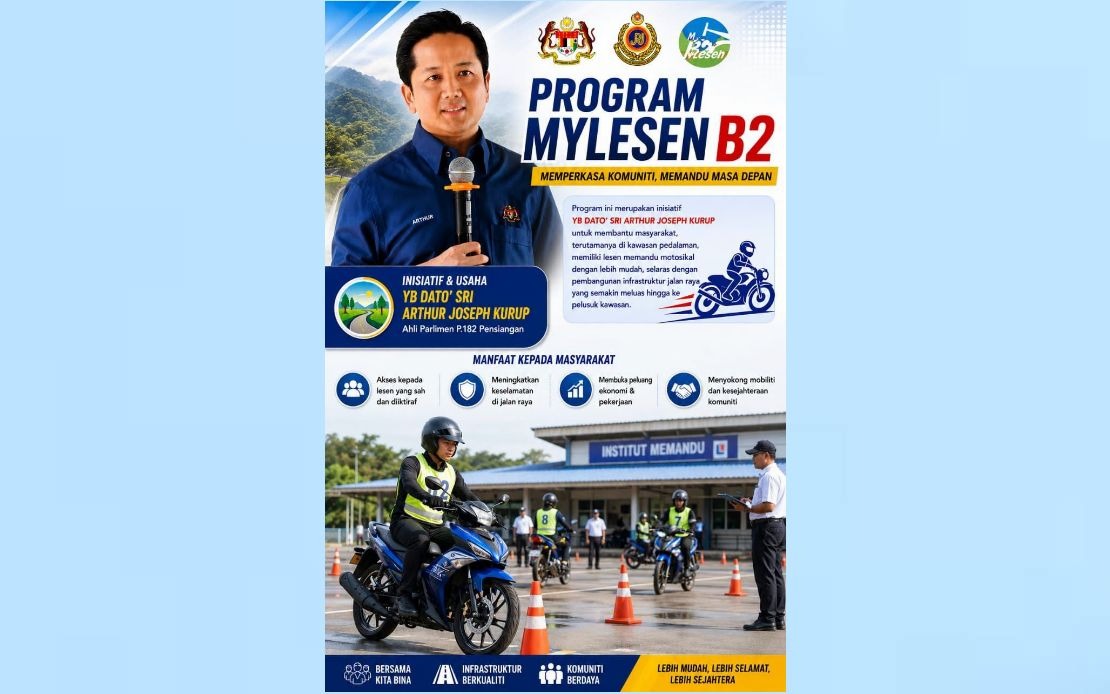
The MyLesen B2 programme has resumed operations in Pensiangan, Sabah, marking a renewed push to bring formal motorcycle licensing services to rural communities across the state. The initiative addresses a persistent challenge in Malaysian rural areas, where residents must often undertake costly and time-consuming journeys to urban centres to complete licensing requirements. By establishing testing and training facilities locally, the programme seeks to remove barriers that have historically prevented many rural Malaysians from obtaining valid riding credentials.
Pensiangan Member of Parliament Datuk Seri Arthur Joseph Kurup, who also serves as Natural Resources and Environmental Sustainability Minister, emphasised the programme's significance for the constituent. Speaking on the initiative's launch, Kurup highlighted how bringing licensing services directly to rural residents would eliminate the need for lengthy trips to driving schools in larger towns and cities. This decentralisation of licensing infrastructure reflects a broader recognition among policymakers that geographic accessibility remains a critical factor determining compliance with road safety regulations across Malaysia's dispersed populations.
The programme maintains rigorous standards despite its convenience factor. Participants will still be required to complete mandatory motorcycle handling courses and pass prescribed examinations before receiving their licences. This insistence on proper training and testing ensures that the initiative does not represent a shortcut but rather a genuine commitment to equipping riders with the knowledge and skills necessary for safe road use. By combining accessibility with educational rigour, the scheme attempts to build a foundation of competent riders within rural communities rather than simply processing paperwork.
Educational components form a central pillar of MyLesen B2's approach. Beyond practical and technical riding skills, participants will receive instruction on road traffic laws and regulations applicable throughout Malaysia. This knowledge-building element is particularly significant for rural communities where informal or unlicensed riding practices may be more prevalent. By formalising riders' understanding of traffic rules and safety protocols, the programme contributes to a gradual cultural shift toward greater road safety awareness in areas where such initiatives can have outsized impact.
The eligibility criteria cast a wide net across the rural population. Residents aged between 16 and 63 may participate, with particular emphasis on individuals who have never previously held a valid driving licence. This focus on first-time licence holders recognises that many rural Malaysians may ride motorcycles without formal qualifications, and the programme offers them an opportunity to regularise their status while gaining proper training. For younger participants, obtaining a licence early can facilitate better long-term habits around road safety and legal compliance.
Beyond safety considerations, Kurup identified economic dimensions to the programme. A valid motorcycle licence opens employment doors for rural residents, particularly young adults seeking work opportunities. In regions where motorcycles serve as primary transportation for accessing employment, education, and services, the licence becomes a practical prerequisite for economic participation. This economic angle suggests that road safety and livelihood support are intertwined issues in Malaysia's rural development agenda.
The permanence of the qualification represents another appeal of the scheme. Unlike temporary permits or informal arrangements, the MyLesen B2 licence remains valid for lifelong use provided holders comply with ongoing regulatory requirements. This stability offers recipients a secure credential that will not expire or lose relevance, providing long-term confidence for their mobility and employment prospects. For many rural residents accustomed to economic uncertainty, such permanence carries particular value.
Logistical accessibility has been prioritised to maximise participation. Registration forms are available at the Pensiangan Parliamentary Service Centre and the Sook State Assemblyman's Service Centre, placing initial contact points within existing community infrastructure. This distribution through established government service channels ensures that residents can access information through familiar institutional networks rather than navigating unfamiliar bureaucratic pathways.
The return of MyLesen B2 to Pensiangan reflects a broader Malaysian policy interest in expanding road safety infrastructure into underserved areas. Sabah's geographic challenges, including distance between population centres and limited urban concentration, make such decentralised programmes particularly relevant. Other Malaysian states with significant rural populations may observe Pensiangan's experience as a potential model for similar initiatives.
Road safety statistics in rural Malaysia have historically shown higher accident rates and fatality figures compared to urban areas, often correlated with lower licensing compliance and reduced formal training among riders. By directly addressing licensing accessibility, the MyLesen B2 programme targets a root cause of these patterns. The combination of convenience, proper training, and emphasis on legal compliance creates conditions conducive to improved road safety outcomes.
For youth in particular, the programme carries significance as an employment enabler. Rural young people seeking opportunities in sectors ranging from delivery services to construction often require valid motorcycle licences. By removing geographic barriers to licensing, MyLesen B2 supports youth employment aspirations while simultaneously building the road safety skills necessary to protect these new riders from injury.
The sustainability of this initiative will partly depend on whether local infrastructure and human resources can be maintained beyond initial rollout phases. Training facilities, examiners, and administrative staff must be sustained to ensure the programme remains operational and responsive to community demand. Long-term success will also require monitoring accident rates and compliance patterns among licence holders to determine whether the accessibility benefits translate into tangible safety improvements.

