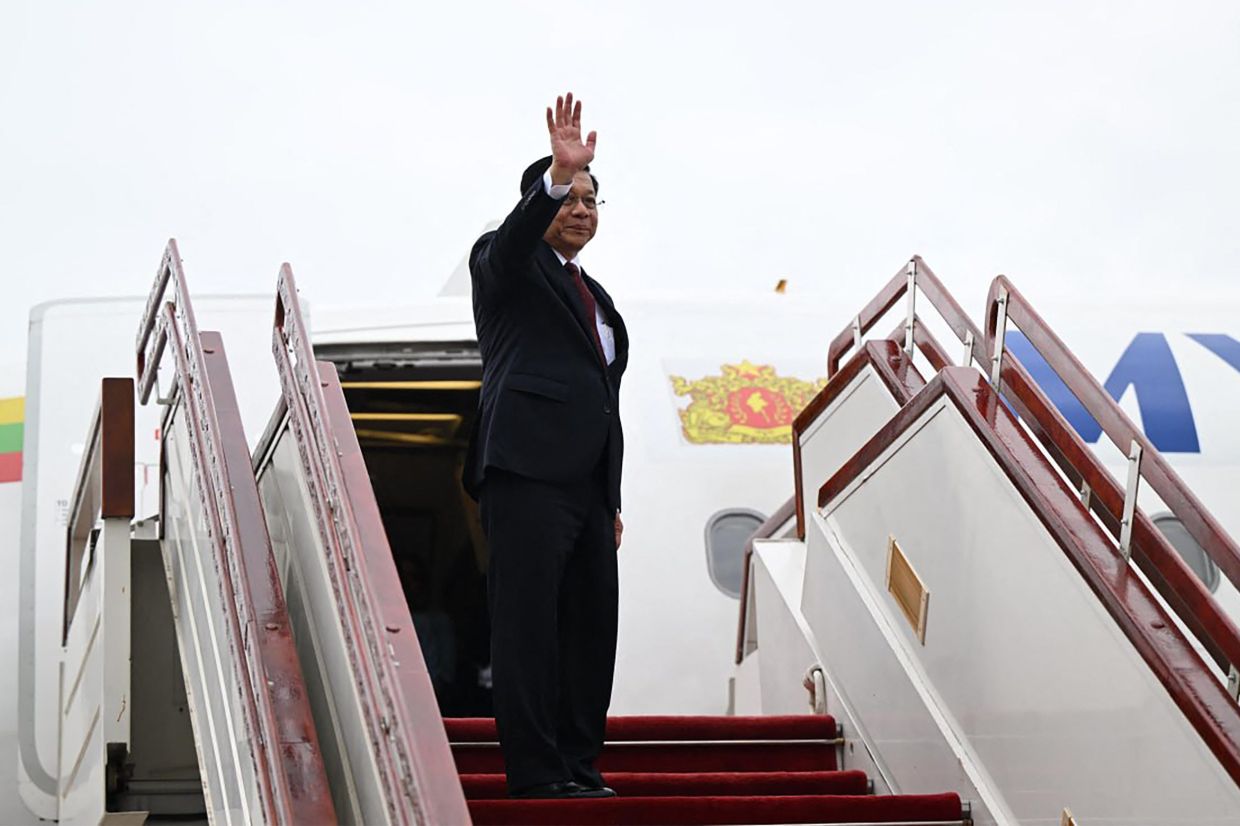
Myanmar's military-backed leader Min Aung Hlaing set off for Moscow on Monday to hold talks with President Vladimir Putin, in what officials describe as an effort to cement strategic partnerships between the two nations. The visit represents the first time the former junta chief has travelled to the Russian capital since assuming the civilian presidency earlier this year, underscoring the geopolitical realignment taking place in Southeast Asia as Myanmar seeks international rehabilitation following its contentious 2021 coup.
Russia has emerged as one of the few prominent international actors willing to maintain close relations with Myanmar after the military overthrew the democratically elected government of Aung San Suu Kyi in February that year. The intervention triggered a protracted internal conflict that has devastated the country's infrastructure and social fabric, with casualty estimates exceeding 100,000 deaths as various armed groups clash with government forces. Moscow's diplomatic support has proven valuable to Naypyidaw at a moment when Western capitals and regional democracies have imposed sanctions and expressed deep disapproval of the junta's actions.
Min Aung Hlaing's appointment as president in April followed elections widely denounced as choreographed theatre designed to legitimise military rule under a democratic veneer. Democracy advocates and international observers from Western nations dismissed the electoral process as fundamentally compromised, citing restrictions on voter participation, control over ballot access, and constraints on independent scrutiny. Nevertheless, the Myanmar military hierarchy proceeded with the installation, presenting it as a restoration of civilian governance while maintaining ultimate authority through overlapping command structures.
The presidency released a statement framing the Moscow engagement as essential for consolidating existing bonds and expanding collaboration across multiple domains, particularly in defence procurement and commercial exchange. Russia's military-industrial complex has long supplied sophisticated weaponry to Myanmar's armed forces, including jet fighters that have been deployed in operations targeting resistance factions scattered across the country's borderlands. International human rights organisations have documented allegations that these aircraft have been utilised in strikes affecting civilian populations, raising serious questions about compliance with international humanitarian law.
The two nations formalised their military partnership through a five-year cooperation agreement signed in February, though the specifics of the arrangement remain largely opaque to external observers. This framework establishes a foundation for expanded defence ties that could include training initiatives, intelligence sharing, and modernisation of Myanmar's military capabilities. For Moscow, the relationship offers a foothold in Southeast Asia and diversifies its international partnerships at a time when Western sanctions restrict collaboration with traditional partners.
During his visit, Min Aung Hlaing will engage with several high-ranking Russian officials beyond Putin, including Prime Minister Mikhail Mishustin and Vyacheslav Volodin, the speaker of the State Duma, Russia's lower parliamentary chamber. These meetings signal the breadth of Myanmar's outreach, touching defence, economic, and legislative dimensions of bilateral relations. Additionally, the delegation will participate in a Myanmar-Russia economic forum designed to explore commercial opportunities and potentially attract Russian investment into Myanmar's resource-rich sectors, from natural gas to timber and minerals.
Min Aung Hlaing's extensive travels since April reveal a deliberate strategy to restore Myanmar's standing on the international stage despite the coup's illegitimacy in the eyes of democratic governments. His itinerary has included visits to China, India, and Thailand, reflecting an effort to cultivate relationships across Asia's major powers while demonstrating that Myanmar remains relevant to regional architecture. Thailand's proximity and historical ties make it a natural partner, while India and China represent crucial economic and security anchors for mainland Southeast Asia's development trajectory.
The wider context of these diplomatic manoeuvres reflects growing competition among global powers for influence in Myanmar, a country positioned at the intersection of South Asian and Southeast Asian geopolitics. China has maintained engagement with the military regime, viewing stability in Myanmar as essential to its Belt and Road Initiative aspirations and regional security concerns. India, conversely, has balanced criticism of the coup with pragmatic security and energy partnerships. Russia's involvement adds another layer of complexity, potentially complicating coordinated international pressure for democratic restoration or accountability for alleged war crimes.
For Malaysia and other Southeast Asian nations observing these developments, Myanmar's realignment toward authoritarian international partners raises concerns about regional stability and the Association of Southeast Asian Nations' principles regarding non-interference and respect for democratic governance. The country's ongoing civil conflict generates refugee flows into neighbouring territories and destabilises cross-border trade networks. Russia's deepening military engagement with Myanmar's junta carries implications for the region's military balance and could influence arms procurement decisions by other regional actors seeking to maintain their competitive position.
The humanitarian dimension remains deeply troubling amid these geopolitical calculations. The Myanmar military's use of Russian equipment in operations that human rights monitors allege constitute war crimes underscores the moral dimensions of international arms transfers. With over 100,000 deaths already recorded and millions internally displaced or seeking refuge, the trajectory of external military support to Naypyidaw directly affects civilian welfare and the prospects for eventual peace negotiations. Russia's continued backing potentially extends the conflict's duration by bolstering the regime's military capabilities and international legitimacy.

