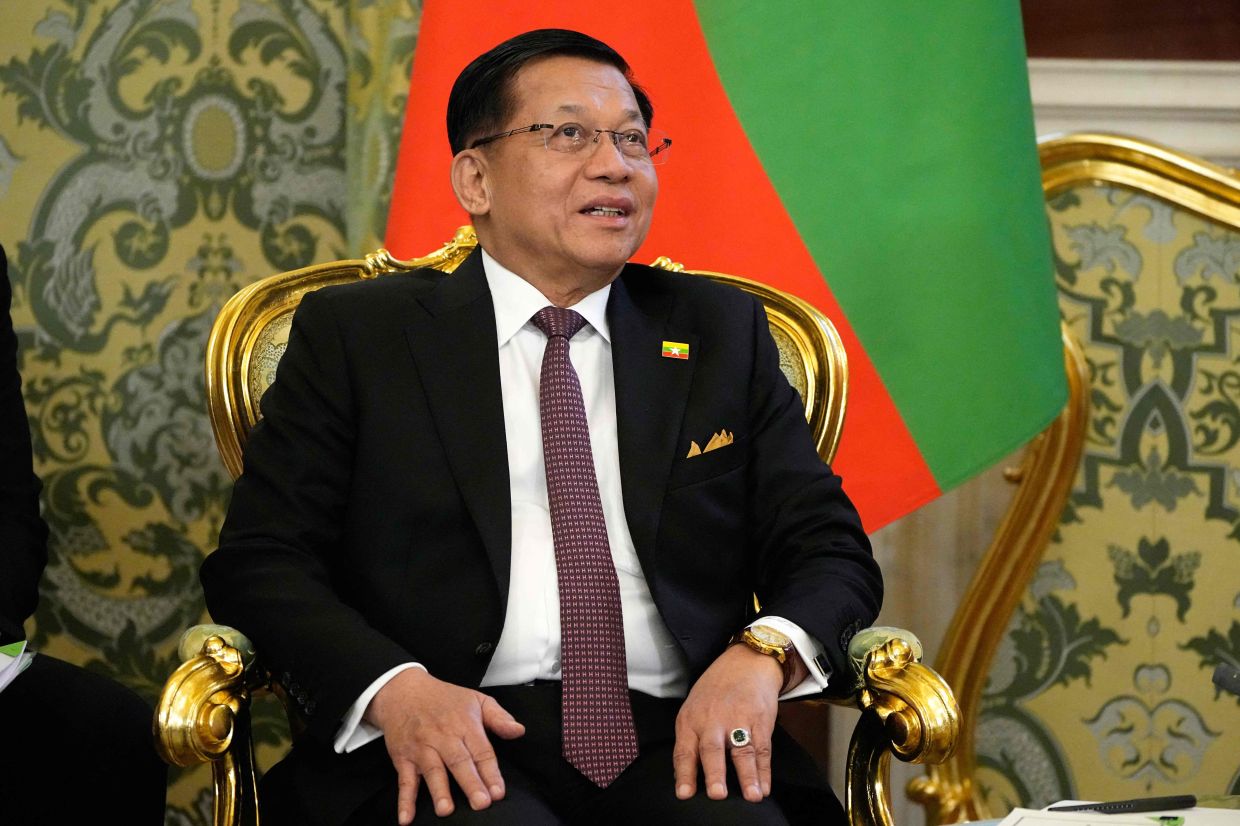
Myanmar's military chief Min Aung Hlaing is preparing for an official journey to Cambodia next month, marking another step in what observers describe as a systematic effort to secure international credibility for his leadership. Cambodian authorities confirmed the early September trip, framing it as a diplomatic initiative designed to deepen ties between Phnom Penh and Naypyidaw. Officials including Kuy Sophal, Minister of the Royal Palace, have begun site inspections for hosting the visitor, with Senate spokesperson Chea Thyrith emphasising that the visit aims to reinforce bilateral friendship and foster mutually advantageous cooperation.
The Myanmar leader's itinerary reflects an intensifying campaign of regional diplomacy that has grown more pronounced since his contested election to the presidency in April. Prior to the Cambodian visit, Min Aung Hlaing has already traversed much of Asia, calling on India, China, Laos, Thailand and Russia—each engagement carefully orchestrated to project an image of normalcy and international acceptance. However, this diplomatic offensive has sparked considerable unease among human rights advocates and democracy campaigners across Southeast Asia and beyond, who view the tour as fundamentally about polishing the image of a leader whose authority rests entirely on military force.
The international controversy surrounding Min Aung Hlaing's presidency stems from events that shattered Myanmar's fragile democratic experiment. In February 2021, his military seized power through a coup that toppled Aung San Suu Kyi, the country's most prominent democracy leader and former State Counsellor. Her subsequent detention, along with that of thousands of activists and political dissidents, has become a defining feature of his rule. Human rights organisations have documented systematic abuses and extrajudicial actions under the military regime, a record that sits uncomfortably with the legitimacy narrative these foreign visits attempt to construct.
The April election that formally elevated Min Aung Hlaing to the presidency was widely dismissed by international observers as deeply compromised. Critics have noted that the electoral process lacked genuine competition, transparent procedures, or meaningful participation from pro-democracy forces, rendering the entire exercise a façade rather than a genuine democratic exercise. Yet by embarking on these high-profile foreign visits, the Myanmar leader appears to be testing whether sufficient diplomatic engagement can gradually normalise his government's standing, at least among neighbouring states and major powers less inclined to press human rights concerns.
Cambodia's willingness to host Min Aung Hlaing carries particular symbolism within Southeast Asia's political landscape. As a nation that itself navigated through conflict and attempted to rebuild national consensus, Cambodia occupies a unique position in the region's unfolding Myanmar crisis. Kin Phea, president of the International Relations Institute of Cambodia, suggests that the upcoming visit represents a reciprocal effort to strengthen bilateral relations, noting that Cambodia's 2022 tenure as Asean chair included attempts to mediate Myanmar's internal political tensions. Phea argues that such engagement need not necessarily represent blanket endorsement, but rather reflects pragmatic regional diplomacy.
Phea's analysis provides important nuance to understanding how Southeast Asian governments are responding to Myanmar's current predicament. He posits that Cambodia could potentially share insights from its own post-conflict recovery experience, drawing on lessons about reconciliation, institution-building, and social cohesion. However, he carefully notes that Myanmar's trajectory ultimately depends on decisions made within Myanmar itself rather than through external engagement. International visits and friendly rhetoric from neighbours, in this interpretation, cannot substitute for genuine internal reforms and credible commitments to human rights protection.
The broader regional framework governing Myanmar's status remains the Asean five-point consensus, a diplomatic blueprint adopted in 2021 that established conditions for Myanmar's eventual reintegration into full Asean activities, particularly attendance at the organisation's flagship summit meetings. This agreement essentially holds that Myanmar's military government must demonstrate tangible progress on ending violence, establishing dialogue with opposition elements, providing humanitarian assistance, and accepting Asean mediation. Individual countries' bilateral visits with Myanmar's leader do not alter this regional consensus or create independent pathways to legitimacy.
Phea explicitly cautions that Cambodia's diplomatic engagement with Min Aung Hlaing should not be misinterpreted as an attempt to bypass or circumvent the five-point consensus. The distinction matters considerably because it clarifies that even as Southeast Asian nations maintain practical diplomatic relationships with Myanmar's current authorities, such engagement operates within constraints imposed by collective Asean decisions. Any formal restoration of Myanmar's participation in regional summits requires consensus or near-consensus among all ten Asean members, a threshold that remains unmet given the junta's resistance to implementing agreed commitments.
For Malaysia and other Southeast Asian observers, Min Aung Hlaing's Cambodia visit exemplifies the delicate balancing act that the region faces regarding Myanmar. The country's geopolitical importance, combined with Asean's non-interference doctrine, creates pressures to maintain diplomatic channels open even with governments whose internal practices are deeply problematic. Yet doing so risks appearing to endorse or normalise an authoritarian military regime while underlying grievances—political detention, suppressed freedoms, and unresolved humanitarian crises—persist unaddressed. Malaysia, which has often adopted stronger critical positions toward Myanmar's junta compared to some neighbouring states, watches closely to gauge whether Cambodia's hospitality represents genuine engagement or inadvertently strengthens the military leader's legitimacy claims.
The timing of these visits also carries strategic weight. As Myanmar's junta consolidates control domestically through repression and seeks to reduce international isolation through selective engagement, regional governments must calculate whether incremental normalisation might eventually encourage genuine reform, or whether it simply enables entrenchment of authoritarian rule. Cambodia's September reception of Min Aung Hlaing will inevitably feature in this broader calculation, particularly among Southeast Asian states and international observers concerned about Myanmar's democratic prospects. Whether this visit genuinely advances bilateral cooperation or primarily serves the military leader's legitimacy agenda remains contested terrain within regional diplomatic circles.

