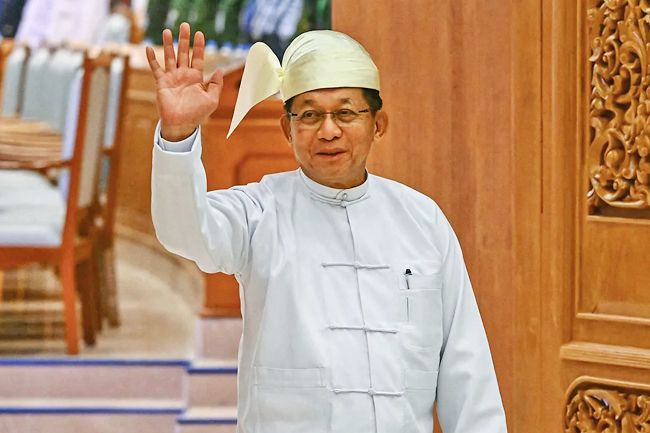
Myanmar's military leader Min Aung Hlaing is scheduled to visit Bangkok next month for talks with Thai Prime Minister Anutin Charnvirakul on August 6 and 7, Thailand's foreign minister revealed on Tuesday. The planned engagement signals Thailand's continued diplomatic efforts to bring the military-ruled nation back into substantive ASEAN dialogue, a stance that reflects Bangkok's unique position as a neighbour hosting millions of Myanmar refugees and facing direct security implications from the country's ongoing internal conflict.
Thailand's Foreign Minister Sihasak Phuangketkeow confirmed the visit after participating in discussions with ASEAN counterparts in Manila, where he described conversations regarding Myanmar's status within the bloc as "frank and candid." The meeting comes at a critical juncture for the regional organization, which remains fractured over how to address a member state ruled by a military junta that seized power in 2021, overturning the democratically elected government of Aung San Suu Kyi. This fundamental disagreement has created a pronounced fissure within ASEAN's traditionally consensus-based decision-making framework.
Myanmar technically retains ASEAN membership, yet it has been systematically excluded from the bloc's principal gatherings and diplomatic events since the coup. This hybrid status—remaining a member while being sidelined from key forums—reflects ASEAN's struggle to balance its commitment to non-interference with mounting pressure from some member states and international partners to hold Myanmar accountable for the military takeover. The exclusion represents an unprecedented challenge to the organization's cohesion and credibility as a unified political voice in Southeast Asia.
Thailand's advocacy for Myanmar's reintegration stems largely from geographical and humanitarian realities that other ASEAN members do not face with the same immediacy. Bangkok shares an extensive border with Myanmar and hosts a significant refugee population displaced by the country's ongoing civil conflict. These circumstances create direct security challenges for Thailand, including transnational criminal networks, drug trafficking operations, and human trafficking rings that exploit the porous border region. Thai policymakers argue that constructive engagement offers a pathway to addressing these pressing issues more effectively than continued isolation.
Sihasak articulated Thailand's approach as a "dual-track strategy," acknowledging both bilateral concerns and broader ASEAN peace objectives. The foreign minister emphasized that Thailand intends to address practical transnational threats—organized crime, online scams, and narcotics trafficking—through direct engagement with Myanmar's leadership. These are not abstract diplomatic concerns but concrete security issues affecting Thai citizens and regional stability. The bilateral dimension offers immediate, tangible benefits that may be achievable in the near term.
However, Sihasak stressed that this pragmatic engagement does not represent an abandonment of ASEAN's longstanding five-point peace consensus, which calls for dialogue, humanitarian assistance, and political rehabilitation. The foreign minister signalled that Bangkok is attempting to navigate a difficult middle path—advancing practical cooperation while nominally maintaining support for ASEAN's formal peace framework. This balancing act reflects the inherent tension between immediate security interests and longer-term regional principles.
A key insight from Sihasak's remarks concerns ASEAN's challenge in measuring progress on Myanmar. The foreign minister posed critical questions about what constitutes meaningful advancement: Would allowing the ASEAN special envoy to visit detained former leader Aung San Suu Kyi represent progress? Would reduced violence along the Thai-Myanmar border signal genuine improvement? These questions acknowledge that Myanmar is unlikely to implement sweeping political reforms overnight, and that ASEAN must adopt realistic benchmarks for assessing incremental change. This represents a significant departure from the bloc's traditional emphasis on comprehensive solutions.
Thailand's willingness to facilitate dialogue between Myanmar's military government and armed ethnic groups along the border represents another dimension of its reintegration strategy. Sihasak suggested that Bangkok could serve as an intermediary to encourage ethnic armed organizations to engage with the junta, framing such engagement as essential "building blocks" for eventual broader reconciliation. Myanmar's complex ethnic landscape—home to numerous armed organizations with varying degrees of autonomy and political representation—means that any genuine peace process must eventually involve these groups. Thailand's border position gives it unique leverage in encouraging such dialogue.
The proposed August visit also occurs against the backdrop of Myanmar's February 2023 elections, which formally installed Min Aung Hlaing as president within the junta's political framework. While these elections were heavily restricted and widely criticized as lacking legitimacy, Thai officials appear to be exploring whether the electoral process—however limited—might create openings for fresh negotiations. This suggests Thailand is seeking any potential opportunity to restart political dialogue, reflecting Bangkok's urgency in addressing the Myanmar crisis.
Meanwhile, the Philippine Foreign Minister Theresa Lazaro disclosed that ASEAN is considering appointing a permanent, long-term envoy to Myanmar rather than adhering to the current yearly rotation system. This proposed structural change implicitly acknowledges that Myanmar's complex situation demands sustained, specialized diplomatic attention that the rotating system has failed to provide. The current arrangement, where different countries take turns representing ASEAN's interests, has created inconsistency in engagement and messaging. A permanent envoy could develop deeper relationships with Myanmar's leadership and track nuanced developments more effectively.
The revelation about the envoy proposal indicates broader concern within ASEAN about its Myanmar strategy's effectiveness. The rotating system's limitations reflect deeper questions about whether the bloc possesses the collective will and unified vision necessary to influence Myanmar's political trajectory. A permanent envoy structure might signal ASEAN's commitment to sustained engagement, though sceptics would argue it risks legitimizing a government that has committed serious human rights violations.
For Malaysia and other Southeast Asian nations, Thailand's diplomatic manoeuvre presents both opportunities and risks. Enhanced Thailand-Myanmar engagement could potentially reduce regional instability and transnational crime flows that affect the entire subregion. Conversely, successful reintegration of Myanmar without meaningful political concessions could set a troubling precedent for how ASEAN responds to future military coups. The bloc faces a critical test of whether it can influence pariah states toward democratic restoration or whether pragmatic engagement simply enables military rulers to consolidate power indefinitely.

