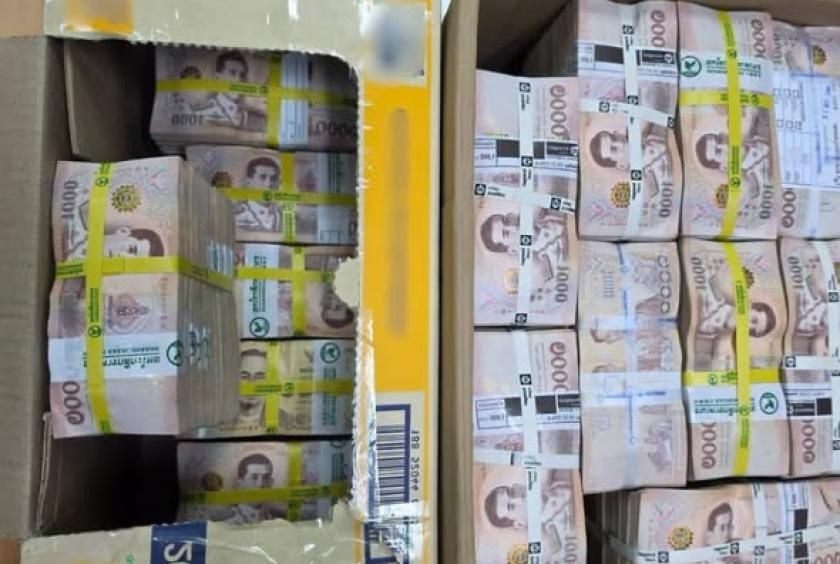
Thai customs officials have detained a 31-year-old Myanmar national accused of attempting to illegally export more than 23 million baht across the northern border, marking another significant cash seizure at a major crossing point between the two countries. The suspect was apprehended at the Mae Sai checkpoint on the Thai side of the Thai-Myanmar Friendship Bridge, where border inspectors discovered the hidden currency during a routine vehicle search.
The discovery unfolded when customs personnel stopped a private vehicle displaying Myanmar registration plates as it transited the Friendship Bridge. Officers conducting a routine inspection of the vehicle's contents found an unusual shipment of foodstuff that warranted closer examination. Upon opening cartons ostensibly containing dried fish and potatoes, they encountered plastic bags packed tightly with Thai currency rather than produce. The methodical concealment suggested careful planning to evade detection, using everyday food items as camouflage for the illicit cargo.
The scale of the seizure underscores the sophistication of smuggling operations along this crucial cross-border route. The first carton alone yielded approximately 17 million baht, while inspectors discovered an additional 6.023 million baht in a second container, bringing the total haul to 23.023 million baht, equivalent to roughly US$689,077. The sheer volume indicates this was likely not an opportunistic personal attempt but rather part of a coordinated scheme to move substantial sums across borders.
Currency smuggling across the Thai-Myanmar border has become an increasingly problematic challenge for authorities on both sides. The Mae Sai crossing, one of Thailand's busiest land borders, processes hundreds of vehicles daily, creating numerous opportunities for contraband to slip through. Criminals exploit the high volume of traffic and the difficulty of inspecting every vehicle thoroughly, though customs officials have become increasingly vigilant in recent years. The successful interception demonstrates that enhanced detection methods and training are yielding results, though determined smugglers continue to devise new concealment tactics.
Thailand's Customs Act and foreign exchange control regulations strictly prohibit the movement of undeclared currency across national borders without proper documentation and authorization. These laws exist to prevent money laundering, tax evasion, and the financing of illicit activities. The charges levelled against the Myanmar driver reflect violations of these foundational financial regulations that Thailand enforces to maintain the integrity of its monetary system and comply with international anti-money laundering standards.
For Malaysia and the broader Southeast Asian region, the incident serves as a reminder of the persistent vulnerability of land borders to financial crimes. Despite decades of cooperation frameworks and modernized customs infrastructure across ASEAN nations, smuggling networks continue to adapt and operate. The prevalence of such cases suggests that organized criminal groups maintain sophisticated supply chains for moving illicit funds, whether generated from drug trafficking, corruption, or other serious crimes. The relatively low risk of detection compared to the potential rewards keeps such operations economically attractive to perpetrators.
The Myanmar driver remains in custody at Mae Sai Police Station as investigators work to unravel the broader network behind the smuggling attempt. Thai authorities have indicated that they are pursuing leads to identify additional individuals who may have orchestrated or participated in the scheme. Such collaborative criminal enterprises typically involve multiple parties—financiers who arrange the operation, logistics coordinators, drivers, and border facilitators. Understanding the full extent of the network could reveal connections to larger smuggling operations or organized crime syndicates operating across the region.
The case also highlights the asymmetries in how different countries address border enforcement. Myanmar's institutional capacity to tackle such smuggling at its end of the crossing may differ from Thailand's resources and technical capabilities. Cross-border cooperation, while improving, sometimes remains hampered by diplomatic tensions, differing legal frameworks, and varying enforcement priorities. Effective resolution of currency smuggling requires coordinated action between neighboring states, information sharing about known smugglers and routes, and harmonized penalties that make the criminal enterprise genuinely risky.
From an economic perspective, large-scale currency smuggling can distort foreign exchange markets and complicate monetary policy implementation. Central banks require accurate data on currency movements to make informed decisions about exchange rates and money supply. When significant quantities of baht disappear into informal channels, it creates gaps in financial statistics and potentially fuels parallel foreign exchange markets where rates diverge substantially from official channels. This can disadvantage legitimate businesses and create opportunities for further financial crimes downstream.
The seizure comes amid broader regional concerns about financial crime and the use of border areas as conduits for illegal activity. Porous frontiers, weak institutional presence in remote areas, and corruption among some officials create an environment where smuggling thrives. Investment in technology, training, and interagency cooperation has improved detection rates, yet the fundamental economic incentives for such crimes remain powerful. As long as criminal organizations generate large cash surpluses that cannot be deposited in formal banking systems without triggering alerts, they will seek ways to move funds across borders physically.
Looking forward, the case demonstrates that border security improvements are working, even if incompletely. The Mae Sai checkpoint interdiction represents success for Thai customs, but it likely represents only a fraction of smuggling attempts that actually succeed. Estimating the true volume of undetected currency movements remains impossible, suggesting the actual scope of the problem exceeds what official statistics reveal. For Malaysian authorities and other regional law enforcement agencies, the incident reinforces the importance of sustained investment in customs modernization, intelligence cooperation, and the adoption of emerging detection technologies.

