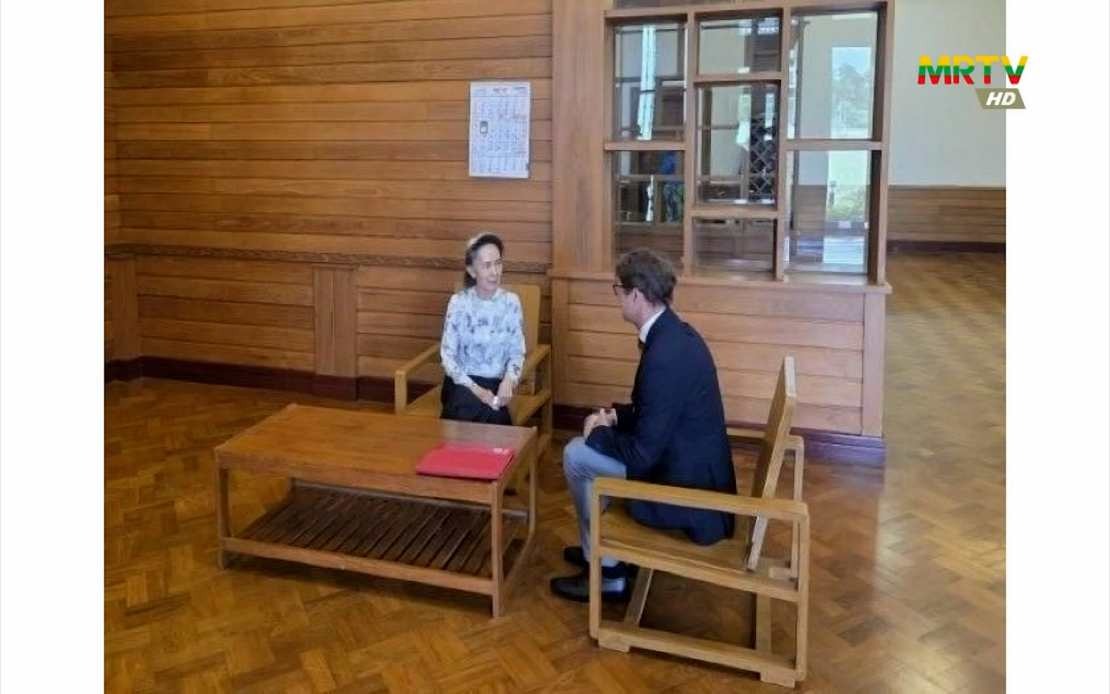
Myanmar's military-backed government announced that detained former leader Aung San Suu Kyi met with an International Committee of the Red Cross representative in Naypyitaw on Monday, marking one of the few documented contacts involving the 81-year-old Nobel Peace Prize laureate since her detention began in February 2021. Government spokeswoman Khine Khine Soe disclosed the meeting through Telegram, releasing photographs showing Suu Kyi in traditional Burmese dress meeting with Arnaud de Baecque, the ICRC's resident representative to Myanmar. The encounter represents a modest concession to mounting international pressure, particularly from neighbouring Southeast Asian nations, demanding verification of the former democratically elected leader's condition and location.
The timing and nature of the meeting underscore the information vacuum that has surrounded Suu Kyi since Myanmar's military seized power in a dawn coup. For more than three years, her exact whereabouts have remained shrouded in secrecy, with no foreign dignitary or international envoy permitted to meet her publicly. This opacity has fuelled widespread concerns about her physical and mental health, particularly given her advanced age and the rigorous detention conditions she has endured. The government's decision to allow the Red Cross meeting, coupled with the release of photographs, appears designed to counter international criticism while simultaneously demonstrating that Suu Kyi remains under firm state control rather than being permitted genuine independent contact.
Beyond the formal meeting imagery, the photographs released by the government included a striking picture of Suu Kyi cutting a birthday cake inscribed with her name and the date 19.6.2026, ostensibly documenting recent birthday celebrations. The cake photograph, showing her residence's sparse interior with visible storage boxes and a clothes rack, provided observers with rare visual evidence regarding her living conditions. However, Reuters could not independently verify the location, date, or authenticity of these images, as no earlier version appeared online before the announcement. This inability to confirm basic details reflects the credibility challenges facing Myanmar's military administration, which has repeatedly asserted that Suu Kyi enjoys good health whilst simultaneously denying international organisations and foreign governments meaningful access to verify such claims.
The detention itself emerged from Myanmar's shocking military coup that toppled a democratically elected civilian government led by Suu Kyi's National League for Democracy. Since that pivotal moment, the Southeast Asian nation has descended into deepening conflict and humanitarian crisis, with widespread armed resistance to military rule destabilising communities across the country. Suu Kyi's imprisonment symbolises this broader democratic collapse and has become a focal point for international criticism of Myanmar's military regime, drawing condemnation from governments and human rights organisations worldwide.
Following a series of closed trials, Suu Kyi received a combined sentence totalling 33 years on charges including corruption, election fraud incitement, and breaches of state secrecy legislation. These convictions, which her supporters characterise as politically motivated persecution designed to eliminate the country's most popular politician, have been modified multiple times. Her sentence was subsequently reduced to 27 years and then cut by one-sixth in April, leaving approximately 18 years remaining, according to her legal team. The arbitrary nature of these sentence modifications—announced without transparent judicial proceedings—reinforces perceptions that the military is weaponising the legal system against its most formidable political opponent.
Suu Kyi's son, Kim Aris, has described the anguish of profound uncertainty regarding his mother's wellbeing. During an interview with Reuters last December, he revealed that he had received no direct communication from his mother in years, relying instead on sporadic secondhand reports about alleged health complications affecting her heart, bones, and gums. This communication blackout, maintained despite his status as her closest living relative, exemplifies how completely the military regime has isolated Suu Kyi from the outside world. His expressed fear that she might die without his knowledge captures the genuine anxiety surrounding her fate that pervades international and regional diplomatic circles.
In late April, following a military-orchestrated election that enabled former junta leader Min Aung Hlaing to assume the presidency, authorities announced that Suu Kyi had been transferred to house arrest. This nominal change in detention status, however, appears to have altered little regarding her actual freedom or ability to receive visitors and communicate. The house arrest designation primarily served public relations purposes, allowing the military administration to project an image of normalisation and leniency whilst maintaining absolute control over her movements and interactions.
REGIONAL pressure has intensified noticeably across Southeast Asia, with ASEAN member states using diplomatic channels to demand access to Suu Kyi. Thailand's Foreign Minister Sihasak Phuangketkeow explicitly called for permission to verify the government's assertions about her health following ASEAN foreign ministers' meetings in Bangkok last month. The Philippines submitted a separate request requesting that an ASEAN special envoy be permitted to meet Suu Kyi, a proposal the military administration has rejected. These diplomatic initiatives reflect deep concern throughout the region that Myanmar's military rulers cannot be trusted to provide truthful information about the detained leader's condition, necessitating independent international verification.
The broader context of Suu Kyi's situation extends back decades into Myanmar's complex modern history. As the daughter of General Aung San, the nation's independence hero and founding father, Suu Kyi inherited both tremendous symbolic weight and profound political significance. During Myanmar's previous military dictatorship, she endured 15 years of house arrest at her family residence beside Yangon's Inya Lake, where she delivered inspiring speeches to devoted supporters gathered beyond the property's metal gates. That period of confinement established her as an international symbol of resistance against authoritarianism and democratic aspiration. Her current detention carries even greater symbolic resonance, representing not merely personal persecution but the apparent permanent suppression of Myanmar's democratic project.
The Red Cross meeting, whilst representing a minor diplomatic breakthrough, fundamentally changes little regarding Suu Kyi's actual situation. The International Committee of the Red Cross typically maintains strict confidentiality regarding individuals it visits, meaning that even if de Baecque gained meaningful access to Suu Kyi, he would not publicly disclose sensitive medical or personal information. This constraint limits the practical value of such visits in satisfying international demands for transparent verification of her wellbeing. Myanmar's military administration appears to understand this dynamic, using the Red Cross visit as a calculated gesture toward international critics whilst maintaining actual information control.
For Malaysian and broader Southeast Asian observers, the Suu Kyi situation represents a cautionary reminder of democratic fragility and military capacity to overturn democratic outcomes. Myanmar's political crisis, unfolding across the region's doorstep, has profound implications for regional stability and demonstrates how quickly institutional safeguards against military intervention can collapse. The continued detention and isolation of Suu Kyi, coupled with official resistance to transparent international verification of her condition, suggests that Myanmar's military regime remains committed to suppressing democratic opposition rather than pursuing genuine reconciliation or political transition.

