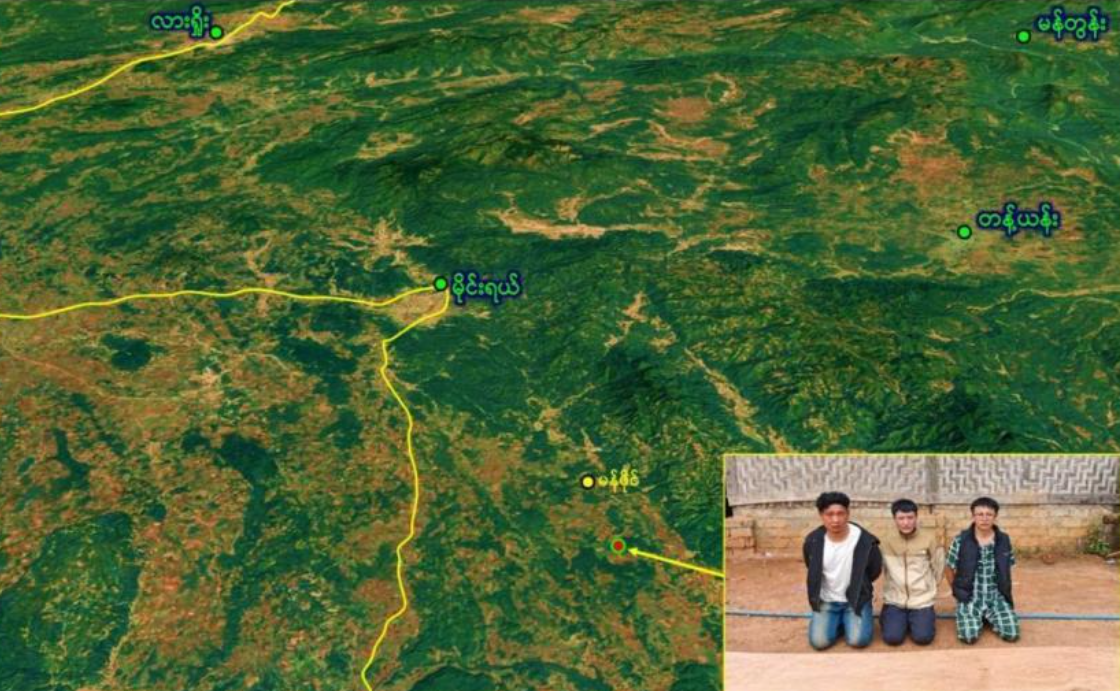
Myanmar's military forces have intensified their crackdown on transnational cybercrime, securing the arrest of three Chinese nationals accused of masterminding an online gambling scam operation in the remote border region of Mongyai Township in northern Shan State. The operation, carried out on August 26, represents the latest enforcement action in a broader campaign to dismantle criminal networks exploiting Myanmar's porous border areas and nascent digital infrastructure.
The arrested individuals had allegedly crossed into Myanmar illegally and established a clandestine operation approximately 26 kilometres southeast of Mongyai town and roughly 5 kilometres south of Manphai Village. Operating from makeshift facilities, the network targeted unsuspecting victims across Southeast Asia through fraudulent online gambling schemes. The location—remote, difficult to access, and distant from major urban centres—provided ideal cover for illicit activity whilst remaining within striking distance of border escape routes.
Myanmarian authorities discovered the operation following intelligence from local residents who reported suspicious activity in the area. Community tip-offs have become crucial to enforcement efforts, particularly in rural regions where security presence remains sparse. Upon receiving these reports, military personnel and security forces launched targeted investigations and conducted subsequent security operations that led directly to the arrests and seizure of operational infrastructure.
The scale of equipment recovered during the raid underscores the sophistication of the criminal enterprise. Authorities confiscated 25 mobile phones, five all-in-one computers, two power stations, one Starlink satellite device, and ten communication radios alongside structural elements of the operation. The Starlink equipment is particularly significant, indicating that the network leveraged advanced satellite internet technology to maintain connectivity in areas where conventional telecommunications infrastructure remains limited or unreliable. This reliance on space-based communications allowed operators to evade terrestrial monitoring and maintain operational continuity despite geographical isolation.
The physical infrastructure seized included one large corrugated iron structure measuring 50 by 20 feet with bamboo walls, supplemented by five temporary tarpaulin shelters of varying dimensions. This temporary construction reflected the transient nature of such operations—criminal networks operating in border regions typically maintain mobile, readily-dismantled facilities that can be evacuated quickly if security forces approach. The makeshift nature of the facilities also minimised investment and accountability, allowing operators to abandon locations without significant financial loss.
Myanmar's intensifying campaign against online scams and online gambling represents a coordinated national response to what has become a significant transnational security concern. Criminal syndicates, frequently organised along ethnic or nationality lines, have increasingly exploited Myanmar's ungoverned spaces and weak institutional capacity to establish regional hubs for fraud operations targeting victims across Southeast Asia. The problem carries particular resonance for the region, as scam networks operating from Myanmar's territory have victimised citizens throughout Malaysia, Thailand, Cambodia, and Vietnam, creating diplomatic tensions and strains on cross-border law enforcement cooperation.
The involvement of Chinese nationals reflects broader patterns of international cybercriminal networks. While some operations involve displaced persons seeking income in conflict zones, many represent organised criminal enterprises with significant capital and technical expertise. These groups exploit regulatory gaps, cultural and linguistic capabilities, and access to sophisticated technology to execute large-scale schemes. The presence of Starlink equipment suggests connections to networks with substantial financial resources and access to advanced procurement channels.
Security authorities have signalled their commitment to dismantling all unauthorised structures associated with scam operations. Military personnel indicated that illegally constructed residential and operational facilities will be systematically destroyed, eliminating the physical footprint that enables such enterprises. This destruction phase serves dual purposes: preventing rapid reoccupation of sites and demonstrating state capacity in border regions where civilian government presence has historically been limited.
The arrested individuals will face prosecution under existing Myanmar legal frameworks following completion of interrogation and formal investigation procedures. The specific charges remain undisclosed in current reporting, but typically involve immigration violations, unauthorised business operations, fraud-related offences, and breaches of telecommunications regulations. Sentencing outcomes in Myanmar can vary considerably depending on judicial interpretation and diplomatic considerations, though authorities have signalled zero-tolerance enforcement policies.
For Malaysian policymakers and security agencies, the Myanmar operation underscores persistent vulnerabilities within regional border security architecture. Scam networks continue exploiting gaps in cross-border intelligence sharing and differing legal frameworks across Southeast Asia. Malaysian telecommunications authorities have documented increasing numbers of fraud calls and messages originating from Myanmar-based operations, affecting hundreds of thousands of citizens annually. Enhanced cooperation mechanisms between ASEAN nations, including real-time intelligence exchange and coordinated enforcement operations, remain essential to disrupting these networks effectively.
The case illustrates how transnational organised crime has adapted to geographical constraints, utilising satellite technology, remote locations, and ethnic networks to maintain operational viability despite intensified enforcement pressure. Myanmar's approach—combining military security operations with community intelligence and infrastructure destruction—offers tactical lessons, though long-term solutions require addressing underlying governance challenges, economic incentives driving participation, and technical capabilities enabling remote operations. As scam networks continue evolving their methodologies, regional authorities must maintain corresponding advances in detection, coordination, and enforcement capacity.

