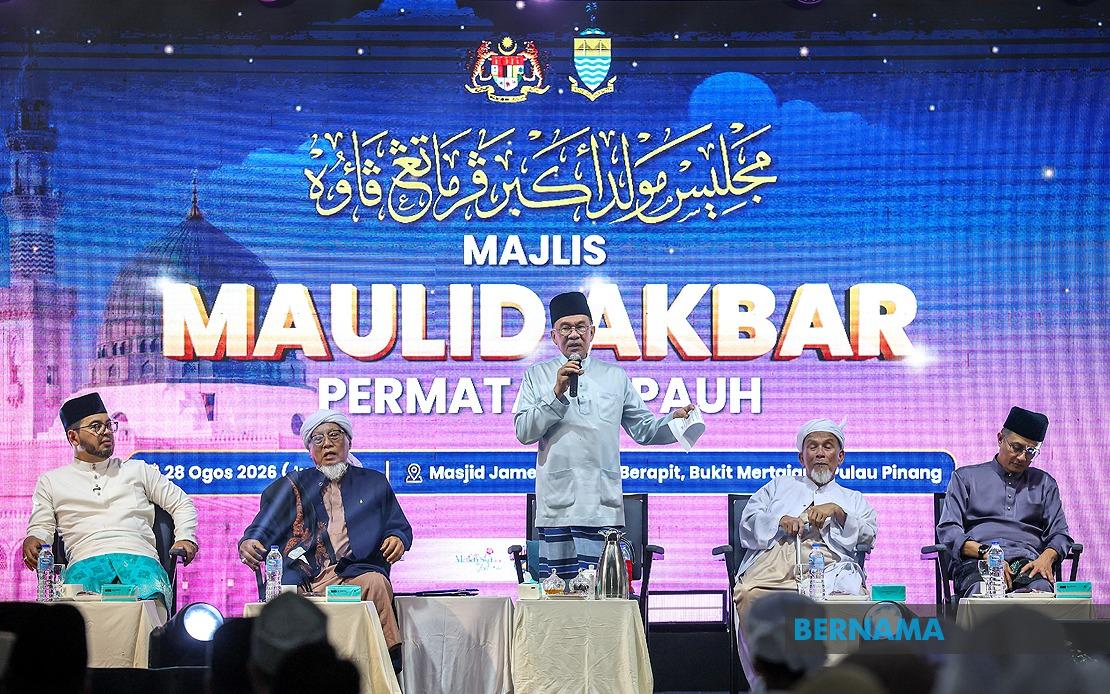
Prime Minister Datuk Seri Anwar Ibrahim has emphasised that Muslims bear a special responsibility to serve as moral exemplars within Malaysian society, advocating for a leadership approach grounded in character and ethical conduct. Speaking at a Maulid Akbar ceremony held in conjunction with National Day at Masjid Tengah in Bukit Mertajam, Anwar underscored that the standing enjoyed by the Muslim community must be earned through consistent demonstration of virtue rather than claimed by religious identity alone. He articulated a vision where societal respect becomes contingent upon visible, tangible evidence of integrity displayed across all spheres of daily interaction and professional endeavour.
The Prime Minister's remarks reflect a deliberate recalibration of leadership discourse that places personal accountability at the forefront of governance philosophy. Anwar stressed that Muslims who work diligently, honour their commitments, refrain from deception and resist the temptation to misappropriate resources naturally generate admiration from their peers and communities. This perspective carries particular significance in the Malaysian context, where public trust in institutions has been repeatedly tested by high-profile corruption scandals and governance failures. By positioning individual moral conduct as the foundation for collective respect, Anwar articulates an approach that demands cultural and behavioural change rather than relying solely on structural reforms or policy announcements.
Central to Anwar's message is the rejection of corruption and wrongdoing as fundamental to Islamic practice and community leadership. He contended that Muslims cannot simultaneously claim to uphold Islamic values while engaging in dishonest practices or abusing positions entrusted to them. This framing transforms integrity from a bureaucratic nicety into a spiritual and religious imperative, potentially reshaping how professional ethics are understood within government institutions and the broader public sector. The emphasis on transparency and honesty serves as a direct counterpoint to the historical pattern of institutional weakening that Malaysia experienced during periods of entrenched corruption.
Anwar expanded his argument to encompass Islam's broader civilisational message, characterising the faith as inherently oriented toward compassion and universal welfare. He called upon Muslims to transcend sectarian boundaries and actively safeguard relationships with all members of Malaysian society regardless of religious or ethnic background. This inclusive framing acknowledges Malaysia's multicultural reality while anchoring it in Islamic theological principles, suggesting that moral leadership benefits the entire nation rather than advancing narrow communal interests. Such language carries strategic importance in a country where religious sensitivities frequently intersect with political divisions.
The Prime Minister introduced the concept of balanced development as essential to both personal and national flourishing. He advocated for simultaneous cultivation of knowledge, spiritual commitment, moral discipline and material wellbeing, arguing that genuine progress cannot emerge from economic or technological advancement in isolation. This holistic vision challenges purely materialist development paradigms that have dominated policymaking for decades. The emphasis on maintaining equilibrium across multiple dimensions of human existence reflects Islamic intellectual traditions while remaining accessible to secular development frameworks that recognise non-material dimensions of prosperity.
A particularly significant element of Anwar's address concerned the relationship between Malaysia MADANI and moral foundations. He argued that the government's development framework cannot function effectively without robust underlying values and character among both leaders and citizens. Malaysia MADANI—the government's aspirational vision for national development—must therefore rest upon ethical bedrock rather than proceeding as an exclusively technocratic or economic project. This positioning suggests that the success of major policy initiatives ultimately depends upon cultural and spiritual renewal rather than institutional capacity alone.
The metaphor Anwar employed regarding remaining "rooted in the earth" while "reaching for the sky" effectively captures the tension between Malaysia's ambitions for technological sophistication and global competitiveness and the need to preserve foundational values. This language acknowledges that modernisation and progress remain legitimate national objectives while cautioning against allowing them to erode the moral and spiritual dimensions that sustain cohesive societies. For Malaysian readers accustomed to development discussions centred on infrastructure, foreign investment and competitive rankings, this reframing introduces a different hierarchy of priorities.
Anwar's emphasis on consultation with Islamic scholars and strengthening dialogue between religious and secular leadership represents an institutional dimension of his broader moral agenda. By highlighting the importance of seeking wisdom from established religious authority and creating channels for constructive critique and advice, he suggests that governance improves when informed by diverse perspectives including religious expertise. This approach contrasts with models that entirely separate religious and governmental spheres, instead proposing structured engagement that respects distinct domains while recognising their interdependence.
The presence of Minister in the Prime Minister's Department (Religious Affairs) Dr Zulkifli Hasan at the ceremony underscores official commitment to integrating religious perspectives into governance discourse. This institutional symbolism reinforces Anwar's assertion that moral and spiritual considerations form legitimate components of national policymaking rather than remaining confined to private belief or ceremonial occasions. For Malaysia's plural society, the careful articulation of how religious values inform public leadership without imposing religious law or doctrine represents an enduring governance challenge.
Anwar's call for Muslims to model integrity and reject corruption carries particular weight given Malaysia's historical experience with governance failures. The message implicitly acknowledges that legal and institutional mechanisms alone cannot combat systemic corruption—cultural transformation requiring individual ethical commitment remains essential. This approach distributes responsibility across society rather than concentrating it within enforcement agencies or regulatory bodies. The effectiveness of such a framework ultimately depends upon widespread internalisation of moral standards and genuine commitment to their observance.
The Prime Minister's framing also addresses perceptions of hypocrisy that have historically undermined public sector credibility in Malaysia. By demanding that Muslims—particularly those in positions of authority—visibly embody the values they espouse, he establishes clear standards against which public conduct will be measured. This creates potential vulnerability for leaders whose actions contradict their rhetoric, yet simultaneously establishes a template for restored institutional legitimacy through demonstrated integrity rather than claims of reform. The success of such an approach depends critically upon consistent application across all levels of leadership.

