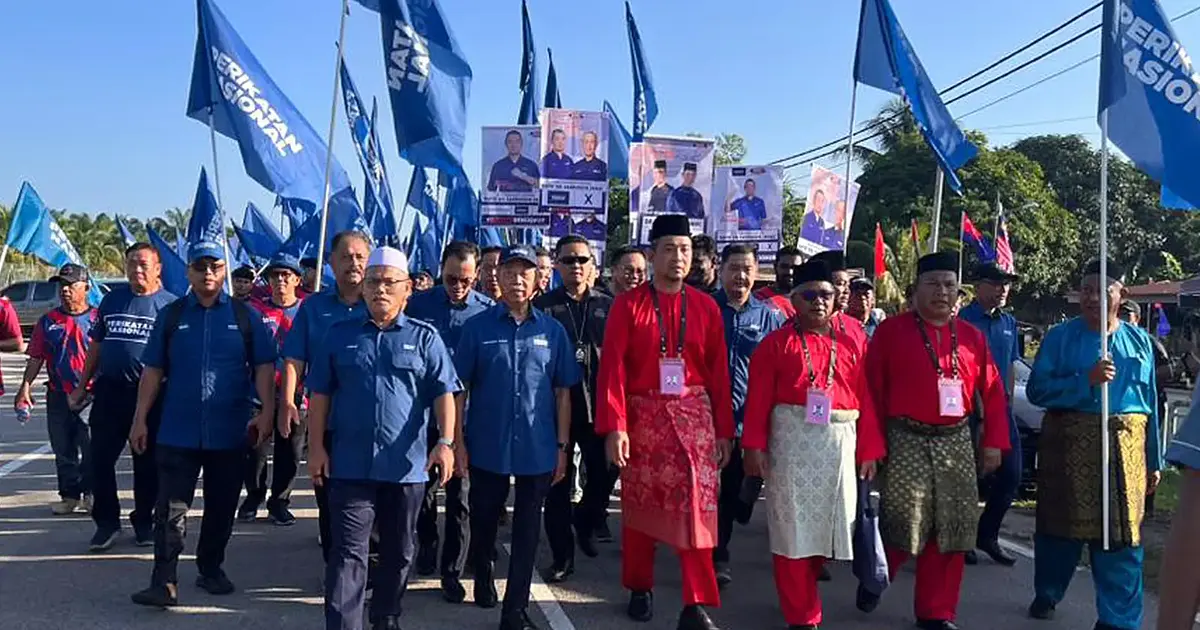
Perikatan Nasional demonstrated its grassroots mobilisation capacity by assembling hundreds of supporters for a campaign roadshow backing Dr Sahruddin Jamal, the incumbent two-term assemblyman seeking to retain his Bukit Kepong seat under the Bersatu banner. The gathering, anchored by Muhyiddin Yassin's prominent participation, underscored the coalition's determination to consolidate support in what appears to be a closely watched constituency within its broader electoral strategy.
Dr Sahruddin Jamal's candidacy carries particular significance given his track record of two consecutive terms representing Bukit Kepong. His experience as an incumbent provides Bersatu with an established legislative presence in the area, a factor the coalition clearly sought to amplify through the scaled-up campaign engagement. The public appearance of coalition supporters in substantial numbers telegraphs confidence in the candidate's viability while simultaneously testing the depth of voter enthusiasm for Perikatan's broader political messaging.
Muhyiddin Yassin's direct involvement in the campaign event reflects the seniority he commands within Perikatan's internal hierarchy and his continued centrality to the coalition's electoral fortunes. As a former Prime Minister and prominent figure in Malaysian politics, his endorsement of Dr Sahruddin carries weight beyond the immediate constituency, signalling to party faithful and potential swing voters alike that the party leadership regards this seat as strategically important enough to warrant personal attention from one of its most recognisable faces.
The mobilisation of several hundred supporters suggests Bersatu has maintained sufficient organisational capacity to turn out meaningful crowd sizes, a metric often used to gauge party health and grassroots engagement. For Southeast Asian coalition politics, where territorial control translates directly into parliamentary seats and ministerial portfolios, such displays serve multiple functions simultaneously—energising the base, intimidating rival parties, and creating visual propaganda material for media circulation.
Bukit Kepong's electoral importance extends beyond its single seat. Constituencies where two-term incumbents compete often become bellwethers for broader regional sentiment, particularly when they are contested by coalition partners each possessing their own territorial networks. The Perikatan show of force suggests the coalition recognises this constituency as neither safe nor marginal, but rather as genuinely competitive terrain where voter mobilisation could prove decisive.
Dr Sahruddin's tenure across two terms implies he has developed localised networks and credibility with voters around specific issues affecting the constituency. Whether those advantages would translate to electoral success against opposition candidates, however, depends on prevailing winds in Malaysian politics at the time of polling. Recent trends across Malaysia have demonstrated considerable volatility in voter behaviour, with swings often larger than historical precedent, making incumbency status a less reliable predictor of outcomes than in earlier electoral cycles.
The campaign event also functioned as an internal party consolidation exercise. Large assemblies of party supporters reinforce bonding among grassroots members, distribute campaign literature and talking points, and allow party machinery to assess enthusiasm levels among rank-and-file activists. For a coalition like Perikatan Nasional, which has experienced various iterations of internal reorganisation and realignment, such opportunities to demonstrate cohesion carry added psychological value.
From a broader Southeast Asian perspective, Malaysia's coalition-based electoral politics differ markedly from systems elsewhere in the region. Rather than individual parties competing independently, the bundling of candidates under coalition umbrellas means that local electoral contests acquire significance as barometers of coalition health. A strong showing for Dr Sahruddin would benefit not only Bersatu but Perikatan's overall negotiating position in potential post-election coalition formations and government construction.
The constituency-level campaign represented a microcosm of the nationwide electoral chess match playing out across Malaysia. Perikatan's decision to invest leadership bandwidth and supporter mobilisation in Bukit Kepong reflects calculations about resource allocation and electoral priorities. Conversely, the opposition's response to this show of strength would shape the competitive intensity of the race and ultimately its outcome.
Dr Sahruddin's positioning as the continuity candidate, supported by senior party figures and substantial volunteer networks, establishes a narrative of experience and established governance against whatever alternative opponents might offer. Whether Malaysian voters in this constituency would prioritise representation by an experienced incumbent or opt for change depends on their assessment of Dr Sahruddin's performance record and the alternative candidates' proposed agendas.
The Bukit Kepong campaign event ultimately illustrated that despite Malaysia's sophisticated electoral competition and shifting voting patterns, traditional campaign mechanics—bringing candidates and supporters together in public displays of solidarity—remain central to how political coalitions compete for voter attention and demonstrate organisational capacity to party members.

