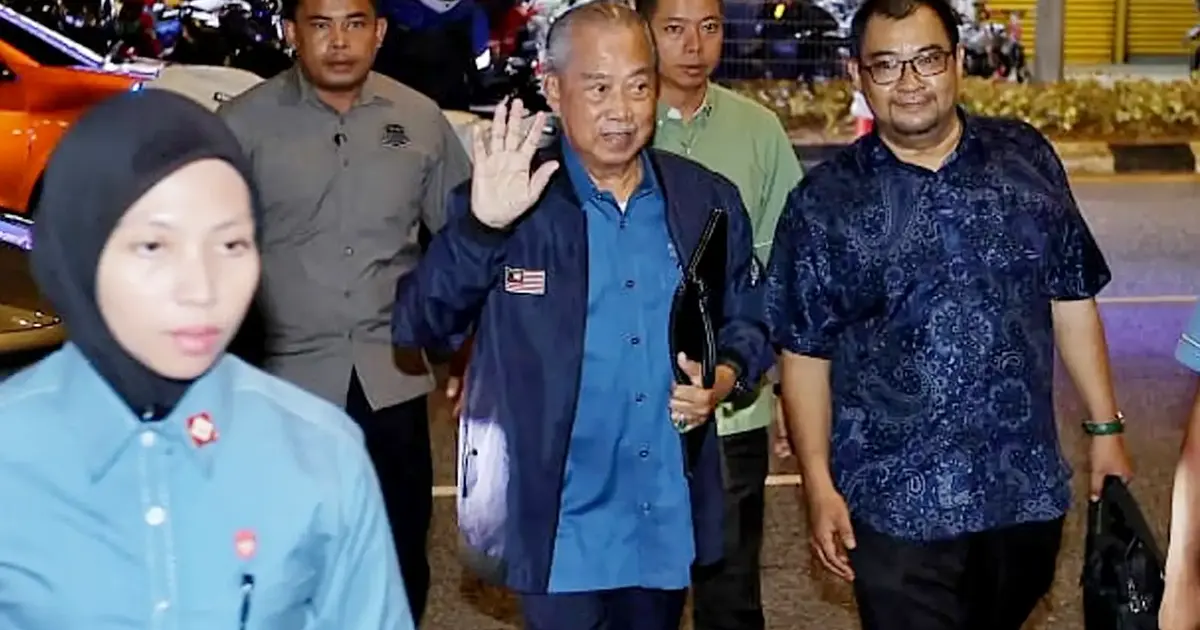
Tan Sri Muhyiddin Yassin and other senior Bersatu figures assembled for an urgent Perikatan Nasional conclave on Wednesday evening, marking a critical juncture for the beleaguered opposition alliance. The hastily arranged gathering underscores mounting tensions within the three-member coalition, which has struggled to maintain cohesion amid deepening factional disputes and strategic disagreements.
The immediate trigger for the emergency session is PAS's definitive announcement to withdraw from its partnership with Bersatu, a development that strikes at the heart of Perikatan Nasional's structural integrity. PAS, the largest component by parliamentary representation within the alliance, has long harboured reservations about Bersatu's direction and leadership, with friction intensifying over the past months as the Islamic party sought to assert greater autonomy and reshape coalition strategy.
Bersatu's predicament reflects broader instability in Malaysia's opposition landscape, where the absence of a coherent alternative governing platform has allowed the ruling coalition to consolidate its position. The party, which once positioned itself as a centrist force bridging Malay-Muslim and multiethnic constituencies, has faced sustained criticism over its internal governance and electoral viability following successive electoral setbacks. PAS's departure removes a critical stabilising presence that had, despite mutual grievances, maintained the veneer of united opposition resistance.
The consequences of this rupture extend well beyond internal party manoeuvres. Perikatan Nasional's parliamentary strength depends significantly on PAS's nineteen representatives and its network of state-level influence, particularly in the northern and east coast regions. Loss of this bloc fundamentally alters the coalition's capacity to mount effective legislative opposition and field competitive candidates in future electoral contests. Without PAS, Perikatan Nasional risks becoming a peripheral force in Malaysian politics, increasingly irrelevant to national policy debates.
For Muhyiddin specifically, the timing presents both immediate and longer-term challenges. As Bersatu president and former prime minister, his authority within the party and broader opposition depends on demonstrating leadership capable of navigating crisis and retaining relevance. The emergency meeting signals an attempt to project decisiveness, yet the underlying reality is that Bersatu finds itself increasingly isolated within the fractious opposition ecosystem. His political capital, already diminished following the party's poor showing in recent elections, faces further erosion if Perikatan Nasional continues its descent into dysfunction.
The meeting's focus on determining Bersatu's future status within Perikatan Nasional illustrates the scale of recalibration required. Several scenarios now appear plausible: the coalition could formally dissolve, with parties pursuing independent strategies; it could reconstitute with adjusted membership and revised terms of engagement; or individual parties might pivot toward negotiated arrangements with the government, effectively abandoning opposition posturing. Each trajectory carries distinct implications for Bersatu's survival as a meaningful political entity.
Regional observers note that Malaysia's opposition fragmentation contrasts sharply with the ruling Barisan Nasional's ability to maintain electoral dominance despite periodic internal disagreements. This disparity reflects deeper organisational weaknesses within opposition parties, whose leaders have repeatedly prioritised factional positioning over coalition-building discipline. The Perikatan Nasional experiment was meant to demonstrate that opposition forces could transcend historic rivalries; instead, it has become another casualty of Malaysian politics' persistent personalisation and short-term opportunism.
For the broader Malaysian electorate, particularly those who view electoral competition as essential to democratic health, these developments carry sobering implications. A weakened, fragmented opposition reduces voters' practical choices at the ballot box and diminishes legislative scrutiny of executive power. Urban constituencies that have increasingly supported opposition candidates may find themselves underrepresented in future parliaments if opposition forces continue their self-inflicted splintering.
The PAS-Bersatu breakdown also reflects theological and ideological tensions that have long simmered beneath surface unity. PAS's steadfast commitment to Islamic governance frameworks has frequently clashed with Bersatu's more secular-pragmatic orientation, creating fundamental disagreements over policy priorities and coalition messaging. Recent statements from PAS leadership suggest the party increasingly views alignment with Bersatu as constraining its appeal to its core electorate and hindering its ability to distinguish itself from Perikatan Nasional's other components.
International observers tracking Malaysian politics have highlighted how coalition instability can paradoxically strengthen incumbent governments by creating voter uncertainty and dampening opposition mobilisation. If Perikatan Nasional's dissolution or significant restructuring proceeds, the ruling coalition may benefit from reduced organised opposition presence in parliament and state legislatures, further entrenching its advantage.
The outcome of Wednesday's emergency session remains uncertain, though few observers anticipate positive resolution that could restore Perikatan Nasional to its previously envisioned role as a credible alternative government. Whatever decisions emerge from the gathering, they are unlikely to arrest the coalition's deeper structural decline or address the fundamental disagreements that have precipitated this crisis. Malaysian politics appears poised to enter a new phase of opposition fragmentation, with consequences that will shape electoral dynamics for years to come.