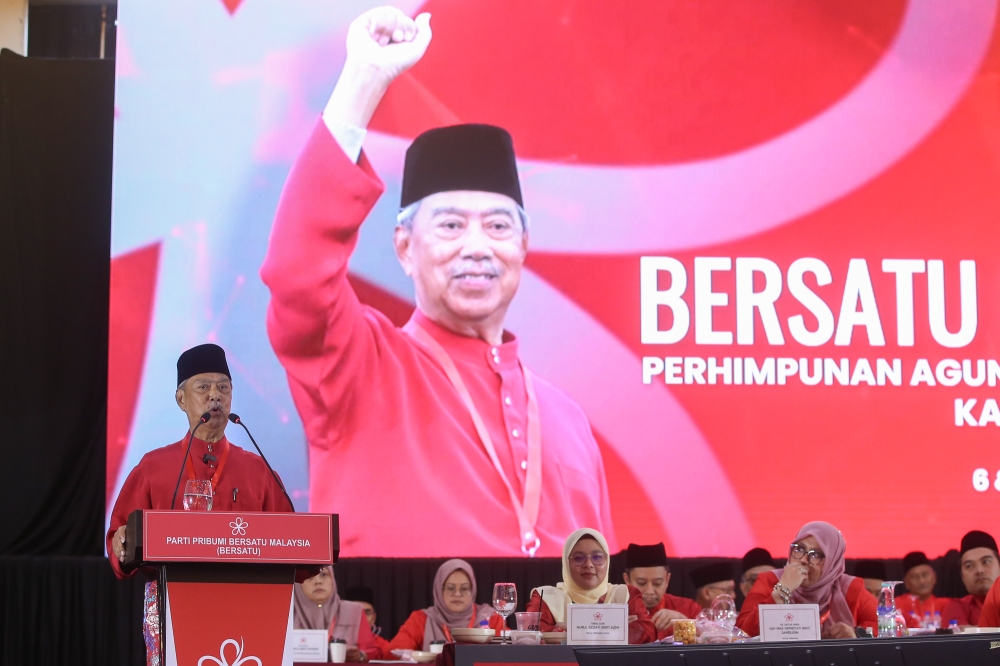
Tan Sri Muhyiddin Yassin, the president of Parti Pribumi Bersatu Malaysia, launched a pointed critique of his own coalition partner Perikatan Nasional on Wednesday, alleging that the bloc has systematically sidelined Bersatu from decision-making processes. Speaking in Kuala Lumpur, the veteran politician suggested that Perikatan's operational structure has rendered Bersatu a peripheral player despite its formal membership, raising questions about the viability of the coalition as currently constituted.
The accusation strikes at a fundamental tension within Malaysia's fragmented opposition landscape. Perikatan Nasional, which comprises primarily PAS and Bersatu, emerged as a potent political force in the aftermath of the 2020 government transitions, capturing significant voter support among Malay-Muslim constituencies. However, the coalition's internal dynamics have proven more complex than initial public presentations suggested, with control concentrated among its larger components. Muhyiddin's remarks represent an unusually candid acknowledgment of hierarchical imbalances that have long simmered beneath the surface.
Moreover, Muhyiddin directed criticism toward the proposed or existing alliance between Umno and other parties, contending that such arrangements fall short of constituting genuine Malay political unity. His statement reflects a broader ideological and strategic disagreement about what authentic Malay-Muslim political mobilization should entail. Rather than viewing cooperation with Umno as a pathway toward consolidated Malay representation, Muhyiddin appears to position Bersatu as the custodian of an alternative vision for Malay politics—one that claims greater grassroots authenticity and ideological consistency.
This rupture within opposition ranks carries significant implications for Malaysian politics heading toward any future electoral contests. The fragmentation of anti-government forces into competing blocs—Perikatan on one side and various Umno-led configurations on another—has historically weakened their collective bargaining power and prevented the emergence of a coherent opposition platform. Muhyiddin's intervention signals that these divisions are hardening rather than softening, despite periodic announcements of collaborative discussions.
For Bersatu specifically, the position is increasingly delicate. The party has struggled to maintain a distinct political identity while operating within coalition frameworks where larger partners dominate resource allocation and strategic planning. Muhyiddin's criticism may represent an attempt to reorient Bersatu toward an independent political trajectory, particularly if the party senses declining returns from subordinate positioning within Perikatan. Such repositioning would necessarily involve recalibrating relationships with other opposition components and potentially reassessing electoral strategies.
The Umno dimension adds another layer of complexity. United Malays National Organisation remains the single largest Malay-based party by membership and organizational reach, yet has faced its own internal turbulence and electoral volatility. Any proposed Umno-led coalition implicitly raises questions about whether the party can deliver sufficient electoral performance to justify its presumed leadership role. Muhyiddin's skepticism suggests that he views such arrangements as lacking the organic Malay political consensus necessary for sustainable governance.
Analysts monitoring Malaysian political developments have long noted that claims to represent authentic Malay or Malay-Muslim interests frequently serve as rhetorical tools masking narrower partisan interests. Muhyiddin's invocation of genuine versus hollow unity follows this established pattern, though his position as a major party president gives his commentary particular weight within opposition discourse. The framing implicitly positions Perikatan and Bersatu as more authentically rooted in grassroots Malay political movements compared to what he characterizes as opportunistic elite arrangements.
The timing of Muhyiddin's statements also warrants consideration. Coming amid broader regional political shifts and ongoing negotiations between various Malaysian political factions, his remarks may constitute repositioning ahead of potential government formation scenarios or electoral contests. Whether intended as a negotiating tactic to extract concessions from Perikatan leadership or as a precursor to more substantial political realignment remains unclear from his public pronouncements.
For Malaysian voters and observers seeking clarity on opposition direction, Muhyiddin's intervention adds to the bewildering array of competing narratives about what coalition structures would best serve national interests. The simultaneous existence of multiple opposition groupings claiming legitimacy and authenticity reflects deeper structural fragmentation within Malaysian politics. This fragmentation, in turn, affects governance prospects and the viability of potential alternative governments.
Moving forward, attention should focus on whether Muhyiddin's criticism catalyzes concrete organizational changes within Perikatan or precipitates broader realignments. The sustainability of any opposition coalition depends ultimately on members perceiving mutual benefit and genuine partnership rather than hierarchical subordination. His allegations suggest that at least some significant actors within the current opposition framework harbor serious doubts about whether existing arrangements satisfy these basic requirements.

