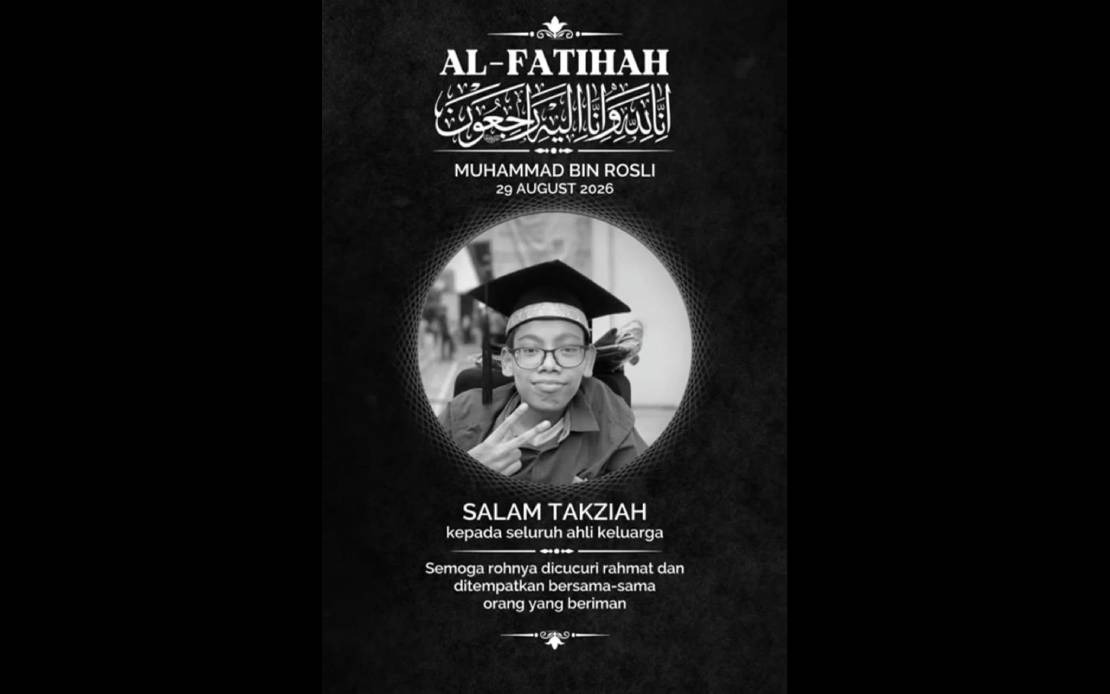
Muhammad Rosli, whose separation from his conjoined twin marked one of Malaysia's most significant medical achievements, passed away this morning at Chancellor Tuanku Muhriz Hospital in Cheras. The news was confirmed by his older brother Ahmad through a Facebook announcement, noting that Muhammad died at 10:45 am at the Universiti Kebangsaan Malaysia facility. Ahmad expressed gratitude for the prayers and support that the family had received throughout their ordeal, asking that well-wishers remember them during this difficult period. Muhammad's remains were laid to rest at the USJ 22 Muslim Cemetery in Subang Jaya the same evening.
Muhammad's final illness was marked by complications related to bladder cancer, which he had been battling since arriving at the King Fahd National Guard Hospital in Riyadh, Saudi Arabia, in July 2025. The young man underwent an intensive treatment programme comprising five separate surgical procedures alongside five rounds of chemotherapy in an attempt to arrest the cancer's progression. Medical staff at the Saudi facility had initially succeeded in declaring him cancer-free following the completion of this gruelling course of intervention. However, the reprieve proved temporary, as follow-up care revealed concerning developments in his condition.
According to Ahmad's account shared yesterday, Muhammad's health had taken a sharp downturn when laboratory results indicated dangerously elevated blood acid levels. This metabolic crisis left him slipping into a semi-conscious state, a deterioration that ultimately proved irreversible. The family faced the heartbreaking reality that despite aggressive medical intervention and years of post-operative survival after his twin separation, complications had finally overwhelmed his system.
The journey that made Muhammad and his brother Ahmad household names in Malaysia began in early 2001, when they underwent preliminary procedures at the University Malaya Medical Centre designed to prepare their bodies for eventual separation. These preparatory surgeries were essential groundwork before the main procedure could be attempted. In September 2002, the twins were taken to the King Fahd National Guard Hospital, where they underwent the landmark separation surgery that would capture global medical attention. The operation lasted 22 hours and 45 minutes, representing an extraordinary feat of surgical coordination and precision given the brothers' shared organs.
The successful separation of Muhammad and Ahmad represented more than a personal victory for the twins and their family. The case became a defining moment in Malaysian medical history and demonstrated the nation's capacity to contribute to cutting-edge surgical innovation. International medical teams worked alongside Malaysian specialists to carefully disentangle the brothers' shared liver and other interconnected anatomical structures. The operation's success meant that both young men could potentially live independent adult lives, a prospect that seemed impossible before the procedure took place.
For more than two decades following their separation, Muhammad and Ahmad remained symbols of Malaysia's medical progress and determination. The twins' survival through childhood and into early adulthood was itself remarkable given the risks inherent in their condition. Conjoined twins who share significant internal organs face extraordinary challenges, and the fact that both brothers lived into their twenties represented a tribute to the surgical team's expertise and ongoing medical support. Their story was frequently invoked whenever Malaysia sought to highlight achievements in healthcare innovation and international collaboration.
The emergence of bladder cancer represented a cruel reversal for Muhammad at what should have been his prime years. While it remains unclear whether the malignancy bore any connection to his previous surgical experiences or shared fetal development, the diagnosis forced him to endure treatment regimes that would challenge anyone's resilience. The decision to seek treatment in Saudi Arabia reflected both the family's faith in the King Fahd National Guard Hospital, where the twins had been so carefully managed before, and the reality that managing complex post-surgical complications sometimes requires specialised centres with experience in rare cases.
Muhammad's death comes at a time when Malaysia continues to build upon its reputation in medical tourism and surgical excellence. His passing serves as a sobering reminder that even the most triumphant medical interventions exist within the larger context of human mortality and the unpredictable nature of disease. The separation surgery that made him famous was a technical and procedural victory, yet it could not ultimately protect him from the health challenges that would emerge as he matured.
For Ahmad and the broader family, the loss marks the end of a unique journey that intertwined personal identity with public interest in ways few individuals experience. The twins were never simply private individuals; they were ambassadors for Malaysian medicine and symbols of what skilled physicians could accomplish. Ahmad's dignified announcement of his brother's passing reflected the grace with which the family had navigated their extraordinary circumstances throughout their lives. As Malaysia's medical community mourns the loss of this remarkable young man, his legacy remains inseparable from the groundbreaking achievement that gave him and his brother their freedom.

