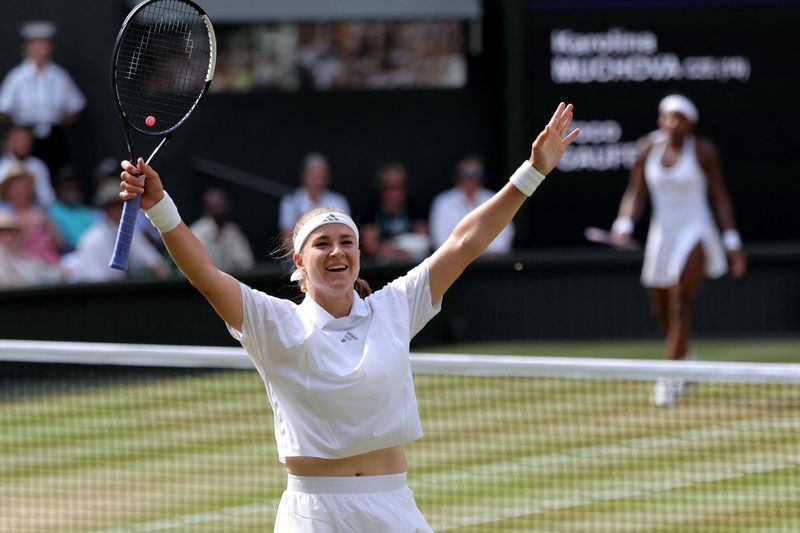
Karolina Muchova's remarkable composure under pressure has sent her to a maiden Grand Slam final at Wimbledon, after she mounted a stunning comeback against American seventh seed Coco Gauff to claim a 6-2 1-6 7-6 victory in Saturday's semifinal. The Czech player's triumph, achieved in a tense two hour 35 minute encounter on Centre Court, not only marks a personal milestone but also sets the stage for a potential all-Czech final should her compatriot Linda Noskova overcome Ukrainian Marta Kostyuk in the second semifinal on Thursday.
Muchova's path to the final carries particular significance for Czech tennis, which has established itself as a powerhouse on the women's tour. A Czech victory at the All England Club would represent the third triumph for the nation in as many years—following Marketa Vondrousova's 2023 triumph and Barbora Krejcikova's success in 2024. This prospective dominance underscores the depth of talent emerging from the Eastern European nation and their particular expertise on grass courts, despite Muchova's own unlikely struggle with the surface.
The irony of Muchova's dominance on grass cannot be overlooked. The 10th seed has disclosed that she suffers from grass allergies, requiring extensive pharmaceutical and medical support simply to compete at the sport's most prestigious tournament. She relies on "a lot of pills, sprays, eyedrops" to manage her condition while performing at the highest level—a remarkable testament to her determination and resilience in overcoming physical obstacles that would deter most athletes.
In the opening set, Muchova's tactical acumen and variety proved devastating against Gauff. Breaking serve in the third and fifth games, Muchova established early control despite the sweltering conditions that made Centre Court feel like a pressure cooker. A powerful 111 mph ace sealed the first set decisively, demonstrating the combination of power and precision that characterises her grasscourt game. Gauff's inability to maintain momentum during this phase suggested the American was struggling to find her rhythm against Muchova's unpredictable shot selection and court positioning.
Yet Gauff demonstrated the mental fortitude that has become her trademark, refusing to concede despite being down a set. The American's journey to this semifinal had already involved navigating four consecutive three-set matches—a gruelling test of endurance and psychological resilience. Rather than capitulating, Gauff transformed the second set into a clinical demonstration of power tennis, ultimately prevailing 6-1 to force a decisive third.
The decider evolved into one of the tournament's most compelling contests, with both players delivering the aggressive, stroke-making tennis that defines modern women's professional play. Ferocious forehands and commanding backhands ricocheted across the court as Gauff applied relentless pressure, creating nine break point opportunities before finally converting on her ninth attempt for a crucial 3-1 advantage. When Gauff broke again for 5-1, victory appeared within grasp, yet Muchova's experience and composure enabled her to claw back into the match.
The decisive tiebreak became a test of nerve and technical excellence. Gauff created two break point opportunities that would have sealed victory at 5-4, but Muchova escaped that pressure with a vital hold of serve. From that juncture, the momentum shifted irrevocably toward the Czech player, who produced her finest tennis when it mattered most. An audacious diving volley winner highlighted her shot-making repertoire, while a perfectly executed lob demonstrated the range of skills she deploys on the grass court.
Muchova earned a match point at 11-10 in the tiebreak courtesy of the lob, but Gauff saved that opportunity to extend the contest further. On the following point, however, Muchova's persistence finally yielded dividends. Gauff, attempting to construct a forehand winner under tremendous pressure, succeeded only in sending the ball into the net, confirming Muchova's advance to Saturday's final.
This semifinal victory establishes Muchova as a genuine contender for the Venus Rosewater Dish, despite her earlier-round battles and unseeded status in the tournament. Her ability to recover from match point deficit against a player of Gauff's calibre suggests she possesses the mental strength and tactical flexibility required to compete for Grand Slam titles. The American, meanwhile, departs having proven herself among the sport's elite competitors, though her failure to convert crucial opportunities will likely haunt her during the off-season.
For Southeast Asian tennis followers, this matchup underscored the global competitiveness of women's Grand Slam tennis, where depth runs extraordinarily deep and any match can shift on a single point or decision. The tournament continues to demonstrate that Grand Slam finals represent the culmination of extraordinary athletic achievement, with Muchova's journey from grass-allergic underdog to potential champion embodying the unpredictability and drama that makes tennis compelling across the region and worldwide.

