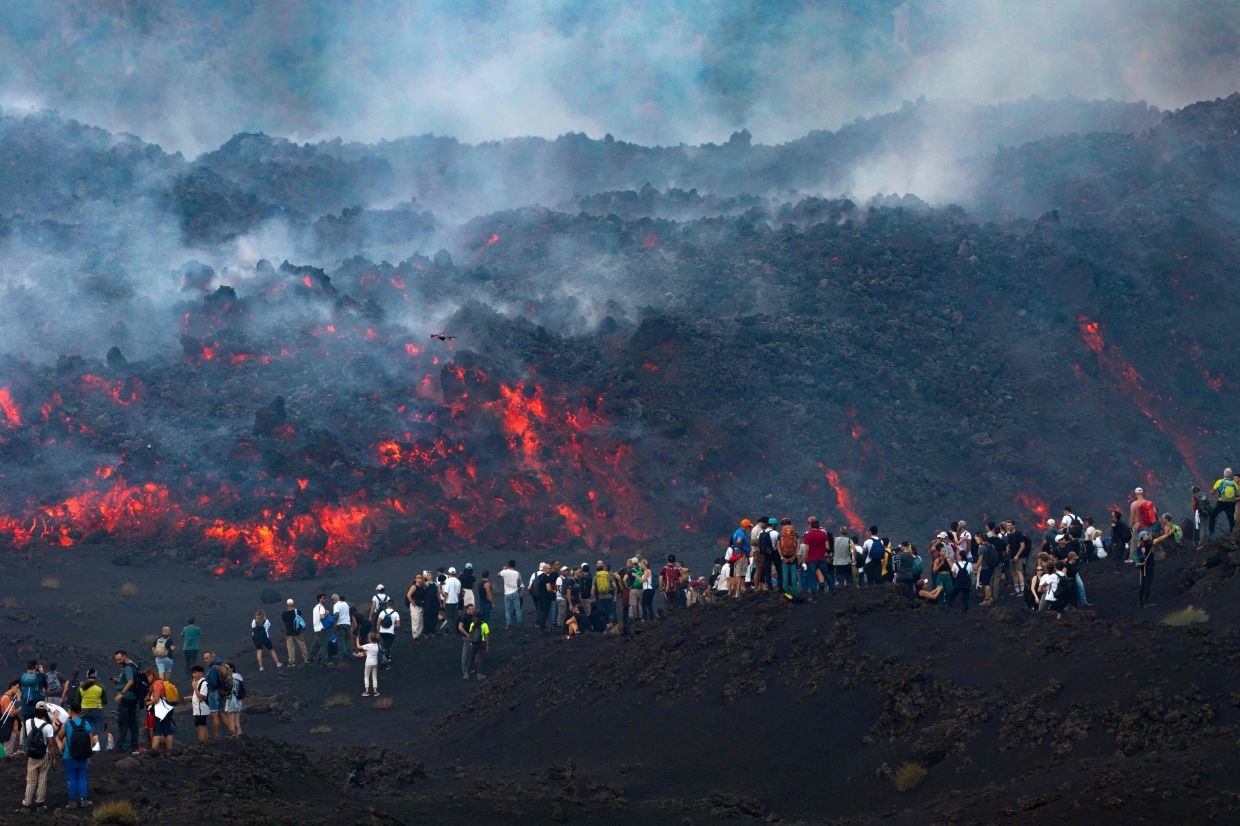
Dramatic footage of molten lava cascading down the slopes of Mount Etna has triggered an unexpected tourism surge to Europe's highest active volcano, much to the consternation of experienced mountain guides who manage visitor access. The eruption, which has persisted for days, has unleashed streams of incandescent rock while simultaneously blanking the region in volcanic ash, creating what local operators describe as a paradoxical moment of danger and wonder that proves irresistible to adventure seekers from across the globe.
Catania airport, the critical transportation gateway serving Sicily's eastern coast and one of Italy's premier holiday destinations, has been forced to suspend operations repeatedly as ash clouds disrupt flight schedules. The disruption underscores how volcanic activity in this region impacts not merely the mountain's immediate vicinity but the broader tourism infrastructure supporting roughly 12 million annual passengers. Italian media reports indicate that hundreds of flights have been cancelled since Saturday alone, suggesting the economic reverberations extend far beyond those attempting to reach Etna's slopes.
Local guide companies have witnessed extraordinary demand for their services. Daniele Perricelli, who manages Guide Etna and has spent his career navigating the volcano's temperamental terrain, reports his operation typically fields around 100 calls during a normal peak summer season. The current eruption phase has transformed this baseline dramatically—his company now receives approximately 300 requests daily, a threefold increase that reflects how geologically spectacular events capture the public imagination. Perricelli explains the appeal plainly: visitors perceive something magnetic in witnessing nature's raw power, particularly when framed within the context of relative accessibility and managed safety protocols.
Ernesto Maria Magri, another established guide in the region, has characterised the phenomenon as a "touristic eruption"—one whose visual drama and manageable risk profile draw crowds who might otherwise skip the destination entirely. What distinguishes Etna from more dangerous volcanic sites is that extensive cooling of previous lava flows creates zones where visitors can approach within mere metres of the flowing molten rock without exposure to extreme temperatures. This combination of genuine peril and achievable proximity creates powerful psychological appeal for tourists seeking authentic encounters with geological forces.
Yet the surge has created complications that concern experienced mountaineers. Perricelli estimates that up to 2,000 individuals climb Etna's slopes each evening, creating congestion that transforms footpaths designed for modest foot traffic into crowded routes where safety becomes contingent on visitor behaviour rather than environmental stability. Troublingly, he observes many climbers ascending without professional guides—a technically permissible approach under Italian regulations that permit independent ascent to approximately 2,400 metres altitude, but one requiring specific knowledge of the volcano's unpredictable behaviour. His casual observation of climbers in flip-flops ascending an unstable, ash-covered mountain illustrates how the eruption's visual appeal can override prudent decision-making.
Local residents themselves have contributed to the overcrowding. Magri notes that community members drawn by the spectacle often arrive without formal guides and sometimes congregate in disorderly clusters that amplify the congestion problem. This mixing of experienced climbers, tourists with guides, casual visitors, and local sightseers creates a heterogeneous crowd whose collective risk exposure increases as density rises. Perricelli emphasises that Etna's instability demands expert interpretation—someone capable of reading the mountain's subtle signals and responding appropriately to sudden changes in volcanic behaviour.
The volcano's elevated status has attracted celebrity attention, which has generated social media criticism. Italian television personality Diletta Leotta, among others, has faced public scrutiny for photographs suggesting proximity to active lava that exceeds safe operational parameters. While guides confirm that certain lower-altitude zones offer genuine safety margins, the distinction between permitted close approaches and genuinely reckless proximity remains nuanced—a subtlety often lost when dramatic images circulate widely.
Italian civil protection authorities have designated Mount Etna at yellow alert status, the second tier on a four-stage scale ranging from green to red. Yellow alert designation reflects the volcano's current pattern of frequent eruptions and potential explosive episodes, indicating an elevated but not catastrophic threat level. This intermediate status appears to have failed to dampen tourist enthusiasm, perhaps because it conveys managed risk rather than prohibition, or because the visual rewards seem to outweigh official caution.
The disruption to Catania airport operations carries significant ramifications for Sicily's tourism economy and broader regional travel networks. Flight cancellations that number in the hundreds represent not merely inconvenience but genuine economic consequences for airlines, hotels, and tourism operators dependent on summer season traffic. For Malaysian and Southeast Asian travellers, Etna's current volatility serves as a reminder that Mediterranean summer holidays can face unexpected disruptions from geological activity—advance travel insurance and flexible itinerary planning become relevant considerations.
The underlying tension here reflects a broader challenge for volcanically active regions that simultaneously attract tourism and require genuine safety management. Guides like Perricelli face the commercial incentive to accommodate record demand while maintaining professional responsibility for visitor safety. Authorities must calibrate regulations that neither prohibit legitimate access nor enable genuinely reckless behaviour. And individual tourists must reconcile the attraction of authentic natural drama with the recognition that volcanic mountains operate according to their own logic, indifferent to human expectations of controllability. As long as Etna continues erupting in visually spectacular fashion, that balance will remain strained.

