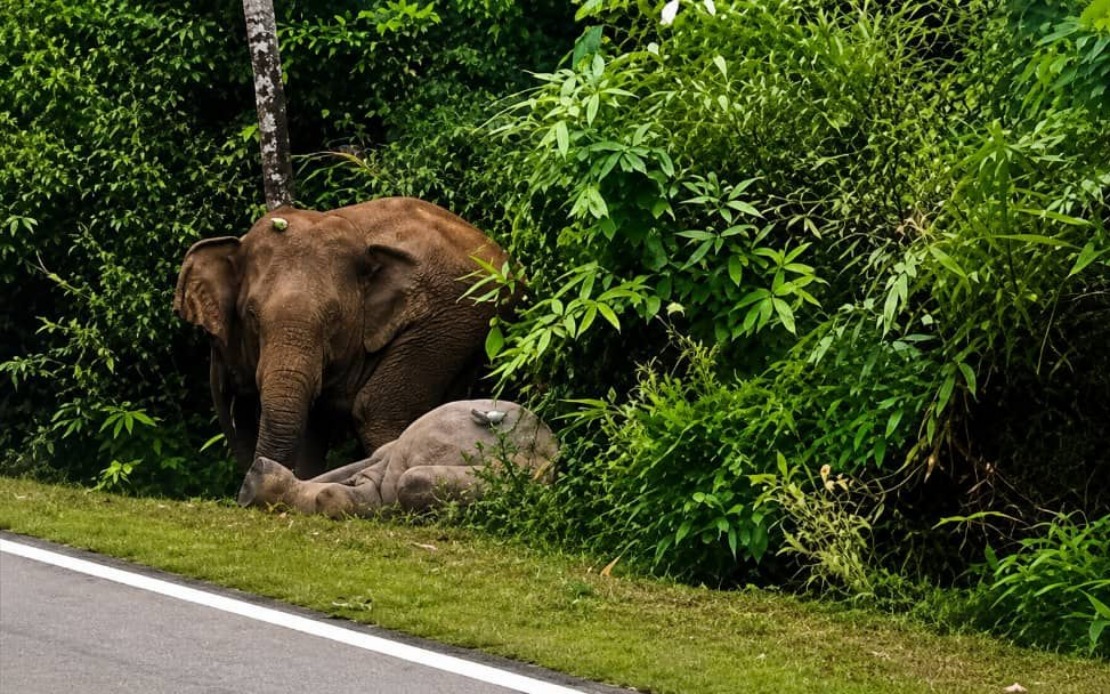
A heartbreaking incident unfolded in Mersing, Johor, this morning when a young elephant was fatally struck by a vehicle, prompting its mother to remain at the roadside for seven hours in a poignant display of maternal grief. The tragedy, which occurred at around 2.28 am along Jalan Felda Nitar, has drawn comparisons to the Gerik incident that captured public attention and sympathy last Mother's Day, reigniting concerns about the escalating clash between human infrastructure and wildlife in Malaysia's increasingly developed regions.
Social media footage documenting the mother elephant's refusal to abandon her offspring circulated widely, with the distressed animal remaining near the carcass even as authorities arrived on scene. The Johor Department of Wildlife and National Parks (Perhilitan) received notification of the incident around 8.30 am and promptly dispatched four personnel to investigate. Upon assessment, wildlife officers determined that the deceased elephant was a female calf, estimated at five years old, measuring approximately 150 centimetres in body length with no tusks. Distinctive physical measurements—including a front footprint width of 11 inches and rear footprint width of 14 centimetres—were documented to aid in future identification and monitoring of the herd.
The vehicle involved was a Perodua Bezza, and the collision resulted in consequences for the human driver as well. A 31-year-old motorist sustained leg injuries after the impact sent his vehicle plummeting five metres into a ravine, necessitating rescue by the Fire and Rescue Department. This dual tragedy underscores the precarious nature of wildlife corridors that intersect with human transportation networks, where both animals and drivers face severe danger during nocturnal travel through elephant territory.
The elephant herd has been identified as belonging to the Jamaluang-Mersing ID group, indicating that wildlife authorities maintain documented records of specific herds operating within particular geographic zones. This classification system enables Perhilitan to track population dynamics and movement patterns, though the incident raises questions about the effectiveness of current mitigation strategies. The Elephant Capture Unit from the Johor Elephant Sanctuary played a crucial role in the response, working to guide the grieving mother back into the forest rather than allowing her to remain at the roadside where she faced continued danger from vehicle traffic.
The carcass of the young elephant was subsequently buried near the accident site, a practical measure that also aims to minimise further disturbance to the bereaved animal. Perhilitan announced plans for intensive patrols throughout the evening and following day to monitor the mother elephant's wellbeing and discourage her from returning to the accident location, a behaviour documented in similar human-elephant conflict incidents. Such maternal persistence in returning to tragedy sites poses ongoing risks both to the animal's survival and to subsequent motorists unfamiliar with the situation.
The Mersing location had previously been designated with elephant crossing warning signs, indicating that authorities were aware of the area's significance as a migration corridor. However, the presence of signage alone has demonstrated limited effectiveness in preventing fatal collisions, particularly during pre-dawn hours when visibility is compromised and drivers may be fatigued or inattentive. The incident raises urgent questions about whether additional engineering interventions—such as underpasses, elevated roadways, or more aggressive speed restrictions during high-risk periods—might be necessary in critical elephant corridor zones across peninsular Malaysia.
The Gerik tragedy referenced in today's incident occurred on May 11 of the previous year, when a young elephant became trapped beneath a container lorry after being struck, while its mother was observed attempting to push the heavy vehicle in what witnesses interpreted as a desperate rescue effort. That event captured global media attention and sparked passionate public discourse about habitat fragmentation, development encroachment into protected areas, and the urgency of coexistence strategies. The Gerik incident brought the human-elephant conflict narrative into mainstream consciousness, leading to renewed calls for stringent enforcement of wildlife protection laws and infrastructure improvements.
The frequency of such tragedies, now occurring in successive years across different Peninsular Malaysian locations, suggests an escalating crisis in human-elephant relations. As development continues to fragment previously contiguous elephant habitats and as transportation networks expand into wildlife territories, herds are increasingly forced onto dangerous roads that bisect their ancestral ranges. The Mersing incident demonstrates that symptomatic responses—rescue operations, patrols, and burial protocols—address only the immediate aftermath rather than the systemic drivers of conflict.
For Malaysian motorists traversing elephant corridors, particularly along routes connecting Johor to other peninsular regions, heightened vigilance during low-light hours remains critical. The young driver's severe injuries serve as a sobering reminder that wildlife collisions carry severe human consequences, potentially complicating conservation narratives focused solely on animal welfare. Insurance companies, vehicle manufacturers, and transport regulatory bodies must grapple with the reality that certain Malaysian roadways present unique hazards requiring specialised driver awareness and vehicle safety protocols.
The incident underscores the emotional and psychological dimensions of wildlife conservation that statistics alone cannot capture. The mother elephant's seven-hour vigil resonates deeply because it communicates something universal about parental attachment across species boundaries. Yet this emotional resonance, while potentially mobilising public support for wildlife protection, must translate into concrete policy changes and infrastructure investments. State and federal authorities face mounting pressure to demonstrate that the lessons from Gerik have genuinely informed revised approaches to development planning, road design, and habitat preservation in elephant range areas.
Moving forward, wildlife experts contend that Malaysia requires a comprehensive reassessment of development corridors overlapping with identified elephant migration routes. This includes enforcing existing regulations preventing construction in sensitive areas, installing wildlife detection systems that can alert drivers to animal presence, and potentially implementing seasonal or temporal restrictions on traffic in critical periods. The mother elephant that grieves in Mersing today represents not merely an individual tragedy but a symptom of a broader conservation failure that demands urgent, multi-faceted intervention from government, corporate, and civil society actors.

