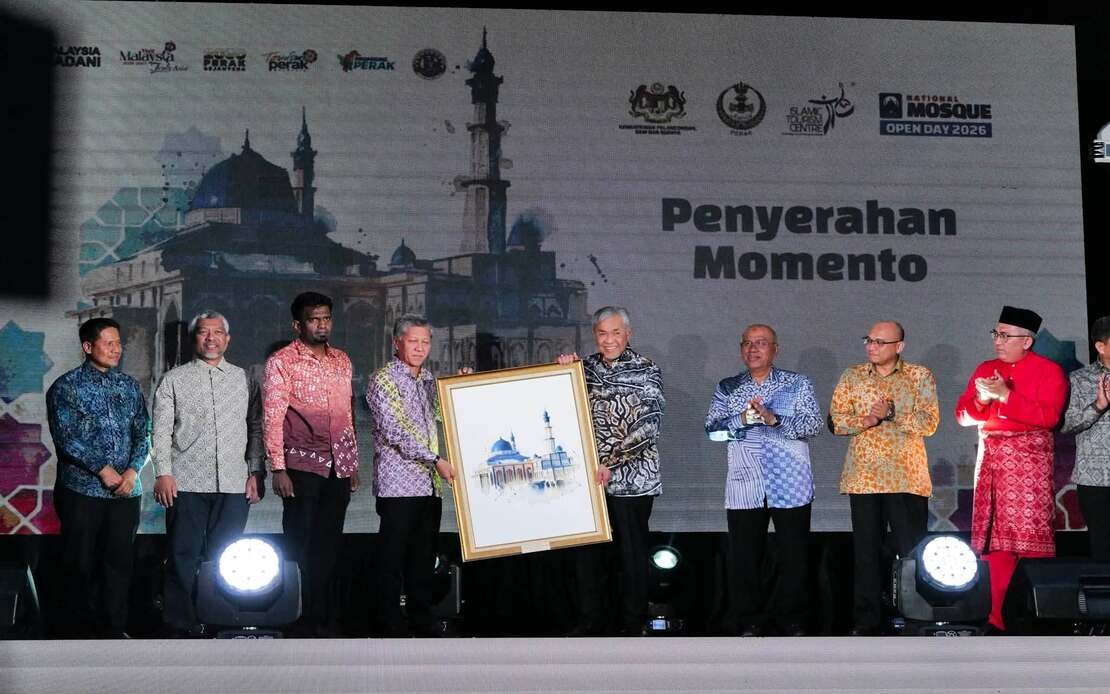
Deputy Prime Minister Datuk Seri Dr Ahmad Zahid Hamidi has called for Malaysia's mosque institutions to assume a more prominent position within the nation's tourism landscape, combining their traditional spiritual and educational roles with an outward-facing mission to welcome international and domestic visitors. Speaking at the National Mosque Open Day 2026 in Bagan Datuk, Ahmad Zahid articulated a vision in which mosques serve simultaneously as active religious centres and gateways for discovering Malaysia's Islamic heritage and civilisation.
The Deputy Prime Minister framed the integration of mosques into tourism infrastructure as a natural extension of their existing responsibilities. Rather than viewing tourism and worship as competing demands, Ahmad Zahid suggested that welcoming guests offers an opportunity to present an authentic portrait of Malaysia's Islamic values and the nation's broader cultural identity. He emphasised that visitors should depart not merely with photographs of architectural splendour, but with meaningful encounters demonstrating Malaysian hospitality and the principles underpinning Islamic life in a multicultural society.
Eventually, Ahmad Zahid argued, the momentum generated by initiatives such as the National Mosque Open Day justifies expansion of such programmes across the country. By opening mosque facilities to visitors of diverse religious backgrounds, educational levels and age groups, these institutions create spaces for genuine cross-cultural exchange conducted in an atmosphere of mutual respect. This approach, he suggested, counters misperceptions and builds nuanced understanding of Islam as a living faith within Malaysian communities.
The strategy extends beyond passive tourism. Ahmad Zahid stressed that the manner in which mosque communities welcome and interact with guests carries theological significance, offering tangible demonstrations of Islamic teachings centred on compassion, wisdom and generosity. By translating abstract religious principles into concrete hospitality practices, mosques become educators in their own right, illustrating how Islamic values manifest in contemporary Malaysian life.
During the same event, Ahmad Zahid expressed satisfaction that Masjid Tuminah Hamidi in Bagan Datuk—completed in 2023 as a waqf honouring his parents—has been designated as Malaysia's 98th Tourism Mosque by the Islamic Tourism Centre (ITC) under the Ministry of Tourism, Arts and Culture. The mosque's recognition reflects its distinctive architectural style and on-site gallery functioning as an Islamic knowledge repository.
Mohammad Faisal Abu Suaib Khan, Director-General of the Islamic Tourism Centre, disclosed that Malaysia currently operates 6,851 mosques, representing substantial untapped potential for tourism development. The ITC envisions significantly expanding the roster of Tourism Mosques by identifying facilities offering distinctive architectural elements, historical significance or cultural programmes suitable for positioning as Islamic tourism products. This expansion requires systematic coordination between the ITC, the Department of Islamic Development Malaysia (JAKIM) and state-level religious authorities.
The certification framework reflects broader regional and global trends in Islamic tourism. Malaysia's positioning as a Muslim-majority nation with substantial tourism infrastructure has created opportunities for developing niche travel markets catering to religiously conscious visitors. The ITC's emphasis on the principle of "Muslim-Friendly, not Muslim-Only" indicates an attempt to design welcoming spaces that accommodate diverse visitor profiles while maintaining Islamic standards and authenticity.
Supporting infrastructure accompanies the mosque integration strategy. The ITC operates initiatives including the Muslim-Friendly Tourism and Hospitality Assurance and Recognition (MFAR) programme and Muslim-Friendly Tourist Guides certification, designed to elevate professional standards across tourism sectors serving both Muslim and non-Muslim clientele. These complementary programmes strengthen the coherence of Malaysia's Islamic tourism ecosystem.
The National Mosque Open Day 2026, conducted from August 13 to 15 at Masjid Tuminah Hamidi and Dataran Bagan Datuk, exemplifies the integrated programming Ahmad Zahid envisions. By combining spiritual activities, community engagement, cultural presentations and recreational elements within a family-oriented framework, the event demonstrates how contemporary mosque institutions balance multiple social functions.
For Malaysian policymakers, the mosque tourism initiative represents a pragmatic approach to economic development aligned with cultural and religious values. By positioning Islamic heritage as a tourism asset, the government creates revenue opportunities for mosque communities while reinforcing Islamic institutional vitality. This strategy becomes particularly relevant as Southeast Asian nations compete for share in global halal and Islamic tourism markets expanding at rates substantially exceeding general tourism growth.
The expansion of Tourism Mosques carries implications for Malaysia's international positioning and domestic interfaith relations. International visitors encountering welcoming mosque environments become informal ambassadors for Malaysia's model of religious coexistence and Islamic modernity. Domestically, the visibility of inter-religious engagement within mosque spaces potentially influences majority Muslim perceptions of religious pluralism and minority perspectives on Islamic institutional openness.
Yet successful implementation requires sustained commitment and resources. Mosque communities must balance tourism operations with uninterrupted worship schedules and educational programming. Training and awareness initiatives for mosque staff and volunteers become essential, ensuring that tourism integration enhances rather than compromises religious functions. The coordination mechanisms between ITC, JAKIM and state authorities must operate efficiently to establish consistent standards across diverse institutional contexts.
The mosque tourism framework ultimately reflects Malaysia's broader positioning as a destination bridging Islamic heritage with multicultural modernity. As Ahmad Zahid's remarks indicate, this positioning demands that religious institutions themselves become active ambassadors for Malaysia's distinctive approach to Islamic life in a plural society.

