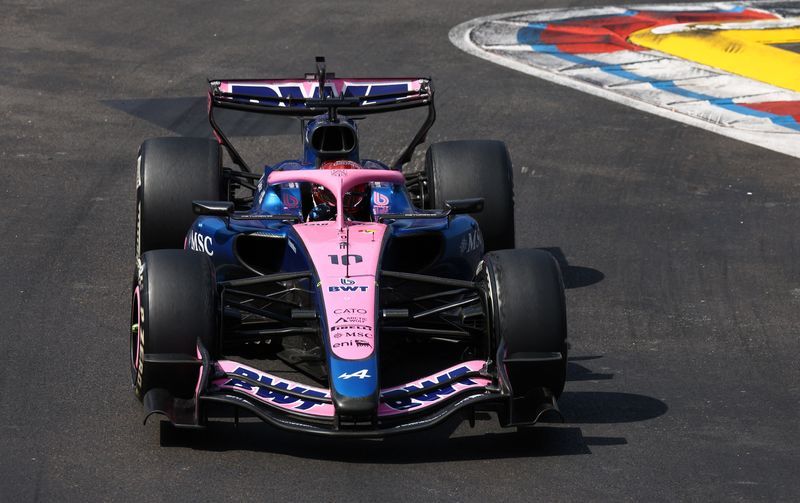
The mystery surrounding Formula One's Monaco Grand Prix result deepens as the sport's governing body confirmed that appeal court judges will require two to three weeks to deliver their verdict on one of the most contentious decisions in recent racing memory. The FIA's international court of appeal convened behind closed doors in Paris on Tuesday to hear arguments in a case that has already been through multiple reversals and now threatens to reshape the championship standings and undermine public confidence in the consistency of race stewardship.
At the heart of the controversy lies a straightforward question with complicated ramifications: who legitimately finished third in the June 7 race at Monaco? Alpine's Pierre Gasly crossed the line in that position but was subsequently demoted to seventh place when stewards applied two five-second penalties for exceeding pit-lane speed limits. Red Bull's Isack Hadjar inherited the podium spot and celebrated accordingly, even spraying champagne on the podium in what would have been a defining moment for the young driver's career. However, just five days later on June 12, this decision was dramatically reversed after Alpine presented evidence of a timekeeping error, leading to Gasly's reinstatement and Hadjar's demotion back down the order.
The back-and-forth nature of the ruling has created an unprecedented situation in Formula One where the result of a completed race remains unresolved weeks after the chequered flag waved. This uncertainty has triggered formal appeals from Red Bull and McLaren, whose drivers also received penalties for the same pit-lane speeding infraction. The extended timeline for a judgment speaks to the complexity of the legal and regulatory questions at stake, suggesting that the court must carefully weigh competing interpretations of Formula One's technical regulations and the sporting code that governs penalties.
The ripple effects of this decision extend far beyond Hadjar's claim to a trophy. McLaren's Oscar Piastri was demoted to fifth place as a direct consequence of Gasly's reinstatement, with Liam Lawson of Racing Bulls dropped to sixth and Arvid Lindblad pushed to seventh. In a championship where points accumulation can determine millions of dollars in constructors' prize money, a single position shift represents far more than mere statistics—it reflects genuine financial and competitive consequences. The Mercedes victory achieved by championship leader Kimi Antonelli, with Ferrari's Lewis Hamilton completing the podium, anchored the race results even as lower positions remain contested.
What makes this situation uniquely troublesome for the sport is the divergent treatment of drivers who committed ostensibly the same infraction. Gasly received his penalties post-race, creating the opportunity for later review and reversal. Conversely, Oscar Piastri served identical five-second penalties during the race itself, meaning he could not benefit from any subsequent review process regardless of circumstances. This asymmetry troubled McLaren team principal Andrea Stella, who articulated his concerns about fairness to competitors who followed different penalty procedures through no fault of their own. Mercedes driver George Russell, another title contender, similarly suffered from pit-lane speeding penalties applied during the race, leaving him outside the points and unable to recover.
Stellas's decision to lodge a formal appeal reflects McLaren's recognition that the Monaco result carries championship implications extending well beyond a single race weekend. The team boss acknowledged at the following Dutch Grand Prix that the reversal of Gasly's penalties raised substantial concerns about the equitable application of sporting regulations. For McLaren, the situation carries genuine monetary and competitive weight, but Stella emphasized that the appeal equally concerns broader questions about Formula One's integrity and whether regulations are administered consistently across different scenarios.
The stewards themselves appeared cognizant of the fairness problem when they reversed their original decision. Official documentation from the June 12 overturning noted that the original penalty application had created an unjust situation for drivers whose identical offences were handled differently. However, stewards simultaneously acknowledged in their written reasoning that existing regulations contain no provision for rescinding penalties already served during a race. This apparent contradiction—recognizing unfairness while lacking mechanism to remedy it—exposes gaps in Formula One's regulatory framework and suggests that the current system may inadequately anticipate scenarios where procedural timing creates substantially different outcomes for equivalent violations.
The closed-door nature of Tuesday's appeal hearing meant no substantive details emerged regarding the arguments presented by the interested parties or the court's apparent concerns. This opacity is standard practice for appeal proceedings but nevertheless frustrates fans and observers seeking to understand the legal reasoning behind such significant decisions. The confidential hearing format reflects Formula One's quasi-judicial structure, where regulatory matters are handled through specialized courts rather than open litigation, yet such secrecy inevitably fuels speculation and criticism about potential bias or inconsistent application of rules.
With the Italian Grand Prix scheduled for Monza on September 6 and Formula One preparing to debut its Madrid circuit on September 13, the racing calendar advances relentlessly even as this unresolved matter hangs over the sport. Teams and drivers competing in upcoming races will do so cognizant that their championship standings remain subject to revision based on a decision that could still weeks away. For Southeast Asian readers following Formula One, this dispute exemplifies the governance challenges that professional motorsport continues to navigate—balancing regulatory clarity against situational fairness, maintaining competitive integrity while acknowledging human error, and ensuring that administrative procedures treat all participants equitably regardless of procedural timing or circumstance.
The extended timeline for the court's decision suggests that multiple complex arguments deserve careful consideration, yet the delay equally reflects Formula One's ongoing struggle to establish clear, predictable rules that eliminate such ambiguity. Whatever the judges ultimately decide, the process has already revealed weaknesses in how the sport addresses penalty administration when timing and procedure create asymmetrical outcomes. The ruling will presumably clarify the regulatory interpretation for future races, but it arrives only after demonstrating how thoroughly the current system can generate confusion, controversy, and uncertainty about fundamental sporting fairness.

