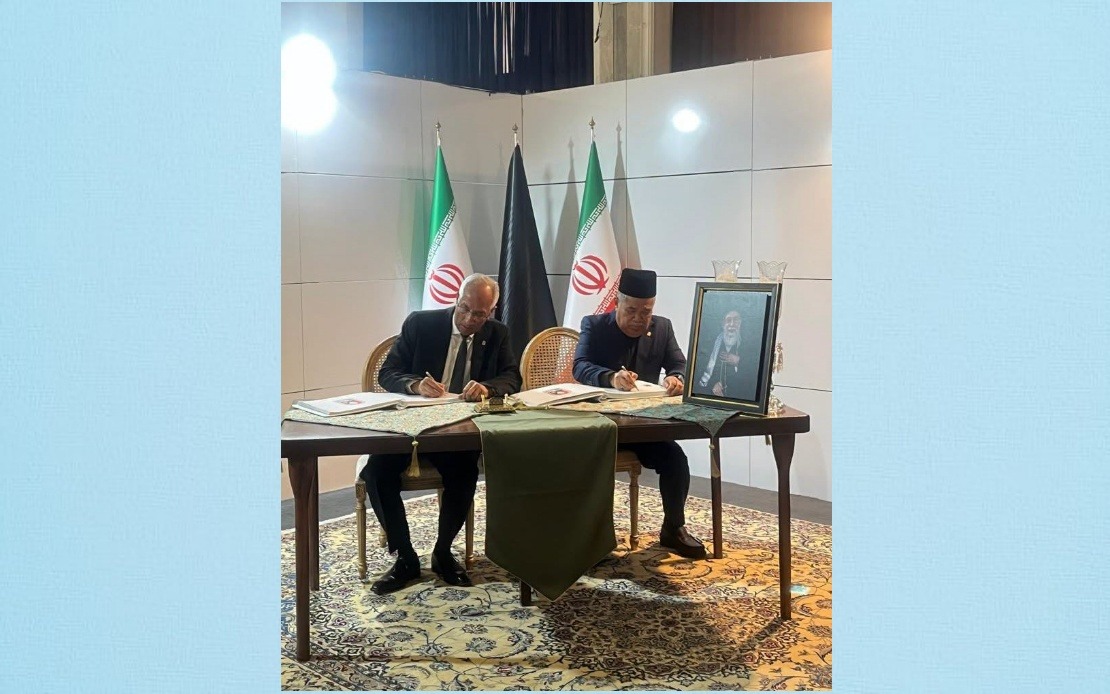
Malaysia's Minister of Agriculture and Food Security Datuk Seri Mohamad Sabu travelled to Iran this week as head of an official government delegation to pay final respects to Ali Khamenei, the country's former Supreme Leader, at a ceremony held at the Grand Mosalla in Tehran. The visit reflects the significance Malaysia places on its relationship with Iran and demonstrates the government's commitment to honouring the life of a prominent regional leader whose influence extended across the Muslim world and beyond.
Khamenei's death occurred on February 28 following what Malaysian officials and Iranian authorities characterised as an attack with involvement from the United States and Israel. Despite the passage of more than one hundred days since his death, the Iranian government organised an extended period of mourning and ceremonial tribute that would span multiple sacred sites across the Islamic Republic. The scale and duration of these observances underscored Khamenei's stature within Iran's political system and his role as a symbolic figurehead for millions of Shia Muslims globally.
According to statements made by Mohamad on social media, the ceremonial programme extended well beyond the initial gathering in Tehran. The delegation and other mourners would travel to the holy cities of Qom and Najaf before proceeding to Karbala, one of Shiism's most revered pilgrimage destinations. The journey culminated with Khamenei's interment at the Imam Reza Shrine in Mashhad, scheduled for July 9, transforming what might ordinarily be a single state funeral into an extended national and religious observance that connected Iran's political capital with its most sacred religious centres.
Upon his arrival in Tehran, Mohamad received formal greetings from Iran's Speaker of Parliament Mohammad Bagher Ghalibaf and Foreign Minister Abbas Araghchi, indicating the diplomatic weight attached to Malaysia's representation. These interactions highlighted the protocol accorded to Malaysia as a significant Muslim-majority nation with established diplomatic channels and historical ties to the Iranian state. The presence of senior Iranian officials welcoming the Malaysian delegation suggested mutual respect and recognition of shared interests in regional affairs.
For Malaysia, the dispatch of a ministerial delegation carried particular significance given the country's position as a leading voice within the Organisation of Islamic Cooperation and its broader engagement with Middle Eastern affairs. Throughout his tenure, whether in various government roles, Mohamad had cultivated a profile as an advocate for Islamic causes and a bridge-builder in Muslim-majority diplomacy. His personal participation in honouring Khamenei reflected not merely routine diplomatic courtesy but a deliberate statement about Malaysia's approach to regional relationships and its respect for Islamic leadership figures.
The timing of the ceremonies also deserved consideration within the context of broader Middle Eastern geopolitics. The involvement the Malaysian government attributed to the United States and Israel in Khamenei's death represented a contentious claim within the region, and Malaysia's willingness to participate in extended mourning ceremonies implicitly acknowledged grievances that resonated across segments of the Muslim world. This positioning reflected Malaysia's historical sympathy toward Palestinian causes and its consistent advocacy for Muslim interests in international forums.
Khamenei's role in shaping Iran's domestic and foreign policy for decades meant his passing marked a significant transition for the Islamic Republic. As Supreme Leader, he had wielded influence over Iran's military, judiciary, and state media, and his death created a succession moment that carried implications for regional stability, nuclear negotiations, and relations with Western powers. Malaysia's diplomatic presence at these ceremonies indicated the country's interest in maintaining stable relations with whatever leadership configuration emerged in Tehran.
For Southeast Asian observers, Malaysia's active participation in such high-level Islamic observances demonstrated the country's ambitions to play a mediating role within Muslim-majority diplomacy. While maintaining relationships with Western partners, Malaysia simultaneously cultivated ties with Middle Eastern powers, a balance that required careful management of symbolic gestures and substantive engagement. The delegation's attendance represented Malaysia's attempt to maintain credibility and relevance within Islamic diplomatic circles without alienating other important relationships.
Moreover, Mohamad's personal presence and public documentation of the ceremonies through social media served to communicate Malaysia's position to both Iranian audiences and domestic constituencies. In Malaysia, where Islamic sensitivities held political weight, participation in such observances carried domestic political implications alongside international diplomatic messaging. The public nature of his statements and prayers reflected an understanding that such gestures resonated with segments of the Malaysian electorate who viewed Islamic solidarity as an important value.
The ceremonies also exemplified how modern nation-states employed ritual and ceremonial participation to signal alignment and shared values within the broader Islamic world. While the immediate occasion was Khamenei's funeral, the extended nature of the observances and Malaysia's participation in them constituted a form of soft power projection. Through attendance, Malaysia signalled its commitment to Islamic causes and its willingness to engage with Iran despite the country's international isolation arising from Western sanctions and geopolitical tensions.
Moving forward, Malaysia's role in these ceremonies likely positioned the country to maintain or strengthen diplomatic channels with post-Khamenei Iranian leadership. The goodwill generated through such high-level participation, combined with Malaysia's established relationships with Iranian officials, provided potential foundation for future cooperation on issues ranging from trade and investment to regional security and Islamic affairs. For a country seeking to amplify its voice in Muslim-majority diplomacy, such visible gestures of solidarity with significant regional powers carried strategic value.
The delegation's journey through Iran's sacred cities also underscored the intersection of political leadership and religious significance in Islamic governance. By honouring Khamenei across multiple holy sites, Malaysia participated in a ceremonial framework that emphasised his role not merely as a political figure but as a custodian of Islamic values and authority. This spiritual dimension distinguished the ceremonies from ordinary state funerals and reflected the particular character of Iran's theocratic system, where political and religious authority remained fundamentally intertwined.

