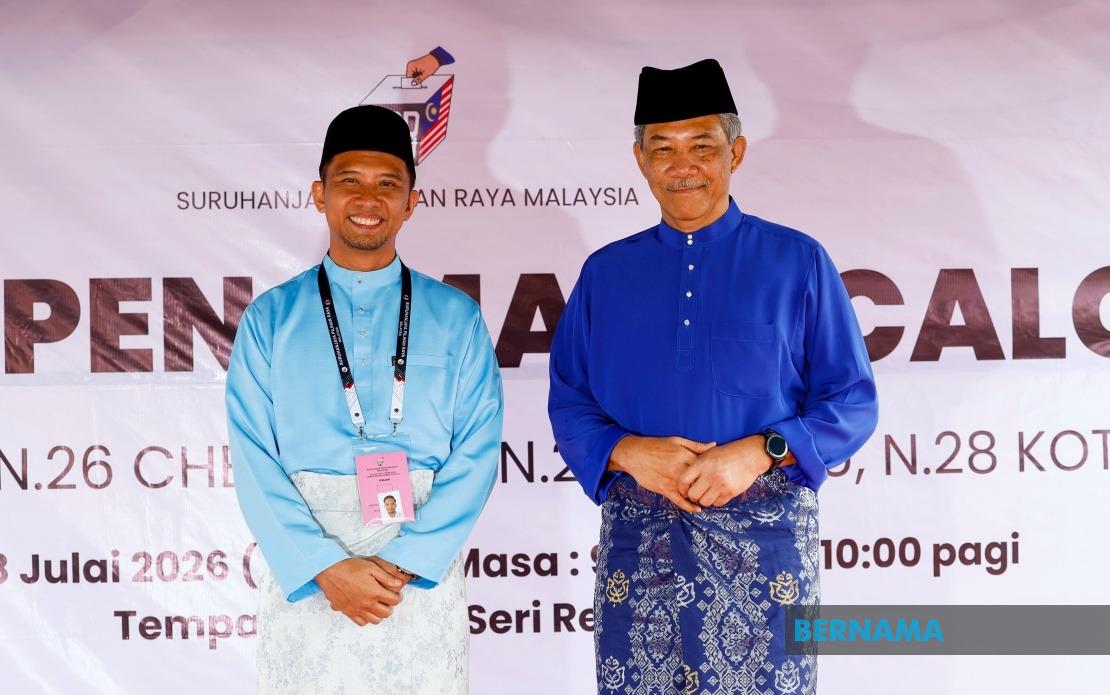
The Rantau state seat contest has crystallised into a straight fight between two starkly different candidates as Negeri Sembilan gears up for its 16th state election. Foreign Minister Datuk Seri Mohamad Hasan, representing the ruling Barisan Nasional coalition, will defend his two-decade grip on the constituency against Pakatan Harapan's Dr Azizul Hakim Mahdi, a 35-year-old medical practitioner entering electoral politics for the first time. The returning officer officially confirmed the contest after the nomination process concluded at Dewan Sri Rembau on July 18, setting the stage for what observers anticipate will be a closely watched bellwether race in the state.
Modamad's formidable electoral pedigree cannot be overstated. The UMNO deputy president has represented Rantau since 2004 and has become one of the party's most durable figures in Negeri Sembilan politics. His elevation to the cabinet as Foreign Minister underscores his standing within the BN machinery, though it may also invite scrutiny from voters questioning whether his attention remains adequately focused on local concerns. In the previous 2023 state election, he secured a commanding 10,280-vote majority, polling 16,957 votes compared to PH's Rozmal Malakan, who managed only 6,677. This substantial margin suggests a loyal voter base, yet opposition strategists may see potential vulnerabilities in any perceived neglect of grassroots engagement.
Dr Azizul Hakim presents himself as a generational alternative, leveraging his healthcare credentials and local business presence to differentiate his candidacy. With a decade of medical practice and ownership of three clinics across Senawang, Puncak Alam, and Melaka, he projects an image of professional competence and community commitment distinct from typical political trajectories. His campaign messaging centres on healthcare accessibility and localized problem-solving, themes that resonate particularly in constituencies where medical facilities and service quality remain contentious issues. The doctor's relatively youthful energy may appeal to demographic segments seeking fresh faces unburdened by historical political baggage.
Beyond Rantau, the Negeri Sembilan contest unfolds across multiple battlegrounds with varying competitive dynamics. Paroi presents a three-way scramble between Ahmad Shahir Mohd Shah of PH, who serves as press secretary to the Menteri Besar, Perikatan Nasional's Kamarol Ridzuan Mohd Zin, and Bersatu's Mohd Nazree Mohd Yunus. The involvement of the opposition coalition's own media functionary signals confidence, though fragmentation on the anti-BN side introduces unpredictability. Chembong features a binary contest between incumbent BN's Datuk Zaifulbahri Idris and PH challenger Danish Nazran Murad, offering a straightforward ideological confrontation. Kota similarly divides three ways, with BN's Suhaimi Aini facing PH's Muhammad Allif Ibrahim and Bersatu's Akmal Noradzmi Abdul Rahim, reflecting the complex realignment of Malaysia's political landscape post-2022.
The broader electoral framework encompasses 36 state assembly seats with a total registered electorate of 889,490 voters. This comprises 867,151 ordinary voters, supplemented by 16,884 military personnel and their spouses, and 5,455 police personnel designated as early voters. The relatively substantial military and police voting contingent reflects Negeri Sembilan's significance as a region with defence and security installations, a factor that traditionally favours governing coalitions. Early voting is scheduled for July 28, with the official polling day set for August 1, providing a compressed campaign window that advantages well-organised machinery over grassroots insurgencies.
Modamad's campaign strategy emphasises the BN manifesto and systematic organizational deployment, reflecting confidence rooted in historical dominance. His messaging prioritizes conveying the coalition's policy platform and consolidating existing support rather than pursuing aggressive expansion. This defensive posture, while understandable given his incumbency, may underscore subtle vulnerability—the assumption that simply mobilizing known supporters suffices. In Negeri Sembilan's political ecology, where rural constituencies predominate and BN has traditionally commanded strong traditional leader networks, such organizational discipline can prove decisive. Yet urbanizing areas and younger voter segments occasionally diverge from predictable patterns, creating pockets of unpredictability.
Dr Azizul Hakim's positioning as a healthcare-focused professional candidate taps into persistent discontent regarding medical accessibility and service quality. Malaysian voters, particularly in secondary towns and fringe areas, frequently cite healthcare grievances as priority concerns. A candidate offering substantive local clinic experience rather than merely rhetorical commitment to health infrastructure may gain traction among pragmatic voters prioritizing concrete delivery over partisan loyalty. His youth simultaneously cuts both ways—fresh energy attracts reform-minded voters, yet his limited political experience invites questions about legislative effectiveness and navigation of complex state governance.
The nomination process's completion triggered the official campaign period, activating the state's electoral machinery across all constituencies simultaneously. For BN, this represents an opportunity to leverage governmental incumbency, administrative resources, and established grassroots networks to solidify control. The coalition retains significant advantages in name recognition, organizational depth, and media access. Conversely, PH's opposition status permits positioning as a vehicle for change and accountability, arguments that periodically resonate in constituencies where voter sentiment tilts toward incumbent fatigue or service delivery frustration.
Negeri Sembilan's electoral significance extends beyond the state itself, influencing national political narratives. Results from constituencies like Rantau shape broader interpretations regarding BN's resilience following Perikatan Nasional's rise and the complex three-way competition within the opposition bloc. A comfortable Mohamad Hasan victory would reinforce BN's capacity to retain heartland support despite contemporary political turbulence. Conversely, any significant reduction in his winning margin or an unexpected upset would signal shifting voter dynamics that analysts would scrutinize for implications regarding the 2026 national election. The 36-seat state assembly contests thus serve as a crucial testing ground for Malaysia's evolving political coalitions.
The military and police voting populations warrant particular attention given their concentration in Negeri Sembilan. These constituencies historically demonstrate strong BN preference, though post-2018 realignments occasionally surprised observers. Their participation through early voting on July 28 effectively determines a portion of the outcome before general polling occurs, potentially establishing momentum narratives that influence remaining voters' behaviour. For candidates like Dr Azizul Hakim, limited access to these organized voting blocks compounds the structural disadvantage of challenging an established incumbent.
Campaign dynamics will intensify over the fortnight preceding August 1 polling. Mohamad Hasan, as a cabinet minister and UMNO deputy president, commands national media attention and party resources vastly exceeding those available to Dr Azizul Hakim. PH's strategy likely emphasizes local issues and healthcare delivery gaps while potentially highlighting Mohamad's extralocal commitments as evidence of divided attention. The doctor's campaign must overcome name recognition deficits while converting professional credentials into perceived legislative value—a challenging calculus in a polity where party machinery and incumbency typically predominate.
Negeri Sembilan's state election ultimately represents a microcosm of Malaysia's contemporary political competition. The Rantau contest between Mohamad Hasan and Dr Azizul Hakim encapsulates broader tensions between establishment governance and reform aspirations, between organizational incumbency and fresh-faced alternatives, between seasoned political operatives and professional-class newcomers. The August 1 results will reveal whether voters in this traditionally BN-friendly state view continuity with Mohamad Hasan as preferable to experimentation with Dr Azizul Hakim's healthcare-centred platform, informing subsequent political strategizing across Malaysia's electoral landscape.

