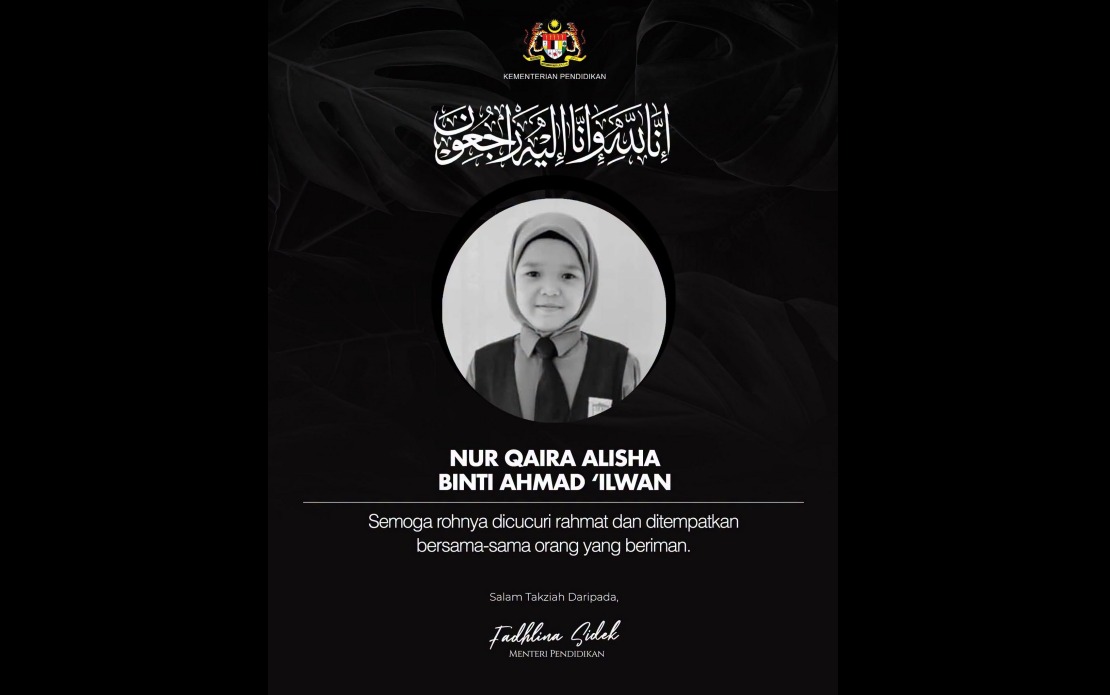
Education Minister Datuk Seri Fadhlina Sidek has instructed the Ministry of Education's Integrity Unit to pursue additional inquiries following a formal complaint lodged by the family of Nur Qaira Alisha Ahmad Ilwan, a Year Four student whose death has prompted urgent questions about school protocols and student welfare safeguards. The minister confirmed that any subsequent proceedings would strictly adhere to established procedures and be governed by equitable treatment of all stakeholders involved in the matter.
Fadhlina disclosed that the Kedah State Education Department has already undertaken an initial investigation into the family's grievances, laying groundwork for the ministry's wider examination. The move signals heightened scrutiny into circumstances surrounding the child's passing and whether institutional systems adequately protected her despite documented health vulnerabilities. The ministry's commitment to reassess procedures reflects growing public concern about accountability mechanisms within educational institutions across the country.
The tragic case centres on Nur Qaira, who had lived with a serious cardiac condition from infancy—diagnosed when she was merely three months old. Medical professionals had consistently advised against her participation in strenuous physical activities, and her school had received formal documentation confirming these restrictions. Yet allegations emerged that during sports house selection events on April 15, a teacher pressured the girl to compete in running activities, circumventing the established medical exemption. This apparent disregard for documented health warnings forms the crux of the family's complaint.
Nur Qaira's condition deteriorated dramatically within days of that sports day. By late April, she required emergency hospitalisation at Sultanah Bahiyah Hospital after experiencing severe vomiting and facial swelling. Medical assessments subsequently revealed heart failure brought on by decompensated dilated cardiomyopathy—a progressive weakening of the heart muscle that her pre-existing condition had made her vulnerable to. The combination of underlying cardiac disease and the physical exertion appears to have triggered the cascade of complications that ultimately claimed her life.
For Malaysian parents, the case exposes a disturbing gap between administrative policy and classroom implementation. Although schools maintain systems for documenting medical conditions and activity restrictions, enforcement mechanisms appear fragmented. The incident suggests that teachers or event organisers may not consistently cross-reference student health files when making decisions about participation in physical activities. This represents a systemic vulnerability that extends beyond a single school, affecting institutions nationwide where similar communication breakdowns could occur with comparable consequences.
Fadhlina's public acknowledgment that student safety and welfare remain paramount priorities reflects the political sensitivity surrounding the matter. The minister emphasised that the ministry recognises its fundamental duty to create environments where vulnerable children receive protection rather than exposure to foreseeable risks. By characterising the investigation as proceeding according to principles of justice, she signalled an intention to balance accountability with procedural fairness—acknowledging both the grieving family's legitimate demands for answers and the need for impartial assessment of individual responsibility.
The decision to elevate the matter to the Integrity Unit carries symbolic weight beyond the specific investigation. It positions the complaint within a formal accountability framework rather than treating it as a routine school incident, demonstrating institutional recognition of systemic importance. For comparable cases accumulating across Southeast Asian education systems, Malaysia's approach may establish precedent regarding how governments handle allegations of preventable harm resulting from institutional negligence involving children with pre-existing medical conditions.
Fadhlina extended formal condolences to Nur Qaira's parents and extended family, framing the ministry's engagement as providing space and emotional support during their bereavement. This pastoral dimension acknowledges that alongside institutional investigations and accountability mechanisms, the family requires genuine human recognition of their loss. The calculated compassion evident in the minister's statement reflects awareness that public confidence in educational institutions depends partly on demonstrating genuine concern for affected families rather than purely bureaucratic responses.
The broader implications extend to how Malaysian schools manage medical information and coordinate between administrative systems and teaching staff. Students with chronic conditions ranging from cardiac problems to diabetes, asthma, and neurological disorders attend mainstream schools throughout the country. Each represents a potential point of institutional failure if teachers lack awareness of restrictions, if documentation systems fail to communicate effectively, or if competitive pressures surrounding school events override documented safety protocols. Nur Qaira's case has galvanised renewed attention to these intersecting vulnerabilities.
Looking forward, the investigation's findings may necessitate revised protocols for teacher training on recognising and respecting documented medical accommodations, enhanced mechanisms for flagging high-risk students before school events, and clearer accountability measures when restrictions are allegedly disregarded. Southeast Asian education systems increasingly recognise that inclusion and participation, while educationally valuable, must never compromise the basic safety of students with known health vulnerabilities. The balance between encouraging full school participation and protecting medically fragile children remains perpetually challenging, but cases like Nur Qaira's suggest that current safeguards require systematic strengthening.
The ministry's willingness to investigate sends a necessary signal that institutional failures affecting student wellbeing warrant serious examination. For Malaysian parents managing children's complex medical conditions, formal investigation into a preventable death acknowledges their fundamental concern: that schools bear responsibility for implementing documented health protections consistently and competently across all school environments and activities.

