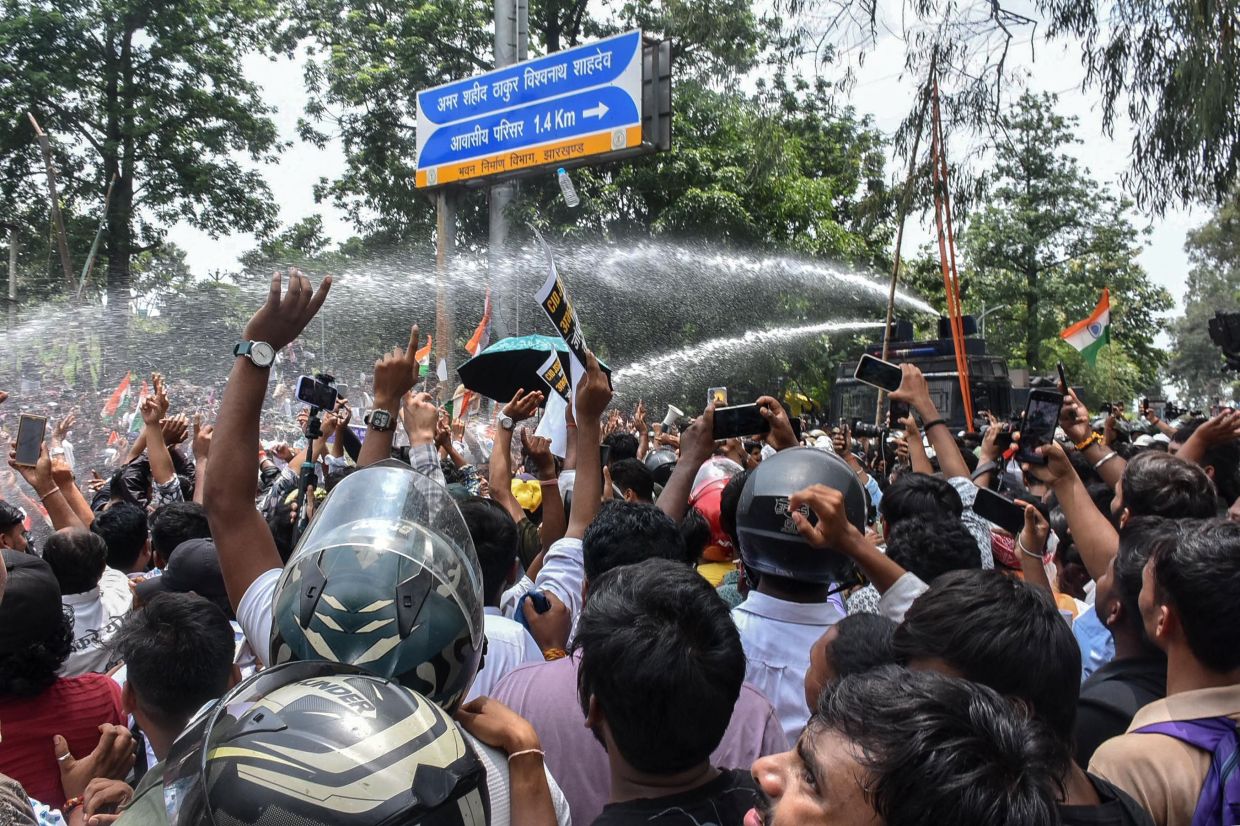
Prime Minister Narendra Modi's Bharatiya Janata Party has levelled fresh accusations against the activist collective that orchestrated prominent student demonstrations in New Delhi, claiming the group has abandoned its campaign zeal when faced with similar unrest in the eastern state of Jharkhand. The criticism emerged as major protests continue to roil the mineral-rich region, with thousands of students demanding independent investigation into alleged irregularities affecting state employment examinations.
According to BJP spokesperson Keya Ghosh, the Cockroach Janta Party has adopted a conspicuously passive stance towards the Jharkhand agitation, contrasting sharply with its aggressive leadership of last month's New Delhi demonstrations. Ghosh suggested on Tuesday that this apparent disengagement reveals the group's true intentions, alleging that its previous activism was designed principally to undermine the Modi government rather than champion genuine student grievances. The timing of the criticism underscores the intensifying political battle between ruling and opposition forces over control of the narrative surrounding youth discontent across India.
The Cockroach Janta Party emerged as an influential grassroots movement when it mobilised thousands of students in New Delhi to protest examination administration failures, ultimately precipitating the resignation of Education Minister Dharmendra Pradhan in late July. The group, which began as a satirical online movement before evolving into a substantial organisational force, promptly concluded its demonstrations following Pradhan's departure. However, within weeks, nearly identical concerns about recruitment exam irregularities triggered widespread student mobilisation in Jharkhand, yet without the same organisational prominence from the activist collective.
While the Cockroach Janta Party has publicly endorsed the Jharkhand students' demands and offered rhetorical support, its institutional presence on the ground remains limited compared to its visibility during the New Delhi campaign. Founder Abhijeet Dipke issued statements condemning police use of water cannons and batons against demonstrators on Monday, framing the issue as part of a broader pattern of state violence against youth activists. Nevertheless, the group has not mounted the same level of coordinated mobilisation that characterised its New Delhi operations, leading BJP strategists to question whether the organisation's commitment extends beyond politically convenient moments.
The Jharkhand demonstrations have been primarily organised by local student networks and job aspirants directly affected by the alleged examination malfeasance, rather than driven by external activist groups. These grassroots organisers have successfully maintained momentum without the centralised structure that defined New Delhi's protests. Some individual members of the Cockroach Janta Party have indeed travelled to Jharkhand and contributed to the demonstrations, with the group's national coordinator Akshay Shinde pledging continued commitment until all student demands are satisfied. Yet this decentralised involvement contrasts with the coordinated, headline-grabbing activities the group orchestrated in the national capital.
Bhalo Ghosh's rhetorical challenge to the Cockroach Janta Party reflects deeper political anxieties within the BJP about losing control of the student activism narrative. By questioning why opposition Congress leader Rahul Gandhi has not visited Jharkhand's protest sites, despite that party's participation in the governing coalition with the Jharkhand Mukti Morcha, the BJP attempted to reframe the discussion as one of partisan inconsistency. The strategy seeks to portray both the activist group and opposition politicians as selectively engaging with student movements based on electoral calculation rather than principle, thereby diminishing the moral credibility of the broader agitation.
Gandhi, who has similarly abstained from physical presence at either the New Delhi or Jharkhand demonstrations, issued a statement affirming students' constitutional right to peaceful protest and emphasising that dialogue offers the only sustainable path to resolving grievances. His careful positioning acknowledges the legitimacy of student demands while avoiding the appearance of directly orchestrating or capitalising on the unrest. This measured response contrasts with the BJP's more confrontational approach, which appears designed to fracture the activist coalition and delegitimise the movements through accusations of hypocrisy and political opportunism.
The political dynamics in Jharkhand add another layer of complexity to these accusations. The state remains under the control of a coalition government led by the Jharkhand Mukti Morcha and the Indian National Congress, with the BJP serving as the principal opposition force in the state assembly. This configuration means that students' demands for federal investigation into state recruitment irregularities effectively challenge the incumbent coalition's administrative competence. The BJP's rhetorical assault on the Cockroach Janta Party and Congress silence may represent an attempt to reposition itself as responsive to youth grievances, even as it simultaneously attacks those mobilising the protests.
From a broader Southeast Asian perspective, these developments illustrate recurring tensions within India's democracy regarding the institutionalisation of grassroots activism and its relationship to electoral politics. The Cockroach Janta Party's evolution from satirical online movement to significant political actor reflects how digital platforms enable rapid mobilisation of disaffected constituencies, yet simultaneously exposes such movements to accusations of inconsistency and hidden agendas. The group's apparent difficulty in sustaining equivalent energy across geographically dispersed protests suggests inherent limitations in maintaining decentralised activism without institutionalised structures or political party affiliation.
The Jharkhand situation also demonstrates how examination irregularities have become a flashpoint for youth frustration across India, reflecting deepening anxieties about employment prospects and meritocratic fairness in competitive recruitment processes. These concerns resonate particularly strongly in eastern India, where both educational and employment opportunities remain constrained relative to other regions. The ability of students to self-organise without external activist leadership indicates growing political consciousness among India's youth, even as established political actors compete to interpret and benefit from such mobilisation.
Looking forward, the trajectory of these protests will depend substantially on whether examination investigations proceed, how security forces respond to ongoing demonstrations, and whether opposition parties and activist groups can sustain coordinated pressure across multiple states. The BJP's strategy of attacking the Cockroach Janta Party's credibility appears designed to fracture the emerging coalition of student activists and opposition voices, while simultaneously positioning itself as victim of politically motivated protests. Whether such tactics succeed in undermining the protests' legitimacy or instead amplify grievances among India's increasingly assertive youth will have significant implications for the country's political trajectory through the remainder of Modi's tenure and beyond.

