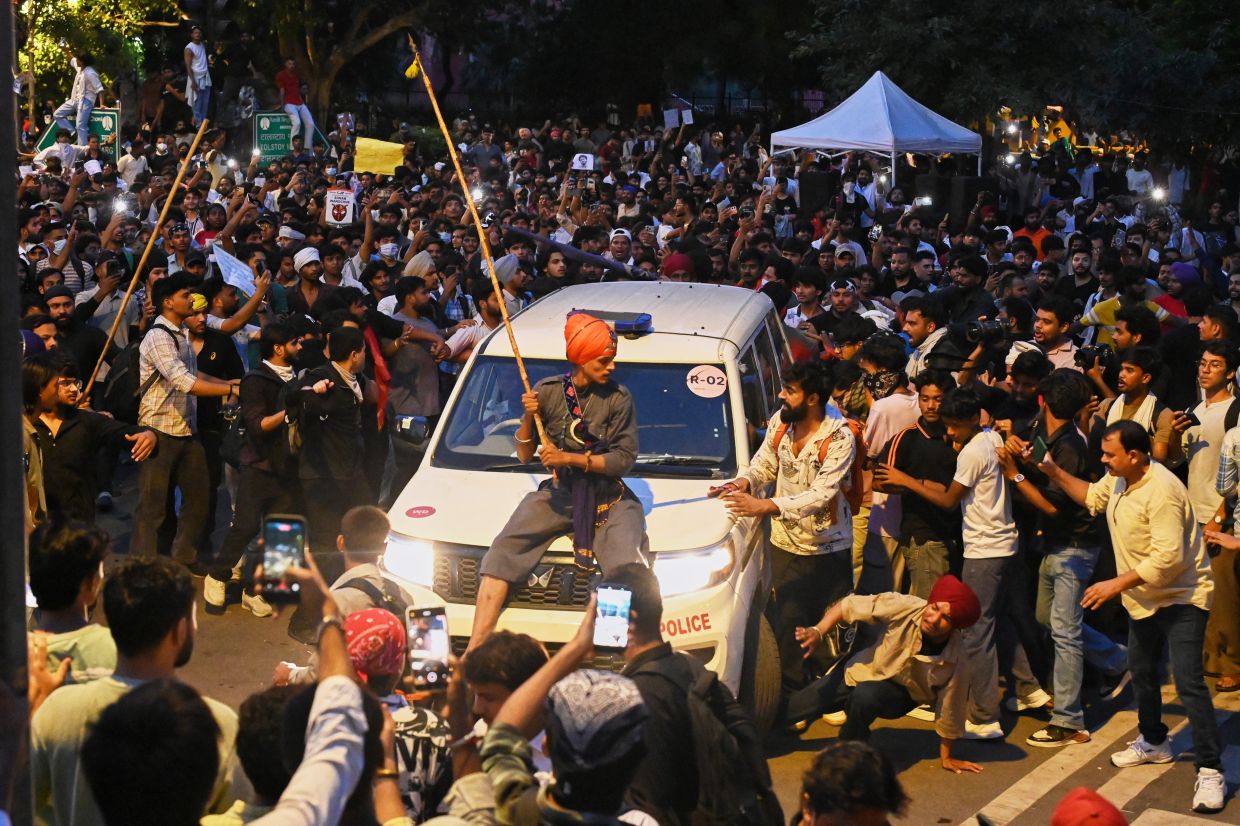
Indian Prime Minister Narendra Modi broke his silence on mounting student unrest by committing to severe penalties for examination fraud perpetrators, marking his first substantive response to protests that have become one of the most significant challenges to his authority since winning a third consecutive election in 2024. Speaking through social media on Thursday, Modi stated that youth welfare and prospects were paramount to his administration, declaring that those attempting to undermine educational integrity would face consequences through specially established fast-track courts.
The Prime Minister's intervention follows a day of significant upheaval in New Delhi, where thousands of demonstrators assembled around the Jantar Mantar district on Wednesday evening, triggering violent clashes that spilled into the night. The protests, overwhelmingly composed of young students and spearheaded by the digitally organised Cockroach Janta Party (CJP) movement, represent an unprecedented mobilisation of youth discontent across multiple dimensions of governance and societal opportunity. The unrest escalated dramatically on Monday when demonstrators attempted to march towards parliament as legislators reconvened for the monsoon session, prompting authorities to deploy tear gas and employ baton charges against crowds numbering in the tens of thousands—resulting in injuries to at least 178 individuals, including police personnel.
The CJP itself emerged surprisingly from the satirical margins of social discourse in May, when it was initially conceived as a humorous commentary on remarks attributed to Chief Justice Surya Kant likening young people to "cockroaches" and "parasites" during judicial proceedings. What began as online mockery has metamorphosed into a sophisticated movement encompassing substantive grievances about unemployment, educational access, economic opportunity, and what participants characterise as an increasingly authoritarian governmental approach. This expansion reflects how digital platforms have enabled rapid coalition-building around dispersed frustrations among India's vast youth population, creating a movement that transcends traditional political boundaries.
The immediate trigger for the escalation remains a series of high-profile examination failures that have shattered public confidence in India's educational assessment infrastructure. Most prominently, the unauthorised disclosure of a medical entrance examination question paper compelled more than two million candidates to undertake retesting, an extraordinary disruption affecting millions of families and their aspirations for professional advancement. Compounding this crisis, separate irregularities in the online marking protocols for examinations taken by nearly two million secondary school students have further corroded institutional credibility and provided sustained momentum to street demonstrations.
Wednesday's confrontation between protesters and law enforcement revealed the volatility underlying these tensions. Security forces deployed heavy-handed tactics against demonstrators congregated outside Jantar Mantar, with CJP spokesman Ashutosh Ranka subsequently alleging that authorities suspended internet connectivity and applied excessive physical force against participants. Delhi Police countered by asserting that protesters initiated violence by throwing stones and plastic bottles at officers, causing significant injuries. This conflicting characterisation of events underscores the polarisation between demonstrators and state authorities, with mutual accusations of disproportionate conduct shaping public perception.
Opposition political forces have seized upon the crisis, utilising parliamentary disruptions to demand Modi's accountability and an explicit apology for Monday's police operations. Congress Party leader Rahul Gandhi launched a particularly pointed critique via social media, asserting that Modi bore primary responsibility for educational system deterioration through deliberate policy choices and selective protection of culpable officials. Such partisan amplification has elevated the protest beyond localised student activism into a broader indictment of governance quality, resource allocation, and institutional competence—challenging Modi's technocratic legitimacy.
The geographical spread of demonstrations beyond Delhi indicates that underlying discontent possesses nationwide dimensions rather than constituting an isolated capital phenomenon. Concurrent rallies emerged Wednesday in major metropolitan centres including Mumbai, Bengaluru, and Patna, suggesting that examination fraud and youth opportunity deficits resonate across India's diverse regional contexts. This dispersed mobilisation pattern creates substantially greater complexity for governmental management than would isolated urban protests, requiring coordinated administrative responses across multiple jurisdictions with distinct political configurations.
International solidarity has further amplified the movement's visibility and moral standing. Students in neighbouring Bangladesh organised a "torch rally" on Thursday evening explicitly to demonstrate support for Delhi protesters, drawing symbolic connections to the youth-driven movements that successfully toppled Sheikh Hasina's government in 2024 and fundamentally restructured Bangladeshi politics. This trans-border dimension elevates Indian student activism within regional consciousness and suggests broader implications for how Southeast Asian governments navigate youthful discontent concerning educational quality, employment prospects, and political accountability.
For Malaysian observers, the Indian experience illuminates the intersection of digital mobilisation, youth unemployment, and educational system failures as potential flashpoints across the region's growing economies. India's examination infrastructure collapses, while less dramatic, echo concerns about credibility and fairness within Malaysia's own education certification systems. The CJP's evolution from satirical commentary to substantive political force demonstrates how social media platforms can rapidly transform narrow complaints into broad movements encompassing multiple grievances—a pattern with evident applicability to Malaysian contexts where youth engagement with governance remains geographically and demographically uneven.
Modi's commitment to fast-track courts and stringent penalties may address immediate political pressure, yet it potentially risks appearing reactive rather than systematic in reforming underlying institutional vulnerabilities that enabled widespread examination fraud. Whether punitive measures without comprehensive structural reform of examination administration, question paper security, and assessment transparency will satisfy protesting students remains uncertain. The coming weeks will likely demonstrate whether governmental action on examination fraud promises materialises sufficiently to diminish momentum, or whether broader youth grievances about opportunity and governance continue driving demonstrations despite official commitments to accountability.

