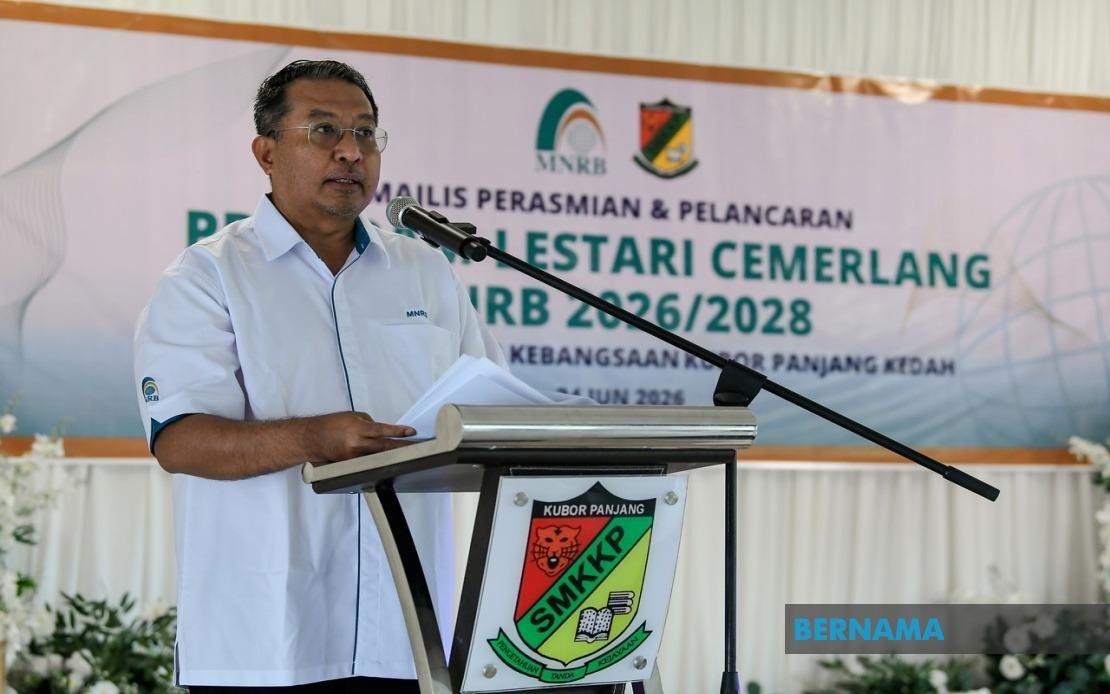
MNRB Holdings Berhad, an investment holding company, has committed nearly RM600,000 to support six schools across Malaysia under its flagship Lestari Cemerlang Programme, marking the latest expansion of a corporate social responsibility initiative that has long prioritised educational advancement in underserved communities. The programme was formally launched at Sekolah Menengah Kebangsaan Kubor Panjang in Pendang, Kedah, with the school becoming the sixth institution to benefit from MNRB's targeted education initiative.
Datuk Rudy Rodzila Che Lamin, interim president and group chief executive officer of MNRB Holdings, emphasised that the adopted school programme represents a sustained commitment to improving educational outcomes across the country. Introduced in 2011, the initiative has evolved into one of the company's most comprehensive corporate social responsibility efforts, reflecting a strategic decision to invest in human capital development rather than pursuing more conventional charitable approaches. The programme's design acknowledges a fundamental truth about Malaysian education: rural and under-resourced schools often struggle with capacity constraints that limit student potential, regardless of individual aptitude or motivation.
The holistic nature of MNRB's educational intervention distinguishes it from narrower funding models. Rather than providing one-off grants or facility donations, the company has designed a multifaceted approach that addresses both academic and co-curricular dimensions of school excellence. This philosophy recognises that student success depends not solely on classroom instruction but on comprehensive personal development, character formation, and exposure to diverse learning experiences. By coupling academic support with broader enrichment activities, MNRB aims to cultivate well-rounded individuals prepared for higher education and professional careers.
Under the programme, participating schools receive a diverse portfolio of support mechanisms tailored to their specific contexts and needs. Extra tuition classes for Form Five students provide targeted academic reinforcement during critical examination periods, while motivational camps and student development programmes aim to build resilience, confidence, and leadership capabilities among younger cohorts. The infrastructure dimension is equally important: MNRB has funded upgrades to learning facilities and sponsored sports jerseys, addressing the tangible resource gaps that often handicap rural schools. A particular innovation has been the establishment of MNRB Smart e-Learning Rooms equipped with smart televisions and internet connectivity, directly addressing the digital divide that threatens to exclude disadvantaged students from emerging educational technologies.
The geographic distribution of participating schools—spanning Perak, Pahang, Negeri Sembilan, Melaka, Selangor, and now Kedah—suggests a deliberate strategy to balance national coverage with manageable implementation. This approach allows MNRB to develop deep institutional relationships with each school, ensuring that support translates into sustained institutional change rather than temporary resource injections. The involvement of state-level education authorities, as evidenced by the participation of Kedah State Education Department's deputy director, indicates alignment between corporate initiatives and government education policy priorities.
Beyond immediate school support, MNRB has established the Tabung Biasiswa MNRB scholarship initiative, which extends financial assistance to academically distinguished students from adopted schools pursuing higher education in business-related disciplines. This programme represents strategic human resource development: by identifying and sponsoring talented students in insurance, takaful, and finance fields, MNRB builds a pipeline of skilled professionals while offering transformative educational opportunities to deserving youth. The data is compelling: of 14 students previously sponsored under this initiative, eight have subsequently joined MNRB upon graduation, suggesting both programme effectiveness and genuine career pathways for beneficiaries.
For SMK Kubor Panjang specifically, five outstanding students have been selected to receive MNRB scholarships supporting their academic progression through diploma, bachelor's, and master's level qualifications. This multi-tier support structure acknowledges that financial barriers persist at multiple stages of educational advancement, not merely at secondary-tertiary transition points. By committing to longer-term sponsorship spanning tertiary education, MNRB demonstrates investment conviction in supporting students through their entire educational journey to professional readiness.
The strategic context of MNRB's education investment deserves consideration. The company operates within Malaysia's financial services sector, where talent acquisition and retention present ongoing competitive challenges. By establishing relationships with schools and channelling scholarships toward finance, insurance, and takaful fields, MNRB simultaneously addresses corporate human resource needs while contributing to national education development. This alignment of corporate interests with social benefit represents enlightened corporate strategy, though sceptics might note that the selection of business-related fields naturally channels talent toward sectors where MNRB operates.
For Malaysian policymakers, MNRB's model offers insights into how private sector institutions can complement government education efforts. The substantial RM600,000 commitment reflects genuine financial commitment while remaining proportionate to MNRB's corporate scale. The emphasis on rural schools and character development addresses persistent equity concerns within the Malaysian education system, where geographical disparities in educational resources continue limiting social mobility. Corporate adoption models like Lestari Cemerlang potentially reduce fiscal pressures on government education budgets while introducing competitive quality improvements.
From a stakeholder perspective, the initiative benefits multiple constituencies distinctly. Teachers gain access to professional development and classroom resources; students receive academic support and exposure to broader learning opportunities; school management obtains infrastructure improvements and strategic guidance; and communities see investment in local institutions. This multi-stakeholder approach generates broader social acceptance and sustainability compared to narrower interventions targeting only student achievement metrics.
The programme's emphasis on character development alongside academic excellence reflects an important educational philosophy increasingly prevalent among Malaysian corporate institutions. The recognition that examination success alone proves insufficient for meaningful life outcomes drives MNRB's investment in motivational programmes, leadership development, and co-curricular opportunities. This perspective aligns with broader educational reform movements emphasising soft skills, resilience, and holistic competency development.
As MNRB continues expanding the Lestari Cemerlang Programme, the challenge will be sustaining programme quality while increasing geographic reach. Scaling corporate social responsibility initiatives often strains implementation capacity and dilutes impact if not carefully managed. MNRB's measured approach—adding schools gradually while maintaining intensity of engagement—suggests institutional commitment to meaningful rather than superficial intervention. Monitoring long-term outcomes of participating students, tracking institutional changes in adopted schools, and measuring programme sustainability beyond corporate funding remain critical evaluation questions for demonstrating enduring educational impact.