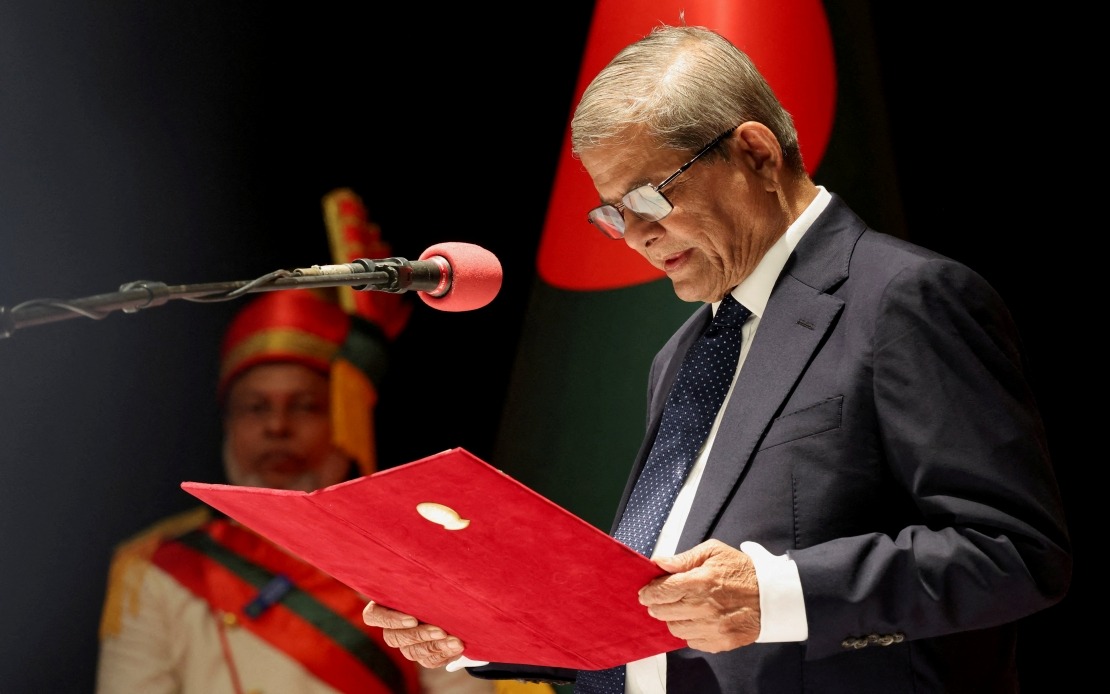
Mirza Fakhrul Islam Alamgir formally assumed the presidency of Bangladesh on Friday evening, taking the oath before a gathering of senior government and military officials at the nation's official residence. The ceremonial proceedings took place at 7.30 pm at the Darbar Hall of Bangabhaban, with Acting Speaker Barrister Kayser Kamal presiding over the constitutional process. This transition marks a significant moment in Bangladesh's ongoing political restructuring following recent developments in the country's governance landscape.
The newly sworn-in president arrived at the official residence to a formal reception arranged by senior state functionaries, who extended the traditional welcome befitting the head of state. He was subsequently received by Acting President Hafiz Uddin Ahmad Bir Bikram, establishing a ceremonial continuity that underscored the constitutional transfer of executive authority. The deliberate nature of these protocols reflects Bangladesh's adherence to established constitutional procedures governing the presidency, even as the nation navigates broader political transformations.
The attendance at Friday's ceremony reflected the highest levels of Bangladesh's government apparatus. Prime Minister Tarique Rahman participated alongside the chief justice, members of the cabinet, foreign diplomatic representatives, members of parliament, and senior officials from the civil and military establishments. This comprehensive gathering demonstrated the institutional significance attached to the presidential transition and signalled continuity within Bangladesh's administrative hierarchy during what observers note is a period of substantial political change in the South Asian nation.
Mirza Fakhrul's path to the presidency carries considerable weight within Bangladesh's political circles. A veteran politician and former secretary-general of the Bangladesh Nationalist Party, he represents one of the country's most established political figures. His election to the presidency by members of parliament occurred in strict accordance with constitutional provisions, reflecting the formal democratic process through which Bangladesh selects its head of state. The BNP, which he formerly led as secretary-general, has been a dominant force in Bangladesh's political landscape for decades, and his elevation represents the party's continued influence within national institutions.
The oath-taking ceremony followed customary constitutional procedures designed to ensure the formal legitimacy of the presidential office. Following the administration of the oath, President Mirza Fakhrul and the outgoing Acting President engaged in a symbolic exchange of positions, a ritualistic element that visually represented the official handover of presidential authority. This ceremonial gesture, conducted before assembled officials and dignitaries, reinforced the constitutional nature of the transfer and acknowledged the continuity of state institutions despite personnel changes at the apex of government.
Subsequent to taking the oath, the newly inaugurated president affixed his signature to the formal oath of office and oath of secrecy, legal documents that constitute binding commitments under Bangladesh's constitutional framework. These documents represent the formal acknowledgment of the president's obligations to uphold the constitution and protect classified state information. The signing of these instruments fulfilled the final procedural requirements, after which the ceremony concluded with the traditional rendition of the national anthem, a customary practice that marks the solemn completion of presidential inaugurations across Commonwealth-influenced democracies.
The timing and circumstances of this presidential inauguration carry implications for Bangladesh's broader institutional landscape. The nation has experienced considerable political turbulence in recent months, with questions surrounding governance structures and political transitions occupying prominent positions in public discourse. The formal installation of a president with deep roots in Bangladesh's established political parties suggests an attempt to anchor the presidency within conventional political frameworks, even as other aspects of Bangladesh's political configuration remain in flux.
For regional observers, particularly those in neighbouring Southeast Asian nations, this presidential transition offers insights into how Bangladesh's institutions are functioning during periods of constitutional reorganisation. Malaysia and other ASEAN members maintain significant diplomatic and trade relationships with Bangladesh, making the stability and functioning of its political institutions matters of regional interest. The smooth execution of the presidential ceremony, conducted according to established constitutional procedures, provides assurance regarding institutional resilience and the continued operation of formal governmental processes.
Mirza Fakhrul's presidency establishes a new chapter for Bangladesh's executive branch, with his background in party politics and senior administrative experience likely to shape the office's approach to both domestic governance and international relations. As the nation's 23rd president, he assumes a constitutional position that, while primarily ceremonial under Bangladesh's parliamentary system, carries significant symbolic weight. The president serves as the formal head of state and custodian of constitutional values, roles that acquire particular importance during periods when nations grapple with questions of institutional legitimacy and political direction. His tenure will unfold against the backdrop of Bangladesh's ongoing efforts to stabilise its political institutions and address pressing developmental challenges facing South Asia's third-most populous nation.

