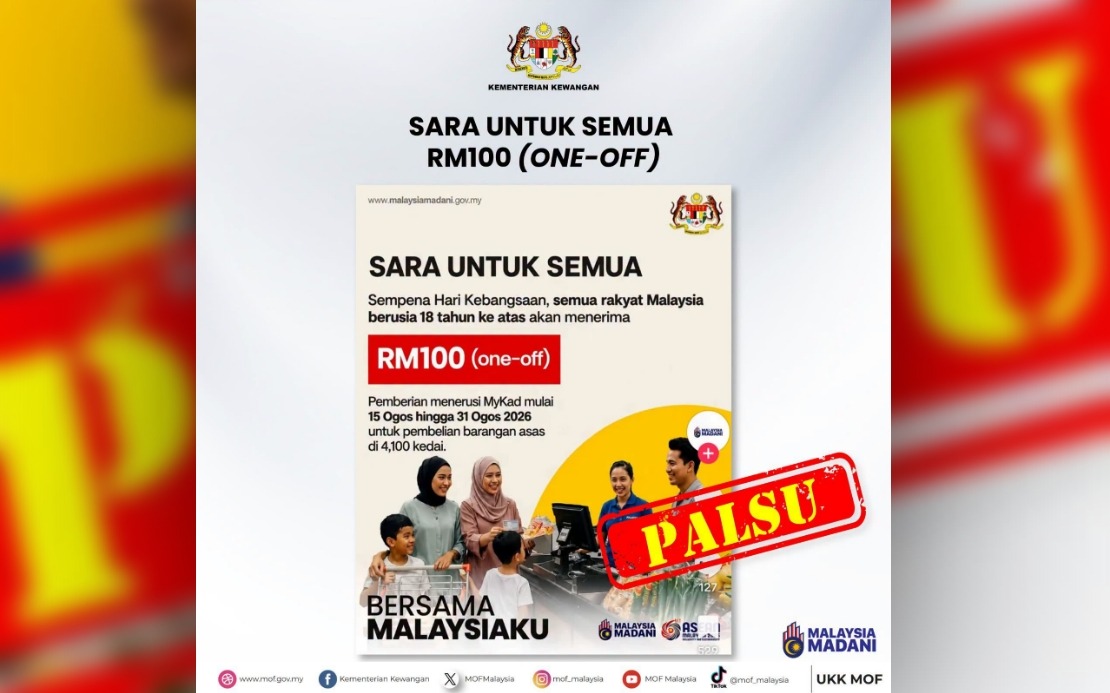
The Ministry of Finance moved swiftly on Tuesday to shut down a false claim circulating online suggesting that all Malaysians aged 18 and above would receive a one-off RM100 Sumbangan Asas Rahmah (SARA) payment to mark the upcoming National Day celebration. The ministry used its official social media channels to issue a clear denial, emphasizing that the poster making this claim lacked any official basis and should not be trusted or forwarded by members of the public.
The viral poster, which had gained traction across various social media platforms, purported to announce a government payment initiative tied to the National Day festivities. Such claims have become increasingly common in Malaysia's digital ecosystem, often spreading rapidly through messaging applications and social networks before fact-checkers can intervene. The emergence of this particular rumour highlights the persistent challenge of misinformation during festive seasons and public holidays, when citizens are generally more attuned to potential government announcements and benefits.
In its official statement, the Ministry of Finance explicitly cautioned Malaysians to exercise critical judgment when encountering such claims. The ministry stressed that no formal announcement regarding any SARA payment scheme for National Day purposes had been issued through its recognized channels. This clarification was particularly important given the widespread use of fabricated government announcements as vehicles for spreading false information, which can undermine public trust in legitimate policy communications.
The SARA programme itself represents one of the government's key assistance initiatives, previously providing direct cash transfers to lower-income households. The programme's association with government support makes it a frequent target for false claims and misinformation campaigns. By allowing unverified announcements about SARA to circulate unchecked, there is genuine risk of raising public expectations and potentially causing disappointment when promised payments fail to materialize. The ministry's quick response reflects awareness of this concern and the need to protect the credibility of actual assistance programmes.
The timing of this misinformation coincides with Malaysia's approach to National Day celebrations scheduled for 31 August. During festive periods, government agencies typically see an increase in inquiries about special payments, subsidies, or other benefits. Malaysians, particularly those who benefit from regular government assistance, naturally become more attentive to potential announcements. Scammers and those spreading misinformation exploit this heightened attention, creating posts that mimic official government communication styles to enhance their credibility.
The ministry's advisory also highlighted a broader information management challenge facing contemporary governance. Citizens are urged to verify announcements through official government channels rather than relying on screenshots, forwarded messages, or social media posts that may lack proper authentication. The proliferation of messaging services and social platforms has created multiple pathways for information to spread, but few reliable mechanisms for ensuring authenticity before content reaches mass audiences. Establishing trusted information sources becomes increasingly crucial in this environment.
From a public policy perspective, the incident underscores why government agencies must maintain proactive communication strategies during sensitive periods. Rather than waiting for false claims to cause widespread confusion, ministries can benefit from preemptive announcements about upcoming initiatives or explicit denials of anticipated false claims. The Ministry of Finance's approach aligns with international best practices in combating misinformation through rapid, authoritative corrections distributed through official channels.
For Malaysian citizens, the broader lesson involves cultivating information literacy skills and developing healthy scepticism toward unverified claims promising financial benefits. While the government does implement various assistance programmes, these are typically announced through formal channels, official websites, and registered media partners. Genuine government payments almost always come with detailed eligibility criteria, application procedures, and timeline information. Posts or images claiming universal payments without such details should raise immediate red flags.
The phenomenon of false payment claims reflects deeper challenges in Malaysia's digital information environment. As internet penetration expands and social media usage becomes more ubiquitous across demographic groups, the vectors for spreading misinformation multiply. Elderly citizens and those less familiar with digital platforms may be particularly vulnerable to believing and sharing such claims. Educational initiatives promoting media literacy and critical evaluation of online information could help reduce the spread of such falsehoods.
Government agencies in Southeast Asia more broadly have grappled with similar challenges as misinformation spreads across borders and between countries. The techniques used to fabricate this SARA payment claim could be adapted to create false announcements about other assistance programmes or government benefits. Building regional capacity to counter such misinformation, alongside public education initiatives, represents an important frontier for digital governance in the region.
The Ministry of Finance's intervention also serves a preemptive function for the weeks ahead. By clearly stating that no National Day SARA payment exists, the ministry reduces the likelihood that citizens will contact government offices seeking information about non-existent payments, thereby protecting administrative resources. This practical consideration is often overlooked but remains significant for government efficiency and public service delivery.
Moving forward, Malaysians seeking information about genuine government assistance should prioritize official sources. The Ministry of Finance maintains a comprehensive website detailing current assistance programmes, eligibility requirements, and application procedures. State governments and local authorities also publish information about assistance schemes available to residents. Relying on these vetted sources rather than social media provides greater assurance that information is accurate and current. In an era of sophisticated misinformation campaigns, this disciplined approach to information consumption remains essential.

