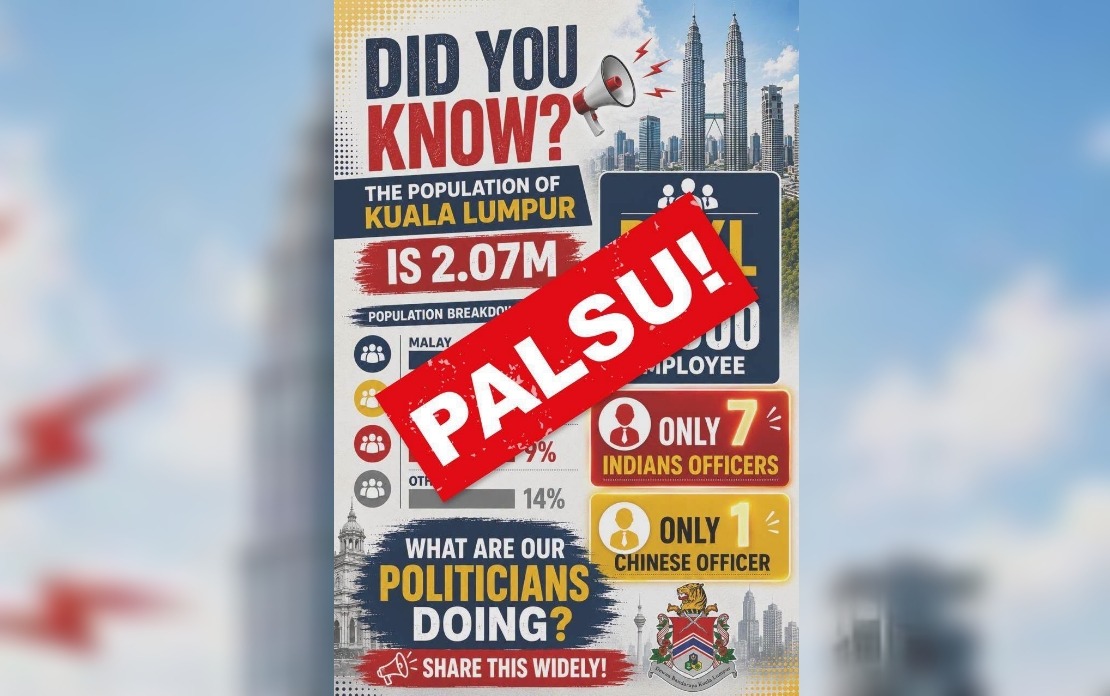
Minister in the Prime Minister's Department (Federal Territories) Hannah Yeoh has moved to address misinformation spreading through social media regarding the ethnic composition of Kuala Lumpur City Hall's workforce, describing the claims as baseless and potentially divisive during the election campaign period. The minister's intervention comes as a WhatsApp post gained traction, alleging that the local authority employed virtually no minority staff members—a claim she has now thoroughly debunked with concrete figures.
The viral message had asserted that DBKL employed only seven Indian staff members and a single Chinese employee, a characterization that bears no resemblance to reality. According to official records as of July 1, 2026, DBKL's actual workforce comprises 9,131 employees across all levels and departments. Within this total, the authority employs 490 staff members of Indian ethnicity and 22 of Chinese ethnicity, demonstrating substantially greater diversity than the false claims suggested. These figures provide a stark contrast to the narrative being peddled online and underscore how misinformation can distort public perception of institutional practices.
Breaking down the composition further at senior levels offers additional context for understanding DBKL's management structure. Within the Management and Professional Group specifically, there are 10 Indian officers and two Chinese officers holding positions that typically require tertiary qualifications and specialist expertise. While these numbers may appear modest in absolute terms, they provide important documentation of the authority's professional cadre and indicate representation beyond entry-level or support positions. Hannah Yeoh's willingness to disclose these granular details suggests confidence in the accuracy of DBKL's human resource records and a commitment to transparency in addressing public concerns.
However, the minister stopped short of claiming that current diversity levels are wholly satisfactory. In her Facebook statement, Hannah acknowledged that there remains scope for meaningful improvement in how minorities are represented across DBKL's various ranks and departments. This measured approach—simultaneously rejecting false claims while admitting genuine shortcomings—reflects a nuanced position that neither dismisses legitimate concerns about institutional inclusion nor tolerates the spread of fabricated narratives. Her candor on this point may be designed to prevent critics from dismissing her rebuttals as defensive or self-serving.
In response to the underlying concerns, Hannah has initiated a comprehensive review of DBKL's human resource systems. She has directed the authority to scrutinize its recruitment methodologies, examine hiring practices at all levels, evaluate the transparency and fairness of promotion procedures, and audit the channels through which job vacancies are advertised to the public. This holistic examination suggests that she views potential disparities not as isolated incidents but as systemic issues that may be embedded in institutional processes. By focusing on mechanisms rather than merely outcomes, the review aims to identify whether bottlenecks exist at particular stages of the employment pipeline.
The review's emphasis on merit-based assessment and procedural fairness indicates an underlying philosophy that equal opportunity should be embedded into how institutions operate, not simply reflected in final hiring statistics. This approach aligns with professional human resources thinking that seeks to eliminate structural barriers or unconscious biases that might affect how candidates from different backgrounds are evaluated. The commitment to transparent processes serves multiple purposes: it potentially addresses genuine concerns about fairness, builds public confidence in DBKL's institutional integrity, and provides a defensible framework for future hiring decisions.
Beyond the administrative response, Hannah has made an explicit plea to all stakeholders not to weaponize diversity issues for political advantage. She urged parties across the political spectrum to resist the temptation to exploit workforce composition as a tool for sowing racial discord or consolidating support among particular ethnic constituencies. Her appeal reflects an understanding that misinformation campaigns often succeed not because they contain verifiable facts, but because they activate existing anxieties about fairness and representation. By framing the correction of false claims as everyone's responsibility, she attempts to position factual accuracy as a shared civic value transcending partisan interests.
The timing of this intervention during an election campaign adds another layer of significance. Political campaigns frequently become spaces where unverified claims circulate rapidly through social media channels, often designed to inflame rather than inform. The fact that Hannah felt compelled to issue a public rebuttal suggests that the WhatsApp post had gained sufficient traction to warrant ministerial attention. Her response demonstrates how government officials must increasingly operate as fact-checkers, using their platforms and authority to push back against disinformation even when doing so risks appearing defensive or politically motivated.
For Malaysian readers, this episode illuminates broader questions about institutional accountability and demographic representation in public service. While DBKL's actual figures reveal greater diversity than the false claims suggested, they simultaneously raise questions about whether minority representation at professional and managerial levels adequately reflects the national demographic composition. This tension between defending against misinformation and acknowledging legitimate improvement needs characterizes much of contemporary public discourse around diversity and inclusion in Malaysia's institutions.
The incident also highlights how social media has transformed the speed and scale at which misinformation can circulate, reaching thousands of recipients before verification mechanisms engage. WhatsApp's encrypted, closed-group communication format makes it particularly difficult for authorities to identify sources or rapidly counter false narratives. Hannah Yeoh's public response strategy—releasing detailed official data and announcing systemic reviews—represents one approach to combating this phenomenon, though its effectiveness ultimately depends on how widely her rebuttal circulates relative to the original false claims.
Moving forward, the outcomes of DBKL's comprehensive review will merit close monitoring by civil society organizations, media observers, and advocates for institutional diversity. The specific gaps identified, the improvements implemented, and the demographic changes in hiring and promotions over subsequent years will serve as concrete measures of whether Hannah's acknowledgment of shortcomings translates into meaningful action. Meanwhile, the broader challenge of addressing misinformation while advancing genuine reform in government institutions remains central to maintaining public trust and institutional legitimacy in Malaysia's evolving political landscape.

