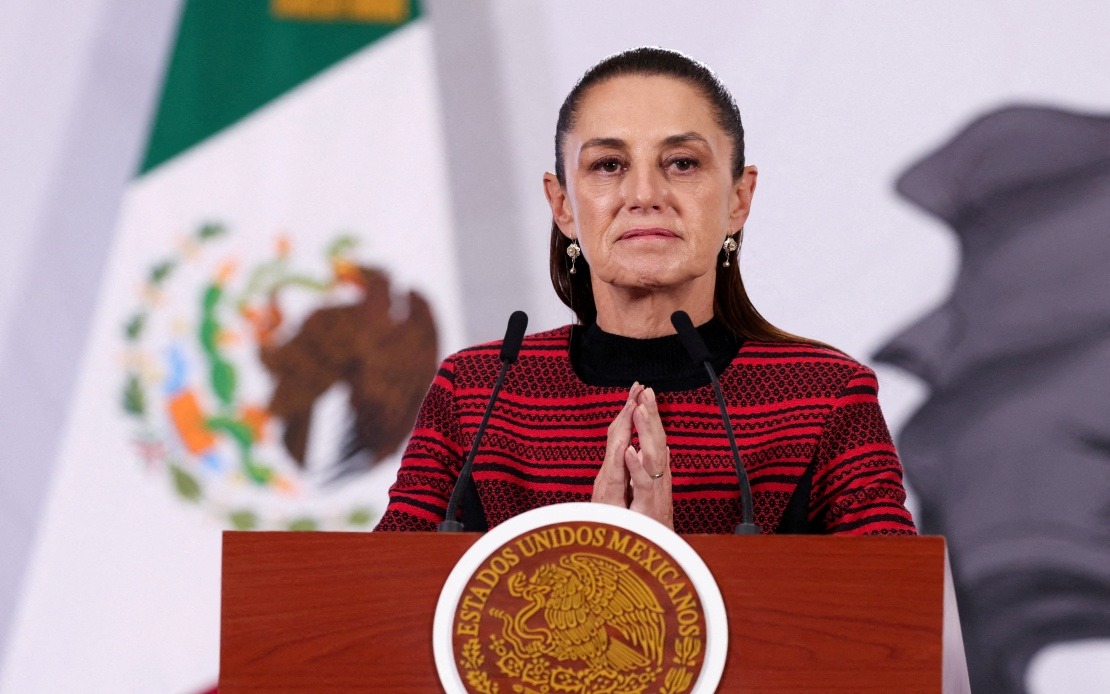
Mexican President Claudia Sheinbaum has confirmed she will travel to the World Cup final after receiving a direct invitation from United States President Donald Trump, a move that carries symbolic weight given the current tension between the two nations. The unexpected acceptance signals a willingness to engage diplomatically despite ongoing disputes centred on trade and security matters that have strained bilateral relations in recent months.
Sheinbaum revealed her plans to Mexican journalists on Friday, noting that both she and Canadian Prime Minister Mark Carney—representing the two other co-hosting nations—had been invited by Trump to attend the championship match between Argentina and Spain. The final will take place in East Rutherford, New Jersey, on Sunday, with the game serving as a high-profile gathering point for global political and sporting figures. The disclosure underscores how major sporting events continue to function as platforms for international diplomacy and public engagement at the highest levels.
The Mexican president's decision to attend carries particular significance when viewed against her earlier actions regarding the tournament. In June, Sheinbaum opted not to appear at the opening ceremony held at Azteca Stadium in Mexico City, instead gifting her ticket to an indigenous woman passionate about football. That choice reflected her administration's priorities around accessibility and symbolic gestures toward marginalized communities, yet her willingness to travel to New Jersey for the final demonstrates flexibility in diplomatic engagement when strategic opportunities arise.
Personal interactions between Sheinbaum and Trump remain limited. Their sole previous in-person meeting occurred in December at the World Cup draw ceremony in Washington, suggesting that the tournament and associated events may serve as occasional venues for bilateral engagement. The rarity of their direct contact makes this World Cup final attendance noteworthy as an opportunity for face-to-face interaction during a globally televised event.
The logistical adjustments required to facilitate Sheinbaum's attendance underscore the importance placed on this diplomatic gesture. Mexican media reports indicate that her scheduled programme in Quintana Roo, a state on Mexico's Caribbean coast, has been reorganized to permit her journey northward. This restructuring of presidential movements reveals how official state visits and international sporting events require careful coordination, particularly when leaders must balance domestic responsibilities with international commitments.
Spain's royal family has confirmed their attendance at the final, with King Felipe VI, Queen Letizia, Crown Princess Leonor, and Infanta Sofía expected to cheer for their national team. The presence of such high-ranking European dignitaries alongside North American leaders reflects the World Cup final's status as a truly global occasion drawing participation from across continents. The concentration of international figures at a single sporting venue inevitably becomes a backdrop for multilateral diplomacy and photo opportunities that resonate across media ecosystems.
Argentina's President Javier Milei has adopted a contrasting approach, declining to attend the stadium for the final due to personal superstition. Cultural practices related to luck and fortune hold particular significance in Argentine sporting tradition, and Milei's adherence to these ritualistic beliefs demonstrates how individual leaders navigate the intersection of personal conviction and public expectation. His absence from the venue, though grounded in superstition rather than diplomatic calculation, presents an alternative model of engagement with major sporting spectacles.
The broader context of Mexico-US relations cannot be overlooked when evaluating this diplomatic moment. Trade disputes and security concerns have created friction between the neighbouring nations, making symbolic gestures of cooperation increasingly valuable for both administrations. Trump's invitation and Sheinbaum's acceptance represent a mutual recognition that despite substantive disagreements, maintaining communication channels and demonstrating willingness to participate in shared international moments serves broader strategic interests.
For Malaysian observers, this diplomatic choreography illustrates how regional powers utilise major international events—sporting or otherwise—as platforms for relationship management. Southeast Asia regularly hosts tournaments and gatherings that similarly attract political figures, creating opportunities for bilateral and multilateral engagement outside formal negotiation settings. Understanding how larger nations leverage such events provides insight into diplomatic strategies that may be applied or observed within ASEAN contexts.
The World Cup final thus transcends its status as a mere sporting competition, functioning simultaneously as a diplomatic forum where international relationships are performed, strengthened, or reset before global audiences. Sheinbaum's attendance represents pragmatic engagement despite tensions, while the convergence of multiple heads of state and royalty underscores how sport remains intertwined with statecraft and international relations in contemporary geopolitics.

