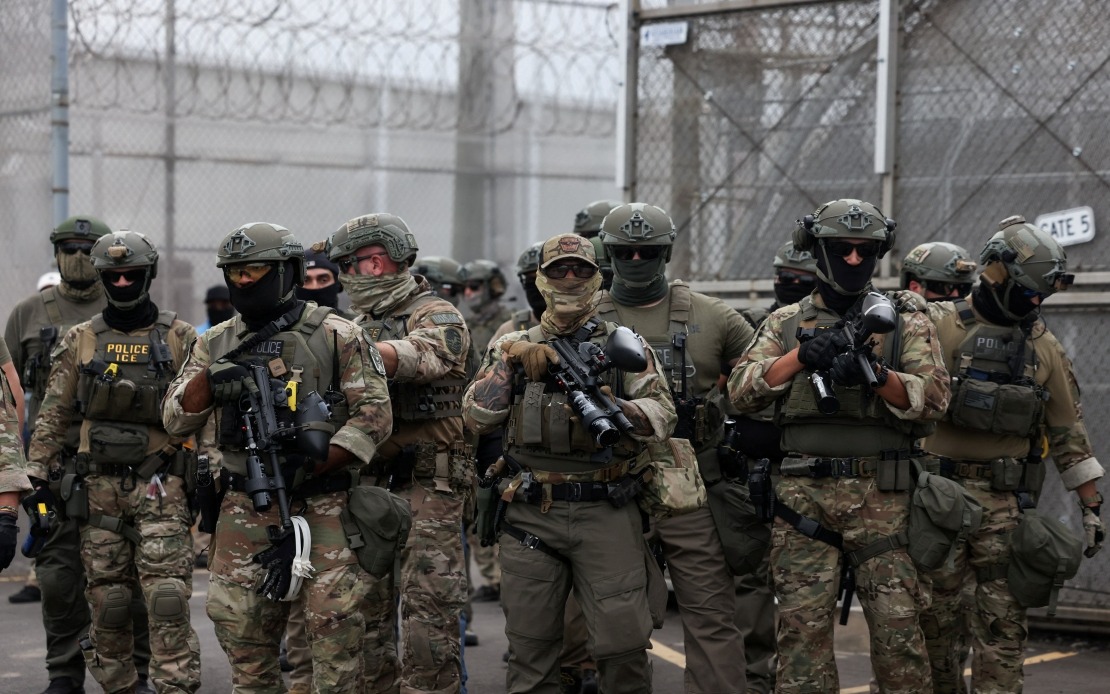
A Mexican national died from gunshot wounds after a confrontation with US Immigration and Customs Enforcement (ICE) officers in an incident the Department of Homeland Security confirmed this week. The department's account, released through social media on Tuesday, described a volatile encounter that escalated rapidly when the driver, identified as Lorenzo Salgado Araujo, allegedly refused officers' commands while remaining in his vehicle during an early morning operation.
According to Homeland Security's statement, the situation deteriorated when Salgado Araujo's vehicle made contact with an agents' car, appearing to deliberately ram it. The department further alleged that he then attempted to strike an officer with his vehicle, a manoeuvre that precipitated the lethal response. An ICE officer discharged his firearm, and Salgado Araujo was transported to hospital but succumbed to his injuries. The department characterised him as someone in the country without legal authorisation, though it did not elaborate on the circumstances surrounding his immigration status or the original purpose of the enforcement action.
The incident has triggered dual investigations that reflect the institutional tensions inherent in such deadly encounters. Homeland Security has initiated an internal review of the shooting, a standard procedural response, while the FBI's Houston field office has assumed responsibility for investigating the alleged assault on the federal officer. This jurisdictional division underscores the seriousness with which federal authorities treat violence directed toward their personnel, even as questions mount regarding the proportionality and justification of the response.
The emergence of civilian eyewitness accounts threatens to complicate the official narrative. NBC News reported that several individuals at the scene recorded photographs and video footage of the operation, introducing the possibility of alternative perspectives on how events unfolded. This documentation capacity has become increasingly consequential in America's fractious debate over law enforcement conduct. Historical precedent suggests legitimate cause for scrutiny; previous high-profile incidents have revealed substantial discrepancies between departmental accounts and the recorded evidence later made public, prompting widespread questioning of official justifications.
For Malaysian observers, the incident underscores troubling patterns within US federal law enforcement. In January of this year, ICE agents shot and killed two US citizens, Renée Good and Alex Pretti, actions that ignited considerable public anger and calls for accountability. The subsequent cases involving fatalities during immigration enforcement operations have intensified concerns about whether training protocols, rules of engagement, and oversight mechanisms adequately protect individuals' lives during confrontations with armed agents. The recurring nature of such incidents suggests systemic rather than isolated problems.
The broader context involves escalating tensions around immigration enforcement policy in the United States. During periods of heightened enforcement activity, encounters between agents and individuals suspected of illegal residency have become increasingly charged and occasionally violent. The ramifications extend beyond individual cases; they shape public perceptions of law enforcement legitimacy, contribute to community mistrust of federal agencies, and generate international scrutiny. For countries like Malaysia, which maintain substantial communities of nationals working or residing in the United States, such incidents carry particular weight.
The reliance on video evidence to challenge official accounts represents a significant shift in how these incidents are adjudicated in the court of public opinion. Eyewitness recordings have repeatedly contradicted law enforcement narratives, exposing gaps between institutional claims and observable reality. This dynamic has profound implications for how accountability operates in federal agencies. When multiple perspectives of the same event become available, government statements lose their monopoly on interpretation, obliging investigators to contend with alternative narratives supported by contemporaneous documentation.
The decision to employ lethal force during immigration enforcement operations remains contested ground in American jurisprudence and policy debates. Advocates for stricter protocols argue that officers receive insufficient training in de-escalation techniques and that the intensity of response often appears disproportionate to the threat posed. Critics countering these positions contend that officers face genuine dangers and require broad latitude to protect themselves. This fundamental disagreement colours how cases like Salgado Araujo's will be interpreted and judged, both through official investigations and in broader public discourse.
For immigration-related communities across Southeast Asia and beyond, the incident reinforces existing anxieties about personal safety within the American immigration enforcement ecosystem. Each fatality generates chilling effects, discouraging people from engaging with authorities or defending themselves during encounters they perceive as threatening. The psychological and social ramifications extend throughout diaspora communities, influencing decisions about legal status, interaction with law enforcement, and attitudes toward migration to the United States.
The forthcoming investigations will require careful examination of multiple evidentiary sources, not merely the departmental account. Whether the FBI's inquiry and internal Homeland Security review prove sufficiently rigorous and transparent will substantially influence public confidence in federal accountability mechanisms. The availability of civilian video evidence means investigators cannot dismiss contradictory accounts as mere perception; physical documentation demands serious engagement. This case will likely contribute to broader debates about immigration enforcement practices, use-of-force policies, and the mechanisms through which federal agencies answer for their personnel's actions.

