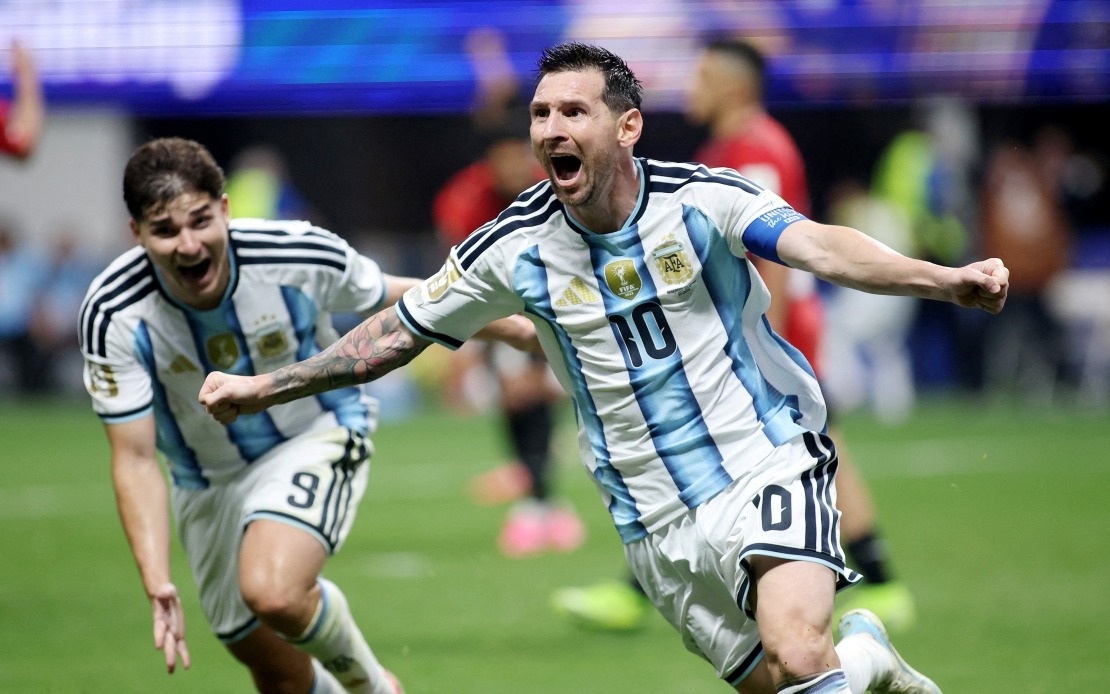
Lionel Messi stands on the precipice of World Cup immortality once more. At an age when most players have long retired from international football, the Argentine maestro has returned to the world's grandest sporting stage to compete for a second global crown. As Argentina prepares to face England in Atlanta on Wednesday, Messi carries with him not merely the hopes of his nation, but also the weight of several remarkable personal milestones that underscore a career unlike any other in football history.
Messi's journey back to the World Cup stage comes barely two years after he orchestrated Argentina's triumphant 2022 campaign in Qatar. That victory, achieved when he was 35 years old, saw him score seven goals, including two in the final itself, as Argentina defeated France on penalties in one of the tournament's most dramatic climaxes. Many observers believed that triumph would serve as the perfect denouement to his World Cup story, a fitting conclusion to a career that had previously yielded precious little silverware on football's biggest stage. Yet here he stands, defying expectations and perhaps his own biological clock, competing at the highest level once again.
The current tournament has seen Messi match the scoring prowess of France's Kylian Mbappé, with both players reaching eight goals as the tournament progresses toward its climax. This tally places them significantly ahead of other contenders such as England's Harry Kane and Jude Bellingham, who have each netted six times. The gap between Messi and the chasing pack reflects not merely goal-scoring ability but his enduring influence on Argentina's attacking play, his capacity to manufacture opportunities through combination play, and his continued clinical finishing from open play and set pieces alike. However, Mbappé holds a marginal advantage in the race for the Golden Boot, having assisted more goals and required fewer minutes of play to register his tally.
Perhaps more significantly, Messi has added two monumental records to his already bulging collection this summer. He and Cristiano Ronaldo have become the first male players ever to participate in six separate World Cup tournaments, a feat that speaks to their longevity and commitment to the international game across nearly two decades. Both men have also eclipsed Lothar Matthaus' previous record of 25 World Cup appearances, with Messi now poised to make his 33rd appearance on Wednesday, moving six clear of Ronaldo's tally. These statistics transcend mere numbers, representing a commitment to excellence that extends far beyond the typical career arc of even elite athletes.
Messi's goalscoring record across World Cup tournaments reveals a narrative arc that defies conventional wisdom about athletic decline and aging. His debut in 2006 yielded just one goal, followed by a barren 2010 campaign. However, his performance at the 2014 tournament hosted in Brazil saw him strike four times, establishing him as a genuine World Cup threat. His 2018 contribution was more modest with a single goal, yet 2022 proved transformative. At an age when most international players have stepped aside, Messi registered seven goals in Qatar, surpassing the combined total from his four previous World Cup campaigns. Remarkably, this resurgence occurred despite the looming prospect of retirement that had perhaps motivated the entire squad to secure the trophy before his departure.
The composition of Messi's goal tally in 2022 requires scrutiny, as penalties featured prominently in his scoring. Four of his seven goals came from the penalty spot, reflecting both the opportunities Argentina generated and the trust placed in him from twelve yards. Yet his conversion rate from penalties tells a more complicated story. Across all World Cup penalties, Messi has converted only four of eight attempts, excluding shootout scenarios. Two notable misses have occurred during this very tournament: a wayward effort against Austria in the group stage and another saved by Egypt goalkeeper Mostafa Shobeir during the knockout round. This inconsistency from the spot contrasts sharply with his perfect record in penalty shootouts, where he has succeeded in all three opportunities, most memorably in the 2022 final against France.
The broader context of Messi's scoring evolution at World Cups illuminates his changing role within Argentina's attacking framework. Early in his international career, he operated within a system that often underutilized his capabilities, constrained by tactical limitations and the competing presence of other attacking talents. As his career progressed and he matured into his prime years, Messi assumed greater responsibility for creating and finishing chances. The 2022 tournament represented perhaps the fullest expression of his talents within a World Cup context, where Argentina's system was built explicitly to maximize his influence and where his experience proved invaluable in navigating the tournament's pressures.
Messi's standing as a two-time winner of the Golden Ball, awarded to the tournament's best player, adds another layer to his legacy. Yet one accolade has historically eluded him: the Golden Boot. Four years ago, he finished second to Mbappé, who scored a hat-trick in the final despite finishing on the losing side. The irony of that outcome—where individual achievement transcended team success—has likely motivated Messi's push for both the championship and the scoring award this time around. Currently tied with Mbappé on eight goals, he remains in contention for both honors, though Mbappé's superior assist count and minutes-per-goal ratio currently favor the Frenchman.
Mirror records at the top of the all-time World Cup scoring charts reveal the extraordinary elevation of contemporary strikers. Messi has surpassed Miroslav Klose's previous record of 16 goals, registering 21 World Cup goals in total. Yet Mbappé, at only one goal behind, appears virtually certain to become the long-term holder of this record. Harry Kane has also climbed the all-time list rapidly with 14 goals, reflecting the improved efficiency of modern forwards operating within contemporary tactical systems. These three players have fundamentally reshaped the World Cup scoring landscape, collectively pushing past the benchmarks established by previous generations.
For Southeast Asian football observers, Messi's continued presence at this level offers instructive lessons about professionalism, preparation, and the pursuit of excellence across an extended career. His longevity contradicts assumptions about athletic decline and demonstrates how elite athletes can extend their effectiveness through intelligent training, tactical adaptation, and sustained competitive motivation. Meanwhile, the competition between Messi and Mbappé represents a broader generational transition, with the younger Frenchman's emergence suggesting continuity in world-class goal-scoring standards. As the tournament progresses toward its conclusion, Messi's final World Cup chapter remains unwritten, with the possibility of securing both the second title and the elusive Golden Boot still tantalizingly within reach.

