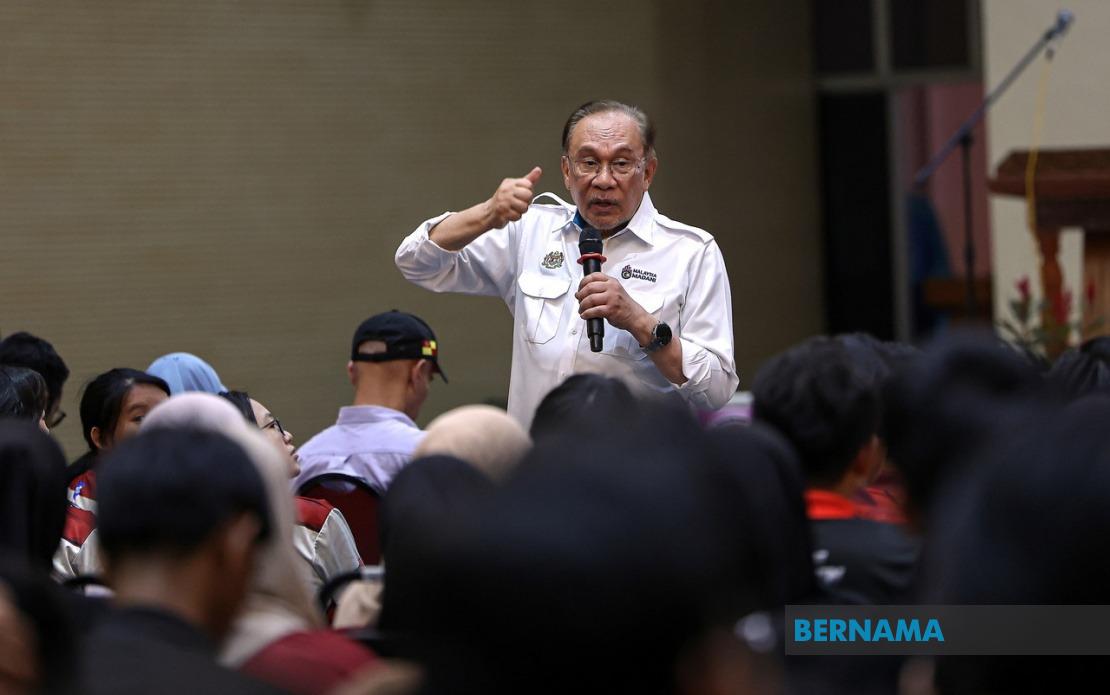
Prime Minister Datuk Seri Anwar Ibrahim has outlined a dual-track approach to matriculation admissions that aims to reward academic achievement while simultaneously extending opportunities to economically disadvantaged students and rural communities. Speaking at the Youth and Sports Complex in Paroi, Seremban, on July 22, Anwar sought to reconcile two competing policy objectives: identifying and fast-tracking Malaysia's highest-performing secondary school graduates whilst ensuring that access to higher education does not become concentrated among privileged urban populations. This balancing act reflects ongoing tensions within Malaysia's education system between meritocratic advancement and affirmative support for underserved demographics.
The centrepiece of Anwar's stated approach is an automatic admission pathway for students achieving 10A grades in the Sijil Pelajaran Malaysia (SPM) examination. By guaranteeing entry to the matriculation programme for these top performers regardless of ethnic background, the government signals that exceptional academic results constitute a sufficient criterion for advancement. This mechanism theoretically creates a colour-blind standard at the highest achievement tier, allowing high-achieving Chinese, Indian, and Malay students equal access based purely on demonstrated excellence. Such a policy responds to long-standing concerns from high-performing non-Bumiputera students that institutional quotas sometimes prevent capable individuals from progressing to further study, and it represents an attempt to align Malaysia's education pathway with increasingly globalised competitiveness standards.
However, the automatic admission guarantee for top achievers addresses only a narrow segment of the student population. The vast majority of SPM candidates—those scoring below 10As—would fall outside this meritocratic corridor and remain subject to broader allocation mechanisms. For these students, the government maintains that considerations of economic disadvantage and geographic hardship should influence placement decisions. Anwar specifically referenced the needs of underprivileged groups and students from rural and interior areas, signalling that socioeconomic factors will continue shaping intake decisions beyond the elite performer tier. This two-tiered structure implicitly acknowledges that academic talent is not uniformly distributed across Malaysia's demographic and geographic landscape, and that structural barriers in less-developed regions can suppress measured achievement even where underlying potential exists.
The continuation of Bumiputera quota protections within this framework constitutes the politically contentious element of Anwar's announcement. By maintaining dedicated quota allocations for Bumiputera students, the government preserves a constitutionally enshrined preference that has anchored Malaysian education policy for decades. Anwar framed this not merely as historical entitlement but as a practical response to demographic concentration and accessibility challenges. Students from Sabah and Sarawak, he noted, often face geographical and infrastructural disadvantages that depress measured examination performance independent of ability. Rural students across Peninsular Malaysia likewise encounter educational resource disparities compared with their urban counterparts. From this perspective, the Bumiputera quota functions as a corrective mechanism addressing not ethnic preference per se but rather structural inequality rooted in geography and development patterns.
For Malaysian higher education stakeholders, this policy articulation carries significant implications. Universities and polytechnics will need to manage cohorts composed of three distinct admission categories: top performers guaranteed through merit, quota-admitted Bumiputera students, and other candidates admitted through conventional channels. This heterogeneity potentially creates both pedagogical challenges and institutional opportunities. Teaching staff must accommodate students entering through different pathways and potentially with varying academic preparation levels. Simultaneously, diverse student bodies enriched by geographic representation from rural areas and interior regions may strengthen institutional culture and provide urban-educated cohorts exposure to perspectives shaped by different Malaysian realities.
The policy also reflects Anwar's broader political positioning within Malaysia's fractious coalition government. By explicitly guaranteeing merit-based entry while preserving Bumiputera protections, he attempts to satisfy both progressive urban constituencies demanding talent-based advancement and traditionalist constituencies invested in constitutional privileges. This rhetorical strategy acknowledges that Malaysian education policy cannot be reformed through simple meritocratic principles alone without triggering constitutional and political backlash. Instead, incremental opening of elite pathways based on exceptional achievement may represent a politically sustainable approach to gradually expanding opportunity whilst maintaining the institutional architecture upon which social compacts depend.
From a regional perspective, Malaysia's matriculation dilemma mirrors challenges across Southeast Asia as education systems navigate between inclusive access and competitive excellence. Neighbouring countries including Indonesia and the Philippines grapple with similar tensions between affirmative support and merit-based selection. Malaysia's approach—establishing automatic entry thresholds for top performers whilst maintaining demographic quotas—offers one model for this balancing act. Whether this framework effectively identifies and advances talent whilst equitably distributing opportunity will depend heavily on implementation details, including how broadly the 10A threshold captures genuine excellence, how rigorously quota allocations prioritise genuine disadvantage, and whether academic support mechanisms help all admitted students succeed regardless of admission pathway.
The remarks also situate education access within Anwar's broader reform agenda. As a Prime Minister who assumed office championing institutional reform and economic inclusion, articulating education policies that nominally serve both excellence and equity serves to reinforce his brand positioning. Whether substantive change materialises will depend on ministerial follow-through, with Youth and Sports Minister Dr Mohammed Taufiq Johari—present at the Paroi announcement—likely playing a coordinating role.
Ultimately, Anwar's matriculation framework represents an attempt to thread a complex political needle: preserving constitutional commitments whilst opening pathways for exceptional achievement, maintaining quota protections whilst demonstrating openness to merit, and balancing urban demands for competitive standards against rural communities' need for accessible opportunity. How effectively this approach serves Malaysia's educational and developmental objectives will emerge through implementation and outcome data over coming years.

