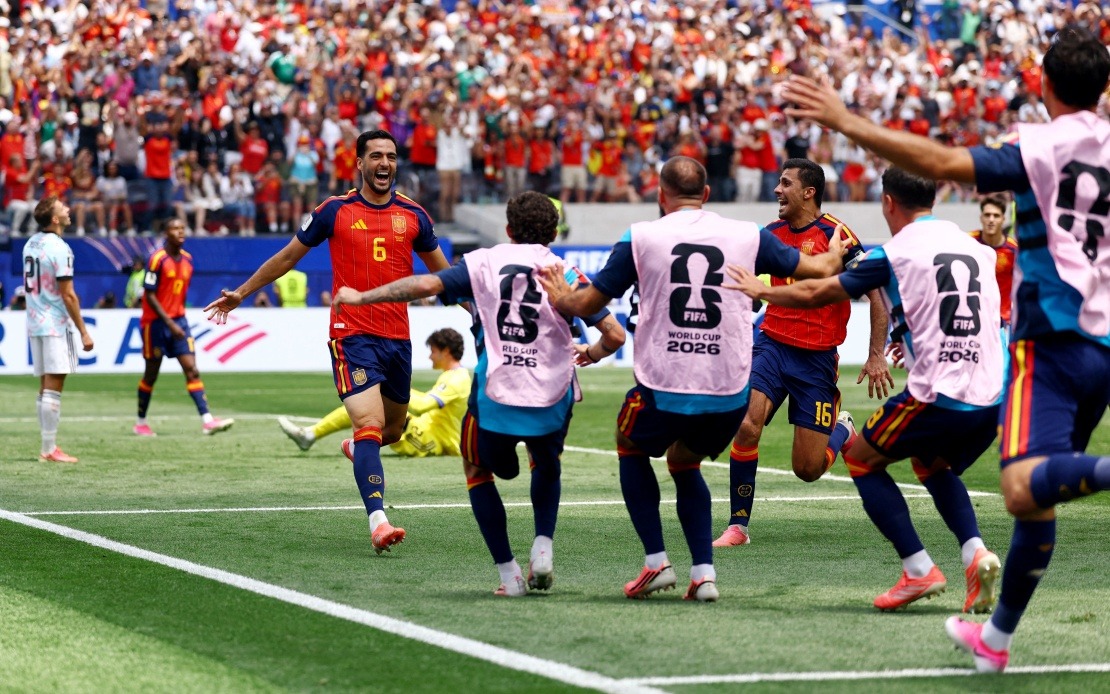
Spain has advanced to the World Cup semi-final stage following a hard-fought 2-1 triumph over Belgium at a fixture held in Inglewood, California on Friday, setting up a tantalizing encounter with tournament favourites France. The victory proved decisive despite Belgium mounting a spirited comeback midway through the match, with substitute Mikel Merino proving to be the crucial difference-maker once again for the European champions.
The match unfolded in contrasting phases, with Spain establishing early control through Fabián Ruiz's opening strike at the 30-minute mark. This goal appeared to have placed the Spanish side firmly in the ascendancy, particularly given their technical superiority and possession dominance throughout the opening period. However, Belgian resistance materialized when Charles De Ketelaere found an equalizer, pulling his side level and momentarily threatening to derail Spain's tournament ambitions. The equalizer also marked a significant moment for Spain's goalkeeper Unai Simón, who conceded for the first time after an extraordinary sequence of 649 World Cup minutes across two separate tournaments—a striking testament to both his form and his team's defensive organization.
Belgium's task became increasingly difficult as the match progressed, hampered by cascading injuries that stripped the side of critical personnel. Captain Youri Tielemans was forced to withdraw during the pre-match warm-up with what appeared to be a hamstring complication, a late blow that deprived the Belgian midfield of an influential voice and playmaking capacity. This absence compounded existing absences, most notably Amadou Onana's unavailability following a knee ligament injury suffered earlier in the tournament. These departures fundamentally weakened Belgium's midfield architecture, reducing their ability to control tempo and transition play—factors that Spanish coaches had clearly identified and sought to exploit throughout the encounter.
The situation deteriorated further for the Belgian side when goalkeeper Thibaut Courtois sustained an injury that forced his removal from play during the 71st minute. Courtois's departure prompted the introduction of Senne Lammens, a Manchester United goalkeeper thrust unexpectedly into a high-pressure World Cup quarter-final scenario. The change proved consequential, as Lammens's inexperience in such circumstances soon became apparent. Facing a long-range strike from Pau Cubarsi, Lammens fumbled his attempt to collect the ball cleanly, spilling possession directly into danger and creating the exact opening Spain required.
With the Belgian defence momentarily disorganized following the goalkeeping error, Merino seized his opportunity with clinical precision, firing past Lammens into the top corner of the net during the 88th minute. The goal delivered Spain with their passage into the semi-final stage and again demonstrated Merino's particular value as an impact substitute. His role in the previous knockout fixture against Portugal had similarly proven decisive, reinforcing his reputation as a clutch performer capable of delivering crucial moments. The Arsenal midfielder's predatory instincts and movement in the penalty area have become hallmarks of his tournament contribution, with selectors clearly placing faith in his ability to change matches through late tactical interventions.
Spain's progression sets the stage for a compelling semi-final encounter against France near Dallas scheduled for Tuesday. This fixture represents a rematch of Spain's Euro 2024 semi-final victory, offering France an opportunity for redemption on a slightly different stage. The French approach this semi-final as tournament favourites, having demonstrated consistent performance throughout the competition and assembled a squad of considerable depth and experience. However, their path has proven marginally less challenging than Spain's, and many analysts regard the Spanish as the more cohesive and technically fluid side despite France's historical pedigree.
France arrives at this juncture as a team seeking to reclaim World Cup glory following their runner-up finish four years ago to Argentina. The 1998 and 2018 champions have maintained their status as a major force in international football, yet the Spanish side represents qualitatively their most formidable opponent encountered thus far in the tournament. Spain's dominance against Belgium, notwithstanding the Belgian injuries, showcased the Spanish team's technical superiority and ability to control matches through possession and intelligent movement—characteristics that have become synonymous with contemporary Spanish football philosophy.
For Malaysian and Southeast Asian football enthusiasts, this semi-final encounter offers a masterclass in contrasting European footballing philosophies. Spain's emphasis on technical excellence, positional discipline, and patient build-up play contrasts sharply with France's more direct approach and reliance on individual brilliance. The semi-final will determine which philosophy prevails under the intense pressure of knockout competition. Spain's trajectory through the tournament, marked by impressive victories and measured performances, suggests a team peaking at precisely the right moment—a factor that could prove decisive against even favourites of France's calibre.

