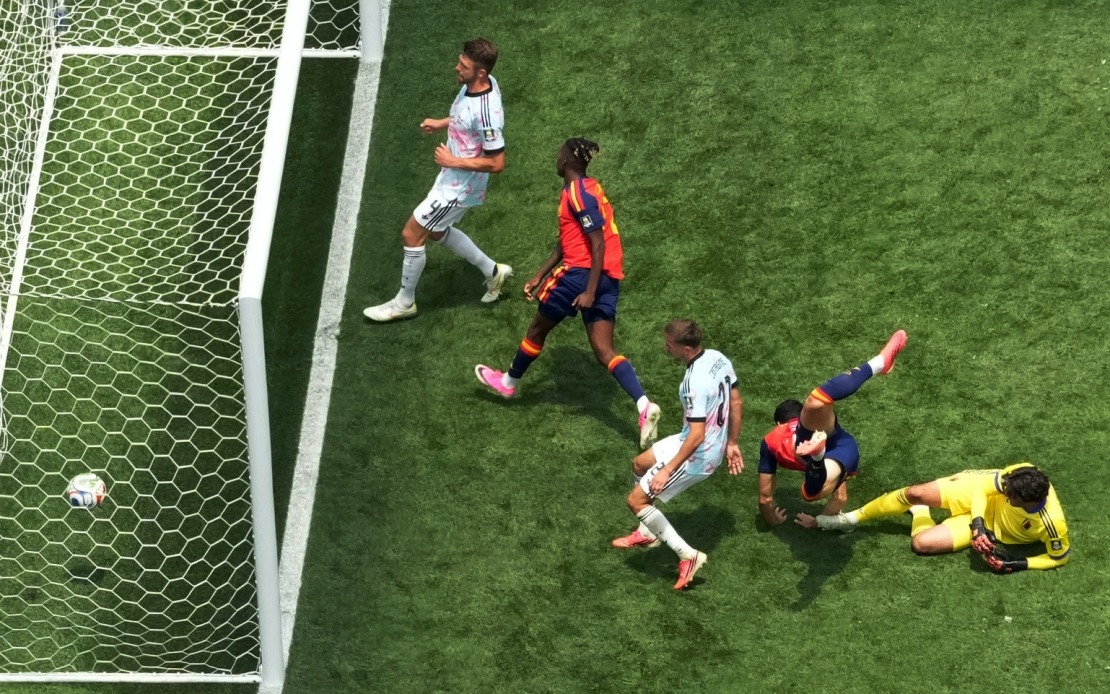
Spain has secured a place in the semi-finals of FIFA World Cup 2026, ending a 16-year drought at the tournament's business end after midfielder Mikel Merino capitalised on a goalkeeping error to snatch a 2-1 win over Belgium at Los Angeles Stadium on Friday. The substitute's composed finish in the dying moments proved decisive for Luis de la Fuente's squad, replicating his heroics from the previous round when he scored the lone goal in Spain's knockout tie against Portugal. The victory represents a significant breakthrough for the two-time World Cup champions, who last reached the semi-final stage in 2010 when they won the tournament.
The contest between Spain and Belgium unfolded as a tightly contested affair, though the European heavyweights dominated much of the early proceedings. Spain's attacking intent was evident from the outset, with the team controlling possession and creating dangerous opportunities through fluid movement and incisive passing. The 18-year-old sensation Lamine Yamal nearly broke the deadlock in the 21st minute, unleashing a curled effort that narrowly evaded the left post, signalling Spain's offensive ambitions. Belgium's defensive setup, overseen by French coach Rudi Garcia, initially held firm despite the sustained pressure, with goalkeeper Thibaut Courtois proving a formidable barrier between the posts.
Spain's persistence paid dividends shortly after the hydration break when midfielder Fabian Ruiz capitalised on a loose ball in the Belgian penalty area to register the opener in the 30th minute. The goal arrived following a quality save from the 34-year-old Courtois, who had thwarted Dani Olmo's initial attempt with a strong hand, only for the rebound to fall kindly to Ruiz. Spain's intensity continued unabated as they sought to extend their advantage, with Courtois required to produce another acrobatic intervention moments later, stretching low to his right to deny Yamal's free-kick that appeared destined for the bottom corner. Despite their dominance in possession and shot generation, Spain's inability to convert further chances proved consequential.
Belgium's equaliser came against the run of play when full-back Timothy Castagne delivered a dangerous cross from the right wing in the 41st minute. Forward Charles De Ketelaere rose above the Spain defence to power a downward header past goalkeeper Unai Simon, restoring parity just before the interval. The goal represented Belgium's clinical approach to counter-attacking football, a tactical approach that threatened to derail Spain's progression despite their superior territorial control. The Red Devils emerged for the second half with renewed confidence, and full-back Maxim De Cuyper came agonisingly close to giving his side a maiden lead when his low drive struck the side netting approximately ten minutes into the restart.
Courtois remained the busier goalkeeper throughout the contest, producing back-to-back saves within rapid succession to deny Yamal and forward Mikel Oyarzabal before an apparent leg injury forced his withdrawal in the 71st minute. Manchester United goalkeeper Senne Lammens entered the field as his replacement, and the subsequent substitution would prove fateful for Belgium's championship ambitions. The substitute goalkeeper immediately came under pressure as Spain intensified their pursuit of victory, and crucially, Lammens misjudged a long-range effort from centre-back Pau Cubarsi, allowing the ball to squirm from his grasp. Merino exhibited predatory positioning to react quickest among the assembled players, firing home a poacher's finish in the 88th minute to secure Spain's passage into the final four.
The victory sets up a compelling semi-final encounter between Spain and France in Dallas on July 15, after the tournament's defending champions dispatched Morocco with a 2-0 scoreline on Thursday. This pairing between two traditional European powerhouses represents a mouth-watering clash that will captivate football enthusiasts across the continent and beyond. Spain's path to Dallas has seen the squad navigate challenging opponents with growing confidence, whereas France's demolition of Morocco demonstrated their capacity to perform decisively when elevated competition materialises. The contrast in playing styles between Spain's possession-based methodology and France's more direct approach promises tactical intrigue.
The FIFA World Cup 2026 represents an unprecedented expansion from previous tournament formats, featuring 48 competing nations rather than the traditional 32-team structure. This enlargement renders the competition the largest ever organised since the inaugural tournament in Uruguay in 1930, with the expanded format distributed across three host nations: Canada, Mexico, and the United States. The inclusion of additional teams has fundamentally altered qualification pathways and tournament dynamics, creating more opportunities for emerging football nations whilst simultaneously increasing match frequency and scheduling complexity. For established squads like Spain and France, navigating the expanded structure successfully underscores their technical superiority and tournament experience.
The tournament commenced on June 11 and will conclude on July 19, spanning approximately five weeks of intense competition. Spain's progression to the semi-finals demonstrates the squad's ability to perform under pressure in knockout football, where marginal errors and individual brilliance frequently determine outcomes. Merino's two crucial goals across consecutive knockout rounds highlight the importance of quality substitutes who can impact matches decisively. Looking ahead to the Dallas encounter, Spain will recognise that France represents perhaps their sternest examination yet, requiring sustained excellence across all facets of play to reach the final. The semi-final promises to showcase the finest attributes of contemporary European football, with possession retention, creative implementation, and clinical finishing all likely to feature prominently.

