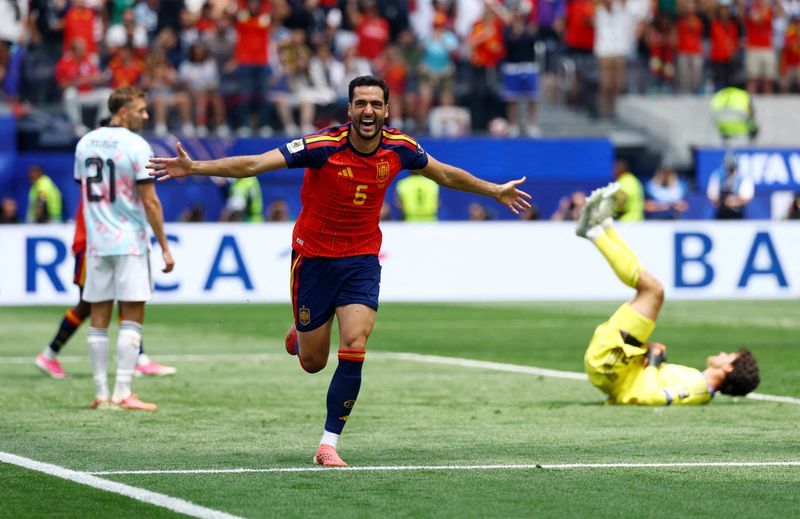
Spain secured their passage to the World Cup semi-finals on Friday with a 2-1 victory over Belgium at Los Angeles Stadium, continuing their impressive tournament run with another late-game heroics from their bench. The decisive moment came in the 86th minute when substitute Mikel Merino capitalized on a goalkeeping error to fire home the winner after Belgium's backup keeper Senne Lammens failed to secure a low drive from Pau Cubarsi. The Spanish supporters who dominated the sold-out crowd erupted as the ball crossed the line, marking Spain's first semi-final appearance since their triumphant 2010 World Cup campaign.
The match unfolded as a tactical battle between two sides seeking to impose their style on the sweltering Los Angeles afternoon. Spain dominated possession and dictated much of the early play, with their aggressive approach yielding rewards through Paris Saint-Germain midfielder Fabian Ruiz after thirty minutes. Ruiz's poaching instinct was on full display as he seized upon a rebound following a brilliant diving save by Belgium goalkeeper Thibaut Courtois, sliding the ball between defender Timothy Castagne's legs to put Spain ahead. The goal vindicated coach Luis de la Fuente's controversial team selection, which saw him start Ruiz instead of Pedri, a decision that raised eyebrows before kickoff but paid immediate dividends on the pitch.
Belgium responded swiftly to equalize just eleven minutes later through winger Charles De Ketelaere, whose perfectly-timed run allowed him to meet Castagne's cross with a firm header past Spanish keeper Unai Simon. The goal represented a significant moment in the tournament context—it was the first goal Spain had conceded throughout their entire campaign, underscoring the defensive solidity they had maintained until that point. The equalizer injected renewed energy into the Belgian side, and despite their injury-related disadvantages, they refused to surrender the initiative, pushing Spain into a competitive second-half battle under exhausting conditions.
The Belgian camp entered the match significantly undermanned, with captain Youri Tielemans withdrawn from the starting lineup just before kickoff due to a warm-up injury, forcing Hans Vanaken into an unexpected role. More significantly, midfielder Amadou Onana remained sidelined following an anterior cruciate ligament tear sustained during Belgium's round-of-16 elimination of the United States. These absences forced Belgium's veteran leaders Kevin De Bruyne and Romelu Lukaku to shoulder heavier responsibility, and whilst they fought valiantly, the missing midfield depth ultimately proved decisive against Spain's increasing dominance.
Spain emerged from the interval with renewed tactical intensity, controlling possession and systematically dismantling Belgium's defensive structure. The Spanish attack flowed through electric eighteen-year-old Lamine Yamal, whose electric runs and incisive play caused Belgian defenders constant distress throughout the second half. De la Fuente's team orchestrated a methodical siege on the Belgian goal, patiently probing for weakness and building sustained periods of pressure that made a Spanish goal feel inevitable rather than merely likely. The substitution of Merino in the 86th minute proved transformative, as the midfielder required just two minutes to make a decisive impact on the match outcome.
Merino's finish proved characteristic of his tournament performance and carries significant historical weight. The goal made him the first player in World Cup history to score the winning goal in two separate knockout-stage matches whilst coming on as a substitute, a remarkable distinction achieved through his previous late winner against Portugal in the round-of-sixteen. Speaking after the match, Merino credited meticulous match preparation rather than fortune for his clinical finishing. "There are no such things as coincidences," he reflected. "If you go into a match well-prepared, things tend to happen again." His tactical awareness and positioning sense speak to a player performing at the highest level of tournament football, combining the impact of late substitutions with the precision usually associated with players operating from the start.
Spain's path to the semi-finals now leads to Dallas, where they will face tournament favourites France on Tuesday in what promises to be a compelling encounter between two of world football's strongest sides. The semi-final represents the ultimate examination for De la Fuente's rejuvenated Spanish squad, which many analysts believed had passed its peak following the dominance of earlier decades. Yet Spain has demonstrated resilience, technical excellence, and crucial finishing ability throughout this tournament, qualities that will be severely tested against a French team seeking to retain their title. De la Fuente expressed cautious confidence about the challenge ahead, stating that France would be equally apprehensive about facing Spanish football's characteristically fluid and possession-dominant approach.
Merino echoed the coach's ambitions when discussing Spain's tournament aspirations. "We are two matches away from winning the World Cup and that is what we are going after," he declared, articulating the genuine belief coursing through the Spanish camp. This confidence rests on tangible evidence—Spain's domination of possession statistics, their ability to create high-quality chances, and most crucially, their capacity to find goals when matches reach their decisive moments. The victory over Belgium was never comfortable, yet Spain's greater depth and quality ultimately prevailed, a pattern that may determine their fortunes in Dallas.
For Belgium, the defeat represents another heartbreaking chapter in a tournament that saw them depart earlier than their squad quality might have suggested. The absence of key players through injury compounds the disappointment, as does the knowledge that a more clinical finish or defensive alertness might have altered the outcome. De Bruyne and Lukaku, veterans accustomed to major tournaments, will reflect on opportunities that slipped away against increasingly dominant opposition. Belgium's injuries meant they entered the match already compromised, yet their fighting spirit never wavered until the final whistle—a testament to professional pride even as their World Cup ambitions evaporated beneath the California sun.

