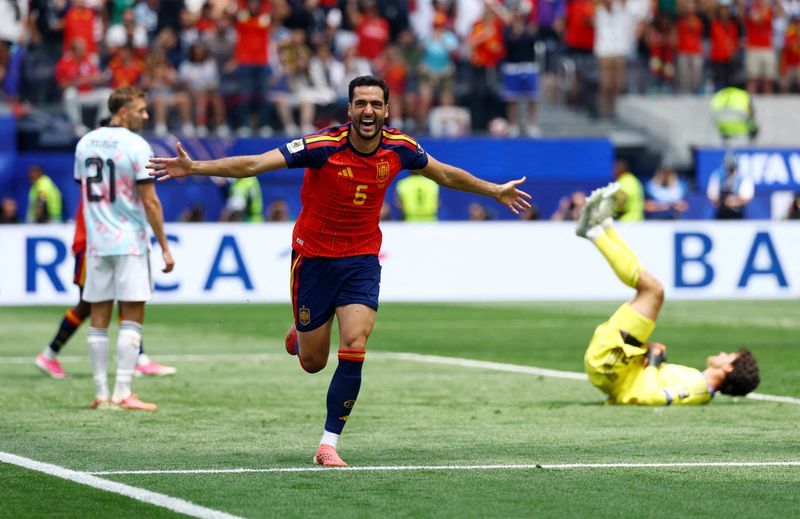
Spain secured a dramatic 2-1 victory over a depleted Belgium side at Los Angeles Stadium on Friday, with substitute Mikel Merino's close-range finish in the 88th minute proving decisive in a quarter-final encounter that showcased the unpredictability of knockout football. The triumph sends Luis de la Fuente's European champions through to a semi-final clash against tournament favourites France in Dallas on Tuesday, reviving Spanish hopes of adding to their sole World Cup triumph in 2010.
The match unfolded as a tactical battle between two sides adopting contrasting approaches. Spain's aggressive early pressing paid dividends when Fabian Ruiz broke the deadlock in the 30th minute, capitalising on hesitancy from Belgium goalkeeper Thibaut Courtois after the goalkeeper had already made a crucial diving save moments earlier. Ruiz's movement to capitalise on the loose ball, firing past defender Timothy Castagne's legs, vindicated coach de la Fuente's unconventional selection to start the Paris Saint-Germain midfielder ahead of the expected Pedri. The decision represented a calculated gamble that appeared to have paid off as Spain established early control.
Belgium's troubles mounted before kickoff when captain Youri Tielemans suffered an injury during warm-up drills, forcing Hans Vanaken into the starting eleven on short notice. The removal of such an experienced midfield presence, combined with the earlier loss of Amadou Onana to an anterior cruciate ligament injury sustained during their round-of-16 victory over the United States, left the Belgian midfield considerably weakened. Despite these impediments, Belgium responded swiftly to Spain's opener through an expertly executed team move, with Charles De Ketelaere capitalising on Timothy Castagne's precise cross delivery to level the affair in the 41st minute. The equaliser marked the first goal Spain had conceded throughout the entire tournament, underlining both Belgium's attacking efficiency and Spain's previously resolute defensive organisation.
The sweltering conditions at the Los Angeles venue, where a capacity crowd predominantly favoured the Spanish contingent, created an oppressive atmosphere that seemed to drain both sides as the first half reached its conclusion. Spain emerged from the interval with renewed intensity, dominating possession and consistently probing at the Belgian defensive structure. Belgium's goalkeeper situation further deteriorated when Courtois's replacement, Senne Lammens, failed to secure a low drive from Pau Cubarsi in the 88th minute. The rebound presented a straightforward opportunity for Merino, introduced from the bench after 86 minutes, to fire past the exposed goalkeeper and seal Spain's passage to the semi-finals.
Merino's intervention represented a textbook example of impact substitution, where a player entering the fray late in proceedings identifies and capitalises on a fleeting chance with clinical precision. The Spanish substitute's involvement underscored de la Fuente's tactical flexibility and his willingness to adjust his personnel in response to evolving match circumstances. Spain's attacking philosophy, which emphasised sustained pressure and exploitation of spaces created by Belgium's depleted midfield, ultimately proved too much for the injury-ravaged visitors to contain over ninety minutes.
Spain's advancement marks only the second occasion they have reached the World Cup semi-finals, their only prior experience coming in 2010 when they proceeded to lift the trophy in South Africa. The 1950 tournament represented their best previous performance when they finished fourth in an era when the final stage consisted of a group format rather than knockout matches. This semi-final appearance therefore carries significant historical resonance for Spanish football, offering the possibility of returning to a final stage they last contested over a decade ago.
The semi-final pairing against France will represent a clash of contrasting narratives and tactical philosophies. While Spain showcased methodical, possession-based football punctuated by incisive finishing, France enters the tie as the tournament's dominant force and pre-competition favourites. The Dallas venue will host what promises to be one of the competition's most compelling encounters, pitting European champions against the competition's most ominous performers to date.
Belgium's exit concludes a disappointing campaign for a side that arrived as a traditional powerhouse but encountered a sequence of debilitating injuries that progressively dismantled their competitive infrastructure. The loss of key personnel, particularly Courtois and Onana, forced the Belgians into unfamiliar operational patterns that ultimately proved insufficient against a Spanish side operating with greater cohesion and depth. Their withdrawal from the competition will prompt significant reflection within Belgian football regarding squad management, injury prevention protocols, and the sustainability of their model during the tournament's most demanding phase.

