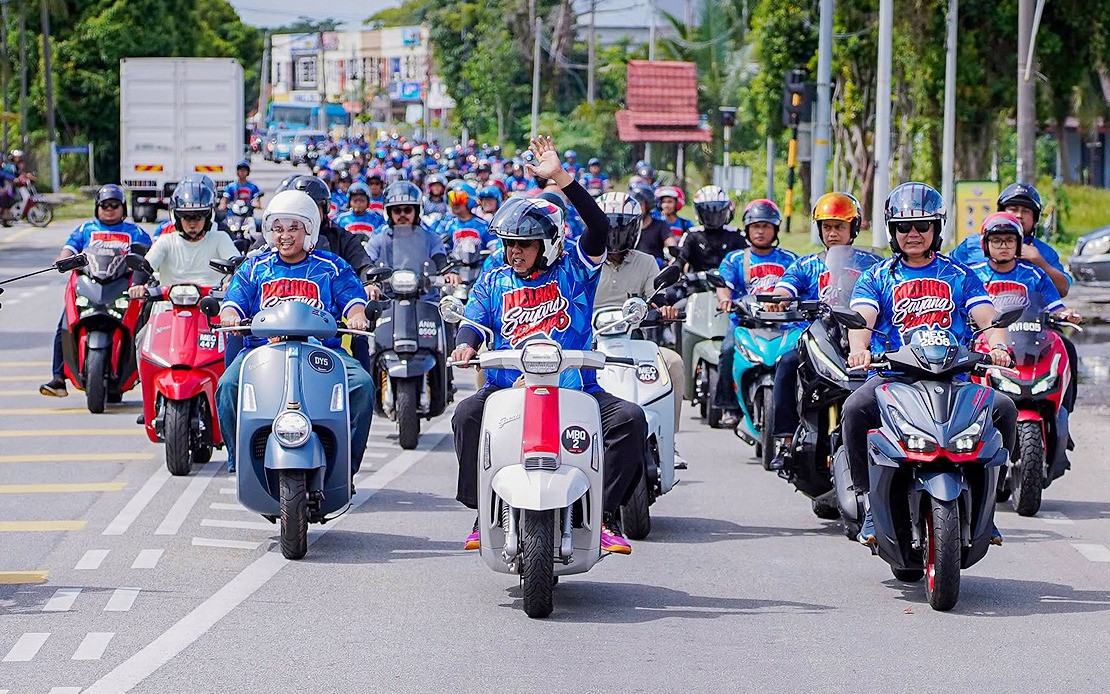
Melaka Chief Minister Datuk Seri Ab Rauf Yusoh has unveiled an ambitious expansion of the state's grassroots outreach initiative, with the Tangga Batu parliamentary WRUR programme—branded as Kampung Kita—now targeting Pantai Kundor and Paya Rumput state constituencies. The two-phase rollout represents a sustained commitment to addressing community concerns through structured engagement rather than ad-hoc interventions, positioning grassroots connectivity as central to the state administration's governance strategy.
The scale of the initiative underscores the breadth of the state's engagement model. More than 200 distinct programmes will be deployed across the two constituencies, spanning welfare assistance, community development initiatives, educational support, youth engagement, entrepreneurship facilitation, and targeted resolution of locally-identified grievances. This multifaceted approach acknowledges that ground-level challenges extend beyond individual complaints to encompass structural gaps in infrastructure, economic opportunity, and social services that require coordinated intervention across multiple government agencies and departments.
Crucially, Ab Rauf characterised WRUR not as a temporary political exercise or seasonal campaign, but as a continuous extension of engagement methodology that has been refined and implemented consistently over two years. This framing carries significance for stakeholder expectations: it suggests the state views grassroots connection as a permanent operational feature rather than an electoral instrument deployed episodically. The consistency claim carries weight given the scale of documented resolution rates. Across 23 previous implementation series, the programme has logged over 4,000 complaints, with nearly 70 per cent successfully addressed. These figures, if sustained, demonstrate institutional capacity for complaint management at a scale meaningful to constituents seeking tangible government responsiveness.
Within the Tangga Batu parliamentary constituency specifically, WRUR had previously operated in Sungai Udang and Kelebang state constituencies, establishing a baseline for performance assessment. That earlier iteration processed 359 complaints, resolving 328 while maintaining active follow-up on the remaining 31 unresolved matters. The modest residual caseload suggests either that particularly complex issues require extended attention or that resolution definitions are precisely calibrated. For Malaysian constituencies where government accessibility remains uneven, such documentation of complaint handling—and explicit acknowledgment of pending items—establishes measurable accountability benchmarks that regional observers should monitor.
The financial dimension of the current phase reflects strategic allocation toward economically vulnerable groups. The sixth distribution cycle disbursed aid packages exceeding RM150,000 in value across multiple beneficiary categories. Fishermen received RM22,000 targeting 220 individuals, addressing vulnerability within a traditional maritime sector facing mounting pressures from climate variability and commercial competition. Separate provisions of RM1,500 each compensated five boat owners whose vessels sank, highlighting the state's attention to asset loss among working populations where insurance penetration remains incomplete. Small and medium enterprise entrepreneurs accessed RM14,000 in business equipment support distributed among 10 operators, reflecting recognition that capital access remains a structural constraint for grassroots entrepreneurship across Malaysia. Beyond these sectoral allocations, aid reached religious education institutions, places of worship, scholarship recipients, and households requiring shelter assistance.
Infrastructure deterioration has surfaced as an immediate priority following recent flood events that displaced residents and threatened livelihoods. Recent flash flooding affected 73 households in Pantai Kundor, triggering rapid response protocols. The Department of Irrigation and Drainage has allocated RM50,000 toward cleaning and maintenance operations at Sungai Seberang Gajah, with completion projected within seven days. This reactive work, however, exists alongside longer-term mitigation efforts: DID has initiated procurement procedures for RM100,000 in improvement works at Sungai Lereh, while the Public Works Department has submitted federal approval requests for a RM16 million culvert upgrade on Jalan Tangga Batu-Tanjung Minyak. The escalating investment scale—from emergency response through preventive maintenance to major capital projects—illustrates the infrastructure investment intensity required for flood-prone areas across peninsular Malaysia where drainage systems face cumulative stress from urbanisation and climate impact.
For constituencies across Southeast Asia observing Malaysian governance innovation, the Tangga Batu WRUR expansion merits attention as a case study in sustained community engagement architecture. The programme's documented complaint resolution rates, multi-sector coverage, and integration of emergency response with long-term infrastructure planning offer replicable elements for regional administrations seeking to strengthen citizen connectivity. The 70 per cent resolution rate, while positive, also identifies persistent gaps where certain complaint categories—potentially those requiring inter-agency coordination or substantial capital expenditure—remain unresolved. Malaysian policymakers contemplating expansion to additional constituencies might usefully conduct root-cause analysis of that 30 per cent unresolved remainder to refine protocols before broader scaling.
The initiative's emphasis on economic support to fishing communities and petty entrepreneurs reflects awareness that rural and semi-rural constituencies contain populations whose welfare remains vulnerable despite Malaysia's overall middle-income classification. Targeting 220 fishermen indicates recognition that primary sector participants continue to experience income volatility and asset vulnerability that government safety-net programming remains necessary to address. Business equipment grants to SME operators acknowledge that microfinance and credit availability, while expanded substantially in Malaysia, may exclude borderline operators lacking formal collateral or credit histories. These granular support modalities suggest the Melaka administration views welfare provision not as uniform cash transfers but as sector-calibrated assistance addressing specific vulnerability signatures.
Looking forward, the completion of Tangga Batu WRUR rollout and subsequent phases will test whether this engagement model can be sustained at equal intensity across different parliamentary constituencies, each containing distinct demographic compositions and grievance profiles. The RM16 million culvert project and smaller Sungai Lereh works signal substantial capital mobilisation, but sustained execution requires coordination between state allocations and federal infrastructure programming—a requirement that imposes coordination demands on Melaka's state administration and potentially constrains expansion velocity if federal budget cycles or competing regional demands dilute available resources. Monitoring whether complaint resolution rates remain stable or trend upward as successive cohorts of constituencies enter the programme will indicate whether the model matures productively or experiences implementation fatigue typical of large-scale community engagement initiatives.

