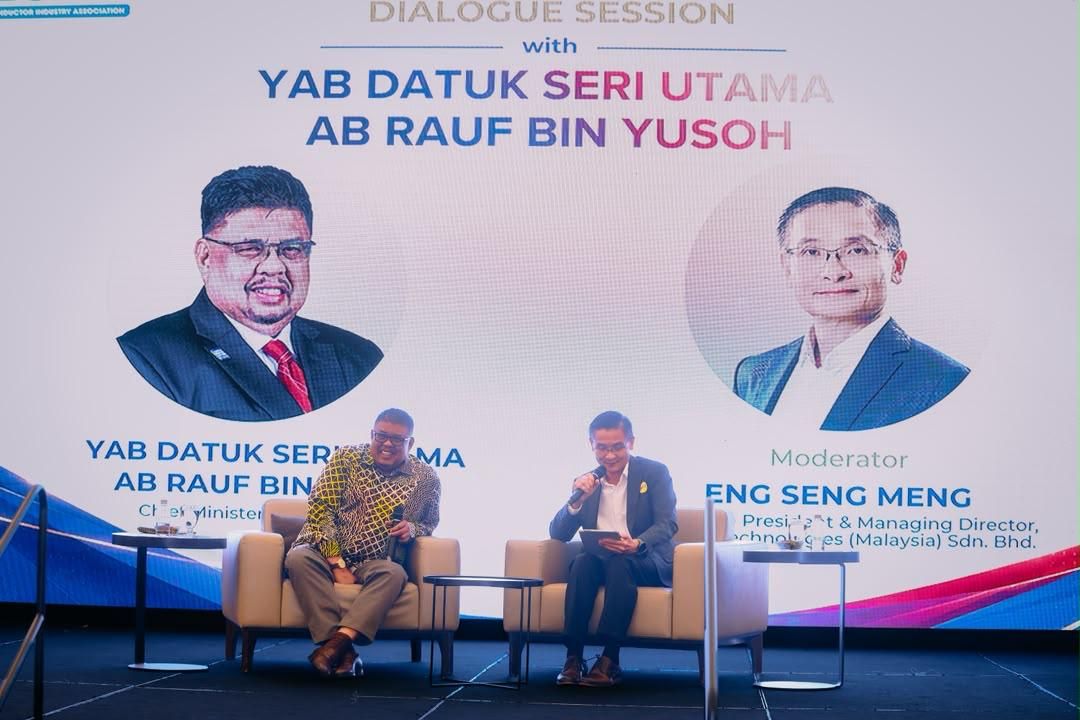
Melaka's semiconductor and electrical-electronics manufacturing sector has matured into a RM17.6 billion cornerstone of the state economy, Chief Minister Datuk Seri Ab Rauf Yusoh revealed during a meeting with industry stakeholders this week. The achievement represents a transformative journey spanning more than five decades, starting from a single international company's pioneering investment in the early 1970s and expanding into a diversified ecosystem supporting hundreds of enterprises across multiple industrial segments.
The sector's genesis traces to an unconventional beginning. Rather than establishing operations within a formal industrial park, the first semiconductor manufacturer operated from the Umno building on Jalan Hang Tuah before relocating to Batu Berendam following Melaka's creation of its first Free Industrial Zone in 1976. This humble origin story underscores how visionary entrepreneurship and strategic government policy combined to unlock latent economic potential. What commenced with a handful of employees has evolved into a globally competitive manufacturing ecosystem, with the sector now contributing substantially to high-value employment and technological advancement across the region.
The contemporary scale of Melaka's manufacturing presence reflects this long-term development. Manufacturing activities now account for 36.1 percent of the state's gross domestic product, with more than 400 companies operating across 18 distinct industrial sectors. This diversification provides economic resilience, insulating the region from overreliance on any single subsector while enabling knowledge transfer and supply-chain integration across complementary industries. The multiplication of manufacturing enterprises has catalysed the emergence of supporting ecosystems encompassing multinational suppliers, domestic small and medium enterprises, vocational training institutions, and logistics infrastructure.
The human and social dimension of this industrial expansion extends far beyond aggregate economic statistics. Five decades of semiconductor manufacturing has created livelihoods for thousands of workers and their dependents, with wages and employment opportunities filtering through Melaka's broader economy. Local suppliers and SMEs have benefited from supply contracts and service provision opportunities, while professional workers have accumulated specialised expertise positioning Malaysia advantageously within global technology supply chains. The intergenerational wealth accumulation stemming from manufacturing employment has contributed to rising living standards and consumer activity throughout the state.
Melaka's sustained attractiveness to foreign manufacturers rests upon three interconnected competitive advantages. Geographically, the state occupies a strategic position nestled between Kuala Lumpur, Johor, and Singapore, conferring proximity to major ports, airports, and regional markets whilst maintaining competitive operating costs that rival alternatives elsewhere in Asia. The state government has preserved more than 2,600 hectares of industrial land for future expansion, providing investors with development flexibility as production scales. This combination of location economics and land availability addresses fundamental site-selection criteria for manufacturing operations requiring both market access and room for capacity augmentation.
Human capital development represents the second pillar of Melaka's competitive positioning. The state has cultivated a Technical and Vocational Education and Training ecosystem encompassing 61 institutions aligned with semiconductor and electronics manufacturing requirements. This TVET infrastructure generates steady flows of industry-ready graduates possessing practical competencies demanded by manufacturers, reducing corporate recruitment and training burdens whilst channelling educational outcomes toward genuine employment pathways. As semiconductor manufacturing increasingly demands technologically sophisticated workforces, Melaka's sustained investment in skills development provides measurable advantage over jurisdictions lacking comparable training capacity.
The third element comprises demonstrable investor confidence validated through decades of continuous international engagement. Multinational enterprises headquartered in the United States, Germany, China, Japan and other major economies have maintained and progressively expanded Melaka operations spanning multiple generations. This persistent commitment reflects accumulated confidence in political stability, regulatory predictability, and business-enabling governance. The recent achievement of RM14.68 billion in approved investments across 312 projects during 2025 represents the state's highest annual investment value in 22 years, suggesting ongoing confidence despite competitive pressures across global semiconductor markets.
However, Ab Rauf articulated a cautionary assessment regarding future competitiveness. Semiconductor manufacturing faces an inflection point where capital allocation decisions made presently will determine technology location, supplier networks, and manufacturing footprints across succeeding decades. Global manufacturers evaluating investment locations demand accelerated project implementation timelines, expanded production capabilities, and investment certainty. Should Melaka prove sluggish in responding to investor requirements, competitors offering faster approval processes and broader manufacturing capacities may capture investment flows destined elsewhere. The stakes extend beyond new manufacturing facilities to encompassing expansion projects, supply-chain activities, and high-skilled employment opportunities that would reinforce Melaka's sectoral leadership.
The risks of complacency translate into tangible economic consequences. Delayed investment decisions could divert manufacturing capacity to competing jurisdictions, reducing employment growth prospects and constraining expansion of Melaka's supplier ecosystem. Local SMEs operating within semiconductor supply chains risk marginalisation if manufacturing activity declines, whilst thousands of high-skilled positions dependent upon semiconductor sector vitality would face consolidation pressures. This potential scenario motivates urgency in implementing business-enabling reforms, infrastructure enhancement, and investor accommodation strategies that preserve Melaka's sectoral advantages.
Addressing these competitive pressures, the state government has formulated the Melaka Semiconductor Strategy 2035, positioning high-value investment attraction, local capability strengthening, and destination appeal as primary objectives. Beyond conventional infrastructure provision and financial incentives, Ab Rauf committed to operational support encompassing expedited regulatory approvals, problem resolution mechanisms, and integrated project implementation assistance. This governmental posture acknowledges that modern manufacturing location decisions increasingly reflect perceived operational partnership quality alongside conventional site factors, with investor retention depending upon sustained administrative responsiveness.
Melaka's semiconductor narrative carries implications extending beyond state boundaries. As Malaysia navigates positioning within global technology supply chains amid intensifying geopolitical competition, regional hubs like Melaka assume heightened strategic importance. The concentration of manufacturing expertise, supply-chain relationships, and human capital represents national assets enhancing Malaysia's technology sector competitiveness. Sustaining Melaka's sectoral momentum requires continued policy attention to workforce development, infrastructure modernisation, and investor engagement, with success potentially replicating value-creation models across other Malaysian regions pursuing advanced manufacturing development.

