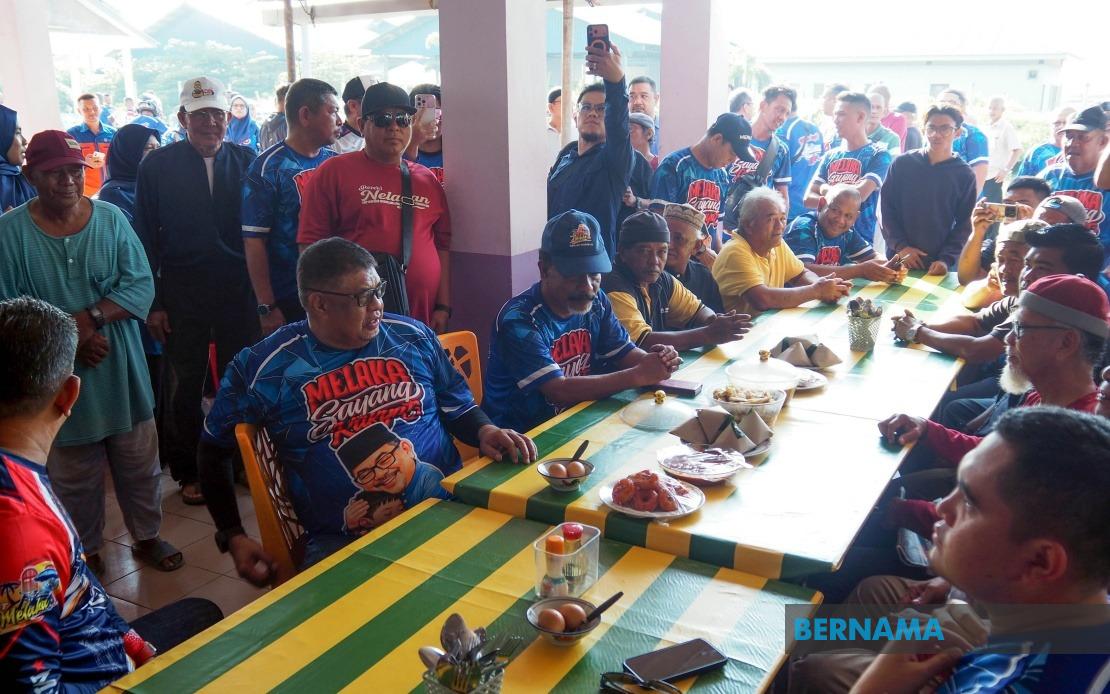
The Melaka state government has embarked on an ambitious programme to strengthen the livelihoods of its fishing community, introducing dual initiatives that combine social safety nets with technological modernisation. Chief Minister Datuk Seri Ab Rauf Yusoh unveiled the measures during a grassroots engagement tour in the Merlimau constituency, signalling a shift towards direct intervention in a sector that remains economically vital yet often marginalised in state policy frameworks.
The centerpiece of the initiative involves extending PERKESO (Pertubuhan Keselamatan Sosial Pekerja) coverage to all registered fishermen in the state. This move addresses a longstanding gap in occupational security for maritime workers, whose exposure to workplace hazards—rough seas, equipment-related injuries, and unpredictable weather conditions—has historically left them vulnerable without formal protection mechanisms. The social security arrangement provides fishermen with benefits covering workplace accidents, disability, and other occupational contingencies that have previously forced many to absorb costs personally or rely on informal community support systems.
Complementing the social protection aspect, the state government is equipping fishermen with fish finders, modern sonar technology that represents a significant departure from traditional methods reliant on experience and intuition. This technological investment addresses a practical constraint that has long affected productivity in Melaka's fishing sector. Fish finders enable operators to identify concentrations of target species with greater precision, allowing for more efficient deployment of nets and reducing wasted effort on unproductive fishing grounds. The economic barrier to individual adoption has historically been substantial—retail units cost between RM1,000 and RM2,000—placing such equipment beyond reach for most small-scale operators working on thin profit margins.
The announcement came during the fifth leg of the Chief Minister's 'Jelajah Ketua Menteri Sayang Rakyat' (Chief Minister's Tour of Caring for the People) initiative, a deliberate strategy to conduct policy consultations at the grassroots level rather than exclusively through bureaucratic channels. This approach acknowledges that understanding genuine community needs requires direct engagement and observation. By visiting the Kuala Sempang Jetty in Jasin and listening to fisher folk firsthand, the state administration claims to gather intelligence that informs more responsive decision-making than top-down planning alone permits.
The immediate financial support disbursed during the event further reinforced the government's commitment to tangible assistance. A total of 107 registered fishermen each received RM200 under the 'Bantuan Jaring Nelayan' (Fishermen's Net Assistance) scheme, channeling RM21,400 directly into household economies at a time when many coastal communities face persistent economic pressures. The scheme targets the equipment that forms the backbone of traditional fishing operations, acknowledging that replacing or maintaining nets represents a continuous operational cost that constrains many small operators.
The distribution of 360 kilogrammes of subsidised fish to the public, valued at RM3,600, served a dual purpose. Beyond providing affordable protein to consumers, the initiative supports price stabilisation for fishermen by creating guaranteed demand channels for portions of their catch. This market intervention helps insulate fishing communities from the demand volatility that often forces fishermen to sell at disadvantageous prices during periods of oversupply.
Fisherman Amirul Shah Fuad Shah, a 35-year-old operator from Kuala Merlimau with over two decades of maritime experience, articulated the practical significance of fish finder technology. His testimony highlights a crucial transition point for Malaysian fishing communities: the adoption of equipment that transforms the profession from one dominated by accumulated knowledge and experiential judgment into a hybrid model combining traditional skills with digital navigation. For veteran fishermen like Amirul, who have built careers on reading sea conditions and understanding fish behaviour, technological augmentation does not replace expertise but rather enhances the precision with which that knowledge can be deployed.
The PERKESO provision carries particular weight given the demographic composition of Malaysia's fishing communities. Kampung Sempang Fishermen's Association chairman Md Khalil Md Jadi, at 67 years old, represents a cohort of ageing maritime workers whose physical capacity to absorb occupational risks diminishes with age. Extending formal social security to this population acknowledges their vulnerability and removes a significant anxiety factor that has historically characterised fishing as an economically precarious occupation. The security of knowing that workplace injuries or accidents trigger defined compensation mechanisms reduces the desperation that drives fishermen to continue working under dangerous conditions when they would otherwise seek treatment or rest.
The modernisation aspect of this package also carries strategic implications for sectoral development. By distributing fish finders, Melaka's government signals recognition that traditional fishing communities cannot remain economically viable indefinitely through unchanged operational methods. Rising fuel costs, climate-related changes in fish migration patterns, and international competition have progressively squeezed margins in artisanal fishing. Technology-driven productivity improvements, while modest at individual levels, can aggregate into meaningful income enhancements across entire fishing fleets. For a state government concerned with poverty alleviation in coastal regions, this technological infusion represents a pragmatic intervention in a sector where productivity gains prove difficult to achieve through other mechanisms.
The policy package also reflects broader Southeast Asian trends in fisheries management. Malaysian states, facing persistent debates about marine resource depletion and the sustainability of current fishing practices, increasingly recognize that supporting fishermen's welfare and productivity simultaneously addresses economic development and conservation objectives. Fishermen equipped with better targeting technology theoretically reduce wasted effort and bycatch, minimising environmental damage while improving their own economic outcomes.
Yet the initiative's long-term effectiveness depends on implementation consistency and complementary policies. PERKESO coverage proves valuable only if fishermen possess awareness of their rights and accessible mechanisms for claiming benefits. Fish finders require maintenance and eventual replacement, necessitating sustained technical support infrastructure. Whether these programmes represent enduring structural improvements or time-limited interventions designed primarily for political engagement remains contingent on follow-up commitment from the state administration.
For Malaysian fishermen and coastal communities watching these developments, the Melaka initiative suggests growing political recognition of maritime worker welfare as a legitimate state concern. Similar programmes may inspire policy adoption across other Malaysian states with significant fishing populations, potentially establishing new baseline expectations for occupational protection and productivity support in a sector that has historically received piecemeal, reactive assistance rather than systematic development strategies.

