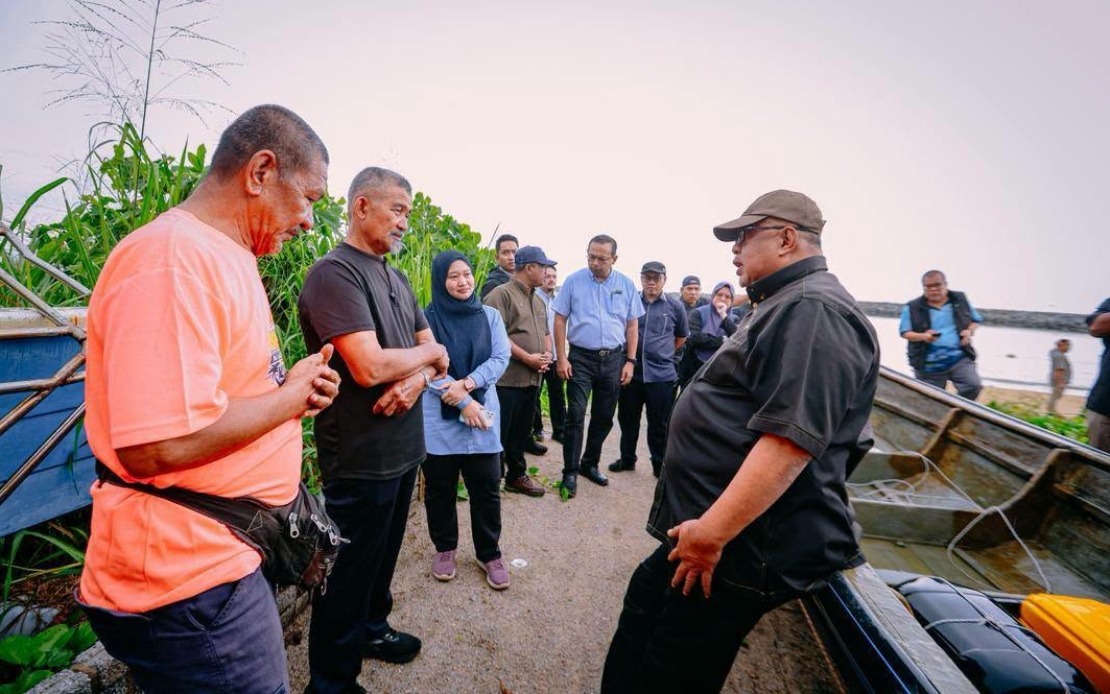
The Melaka state government has mobilised several key agencies to rapidly address longstanding difficulties affecting the fishing community in Pasir Gembur, Tanjung Bidara, after Chief Minister Datuk Seri Ab Rauf Yusoh conducted a direct inspection of the area and consulted with residents. The directive involves the Public Works Department (JKR) and the Drainage and Irrigation Department (DID), working in coordination with the Alor Gajah Municipal Council and other relevant authorities to implement practical solutions that directly impact the livelihoods of local fishermen.
During his visit to the coastal settlement, Ab Rauf convened a coordination meeting bringing together representatives from multiple government departments to assess the current state of the new fishermen's complex development and to systematically identify the obstacles that the fishing community continues to face. The Chief Minister's engagement reflected a broader commitment to moving beyond ceremonial site visits, emphasising instead a hands-on approach to understanding community grievances and translating those insights into actionable government responses.
The specific measures emanating from this coordination effort address both immediate infrastructure challenges and longer-term planning concerns. The DID has been tasked with conducting a comprehensive feasibility analysis regarding the deepening of the navigational channel that fishing boats currently use between Pasir Gembur and Batu Tenggek. This channel improvement is critical for enhancing maritime access and operational efficiency for local fishermen, particularly during periods when tidal conditions or sedimentation restrict vessel movement.
Parallel to the channel work, the JKR has received instructions to identify and prepare an alternative site for the proposed fishermen's complex that would substantially mitigate the recurring threats of seawater intrusion and tidal flooding that have plagued the current location. This site selection exercise represents a fundamental recalibration of the project's spatial planning, acknowledging that the existing location's vulnerability to high-tide inundation creates operational and commercial hardship for the fishing community that the facility is designed to serve.
The Melaka government has additionally enacted a regulatory freeze on private construction within the designated coastal wave-breaker zone, establishing clearer governance over coastal land use. This measure aims to prevent further encroachment and unauthorised development that could exacerbate flooding, tidal surges, and other environmental vulnerabilities in the area. Ab Rauf emphasised that any structures—existing or proposed—located within the coastal reserve must now obtain a Temporary Occupation Licence from the Land Administrator and secure clearance from relevant technical departments, creating a more transparent and accountable approval framework.
This regulatory approach reflects emerging best practice in coastal zone management across Southeast Asia, where competing demands from fishing communities, private developers, and public infrastructure projects frequently generate conflict. By requiring explicit licensing and multi-departmental approval, Melaka is attempting to balance development pressures with environmental sustainability and community protection. The policy signals a shift toward more rigorous environmental and safety assessments before coastal structures are permitted.
Ab Rauf's characterisation of his Pasir Gembur visit as substantive engagement rather than symbolic appearance underscores a wider strategic messaging effort within the Melaka administration. He framed the inspection and subsequent directive as embodying the state government's "Melaka Sayang Rakyat" (Melaka Cares for the People) commitment, positioning concrete infrastructure decisions and administrative coordination as the authentic expression of this political pledge. This framing attempts to establish a link between campaign rhetoric and verifiable government action on behalf of ordinary residents.
For the fishing community in Pasir Gembur and Tanjung Bidara, these directives offer tangible prospects for operational improvement and enhanced resilience. Channel deepening would reduce transit time and operational constraints for fishing vessels, potentially lowering fuel costs and expanding the accessible fishing grounds. A better-sited fishermen's complex would provide essential storage, processing, and trading facilities without the constant exposure to tidal damage that currently disrupts commercial activity and destroys equipment and catch.
The implications extend beyond Tanjung Bidara to other fishing communities across Melaka and indeed throughout Malaysia facing similar infrastructure and environmental challenges. The coordinated multi-agency approach—combining hydrological assessment, civil engineering solutions, regulatory controls, and community consultation—offers a replicable model for addressing coastal vulnerabilities elsewhere. State governments confronting tensions between traditional fishing economies and modern development pressures may adopt comparable frameworks blending infrastructure investment with environmental protection.
The feasibility study process initiated by DID will be particularly instructive, as channel deepening in coastal areas involves complex considerations including sediment transport dynamics, marine ecology, cost-benefit analysis, and maintenance requirements. The technical findings will likely inform not only the Pasir Gembur project but also comparable initiatives in other Malaysian fishing centres where navigational channel constraints limit commercial viability.
With JKR tasked to identify a more resilient site for the complex, questions of land availability, accessibility, and environmental suitability will drive the selection process. The new location will require proximity to fishing grounds and market infrastructure while minimising flood and seawater intrusion risks. Successfully resolving this spatial puzzle will demonstrate whether Melaka can achieve the simultaneous objectives of supporting fishing livelihoods, protecting public investment, and maintaining coastal environmental integrity.
The timeframe for these departmental actions remains unspecified in Ab Rauf's announcement, though the emphasis on "immediate" follow-up suggests the government intends to progress these initiatives within months rather than years. Sustained momentum will depend on political commitment and inter-departmental coordination, particularly given the technical complexity of the work and the competing budgetary priorities that state and federal agencies typically navigate.

